THE ADVENTURE COLLECTIVE® · Independent discovery and booking for outdoor travel

A five-hour escape from Marrakech through olive groves and Atlas foothills to the 110‑meter Ouzoud Falls. Expect easy walking, close-up views from wooden bridges and boats, and a mint‑tea‑sweet slice of Berber country life.
A five-hour escape from Marrakech through olive groves and Atlas foothills to the 110‑meter Ouzoud Falls. Expect easy walking, close-up views from wooden bridges and boats, and a mint‑tea‑sweet slice of Berber country life.
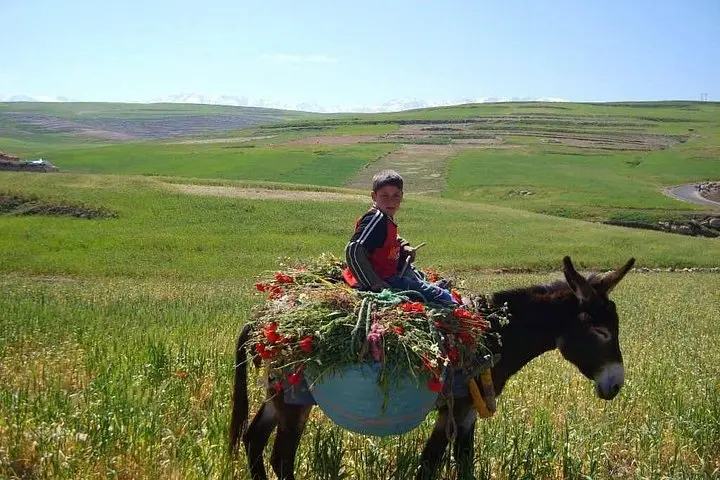
You leave Marrakech behind through a widening palette of rust-red earth and scrub olive groves, the Atlas foothills sliding into view as your transport hums north. After roughly 150 km and a few country towns, the road bends and the first mist appears ahead — Ouzoud's cascades announcing themselves with the low roar of water. On arrival the path down to the falls is scuffed with centuries of foot traffic, shaded by thujas and olive trees, and punctuated by terraces where local families run small restaurants serving tajine and mint tea.
Verified experiences and guided adventures in the surrounding area.
Operated by Kech Viajes · Ouzoud, Azilal Province
You leave Marrakech behind through a widening palette of rust-red earth and scrub olive groves, the Atlas foothills sliding into view as your transport hums north. After roughly 150 km and a few country towns, the road bends and the first mist appears ahead — Ouzoud's cascades announcing themselves with the low roar of water. On arrival the path down to the falls is scuffed with centuries of foot traffic, shaded by thujas and olive trees, and punctuated by terraces where local families run small restaurants serving tajine and mint tea.
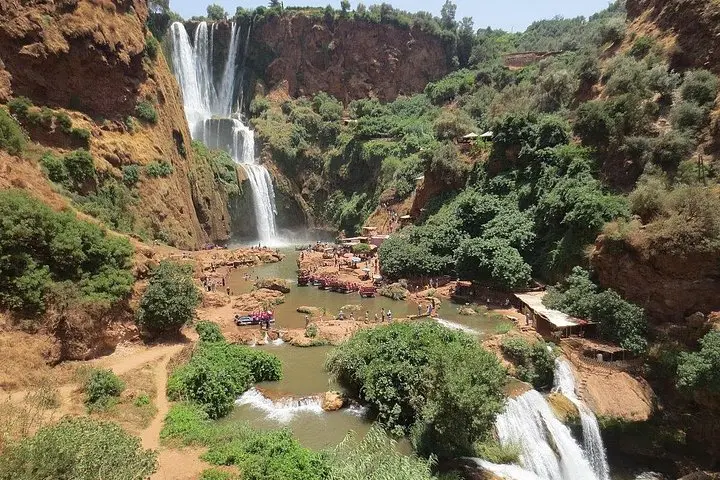
Geologically, Ouzoud is a place of gentle violence: water chisels soft limestone and sandstone, dropping in steps for a total height near 110 meters. The falls split into multiple curtains, sending fine grit of spray that often produces a steady rainbow on sunny afternoons. Culturally, Ouzoud sits where Berber agricultural traditions meet modern tourism; the name itself is reported locally to mean "sweet" in the regional Berber dialect — an apt description for the valley's recessed orchards and cool pools.
Wildlife is part of the scene. Barbary macaques — the “magots” locals call them — patrol the olive groves and sometimes perform an audacious carousel for lunching visitors. Birdlife inclines to water-loving species: kingfishers flash across plunge pools, and seasonal migrants ride the thermals above the gorge.
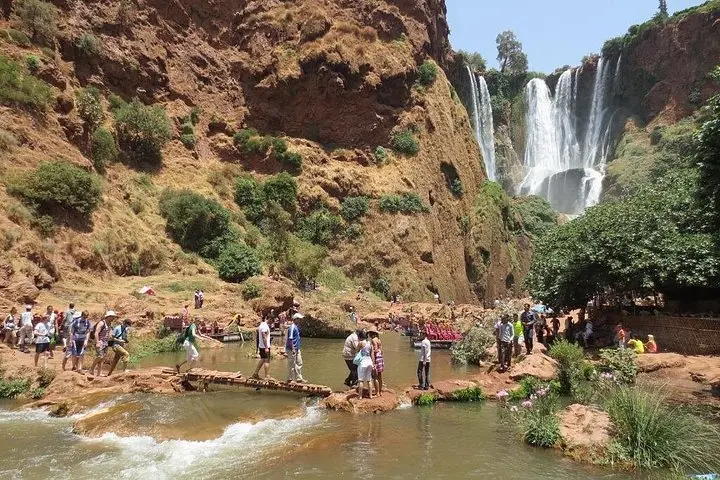
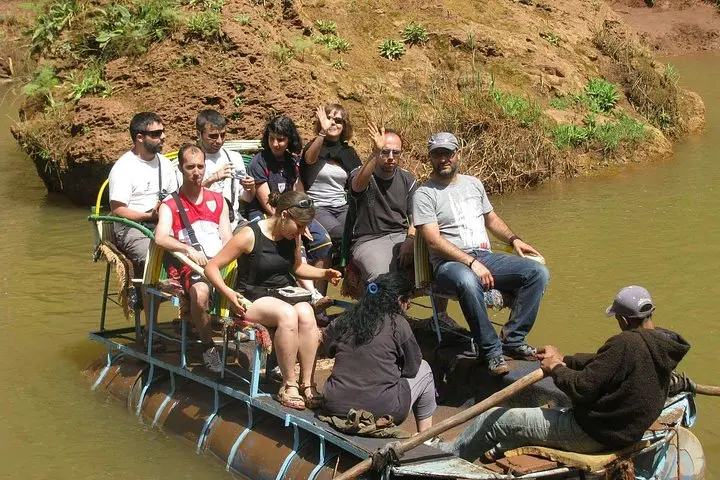
The experience is flexible. You can walk the well-laid trails and wooden viewpoints in an easy loop that takes 60–90 minutes at a relaxed pace, cross the wooden suspension bridge, or for a small fee board a kitschy boat for a close approach to the base. Local eateries line the upper rim and the village; many include panoramic terraces where a mint tea tastes of the place itself.
Practical guidance: arrive early to catch softer light, cooler air and stronger potential for the rainbow. Wear grippy shoes — the path and rocks near the water get slippery — and carry enough water and sun protection; shade is intermittent. Respect the macaques: they are wild animals, and feeding or sudden moves can provoke bites. Small vendors and boat operators price in dirhams; carry cash in small notes.
This is a day trip built for minimal technical demand but maximal sensory payoff. If you want quieter time, ask to be dropped a short walk from the main viewpoint and take the lower trail counterclockwise; you’ll find quieter pools and better photo angles of the multi-tiered falls. Return to Marrakech in the afternoon with a headful of spray, a few good photos, and the peculiar calm that comes after walking in a place where water keeps insisting on its path.
The drive is about 150 km and typically takes 2–3 hours each way depending on traffic and stops.
There are small pools where locals wade, but strong currents and slippery rocks make full swimming risky—exercise caution.
Local skiff-style boats operate close to the falls for a small fee; they are informal and weather-dependent—ask your guide about conditions before boarding.
Not necessary—there are several small restaurants and tea stalls, but packing snacks is helpful if you prefer not to wait at busy times.
Upper viewpoints are accessible for families, but lower paths and areas near the water are steep and uneven—strollers are not recommended there.
The macaques are habituated to humans; they can snatch food or belongings and sometimes bite if provoked—observe from a distance and secure items.
Kech Viajes operates guided outdoor trips and adventures with an emphasis on safety, stewardship, and memorable experiences.
You leave Marrakech behind through a widening palette of rust-red earth and scrub olive groves, the Atlas foothills sliding into view as your transport hums north. After roughly 150 km and a few country towns, the road bends and the first mist appears ahead — Ouzoud's cascades announcing themselves with the low roar of water. On arrival the path down to the falls is scuffed with centuries of foot traffic, shaded by thujas and olive trees, and punctuated by terraces where local families run small restaurants serving tajine and mint tea.
You leave Marrakech behind through a widening palette of rust-red earth and scrub olive groves, the Atlas foothills sliding into view as your transport hums north. After roughly 150 km and a few country towns, the road bends and the first mist appears ahead — Ouzoud's cascades announcing themselves with the low roar of water. On arrival the path down to the falls is scuffed with centuries of foot traffic, shaded by thujas and olive trees, and punctuated by terraces where local families run small restaurants serving tajine and mint tea.
Geologically, Ouzoud is a place of gentle violence: water chisels soft limestone and sandstone, dropping in steps for a total height near 110 meters. The falls split into multiple curtains, sending fine grit of spray that often produces a steady rainbow on sunny afternoons. Culturally, Ouzoud sits where Berber agricultural traditions meet modern tourism; the name itself is reported locally to mean "sweet" in the regional Berber dialect — an apt description for the valley's recessed orchards and cool pools.
Wildlife is part of the scene. Barbary macaques — the “magots” locals call them — patrol the olive groves and sometimes perform an audacious carousel for lunching visitors. Birdlife inclines to water-loving species: kingfishers flash across plunge pools, and seasonal migrants ride the thermals above the gorge.
The experience is flexible. You can walk the well-laid trails and wooden viewpoints in an easy loop that takes 60–90 minutes at a relaxed pace, cross the wooden suspension bridge, or for a small fee board a kitschy boat for a close approach to the base. Local eateries line the upper rim and the village; many include panoramic terraces where a mint tea tastes of the place itself.
Practical guidance: arrive early to catch softer light, cooler air and stronger potential for the rainbow. Wear grippy shoes — the path and rocks near the water get slippery — and carry enough water and sun protection; shade is intermittent. Respect the macaques: they are wild animals, and feeding or sudden moves can provoke bites. Small vendors and boat operators price in dirhams; carry cash in small notes.
This is a day trip built for minimal technical demand but maximal sensory payoff. If you want quieter time, ask to be dropped a short walk from the main viewpoint and take the lower trail counterclockwise; you’ll find quieter pools and better photo angles of the multi-tiered falls. Return to Marrakech in the afternoon with a headful of spray, a few good photos, and the peculiar calm that comes after walking in a place where water keeps insisting on its path.