THE ADVENTURE COLLECTIVE® · Independent discovery and booking for outdoor travel

Experience Manaus’s colonial grandeur and a river phenomenon in one half-day: explore Teatro Amazonas and the Adolpho Lisboa Market, then speedboat to the iconic Meeting of the Waters and a floating village.
Experience Manaus’s colonial grandeur and a river phenomenon in one half-day: explore Teatro Amazonas and the Adolpho Lisboa Market, then speedboat to the iconic Meeting of the Waters and a floating village.
You step off a shaded pier in Manaus and the river reaches out like two different moods arguing for attention — one glassy and black, the other churned with clay-colored sediment. A speedboat lifts you past floating houses and battered fishing skiffs; the Rio Negro and Solimões run side by side, each refusing to mix as if the rivers themselves have stubborn personalities.
Verified experiences and guided adventures in the surrounding area.
Operated by Amazon Destinations · Manaus, Amazonas
You step off a shaded pier in Manaus and the river reaches out like two different moods arguing for attention — one glassy and black, the other churned with clay-colored sediment. A speedboat lifts you past floating houses and battered fishing skiffs; the Rio Negro and Solimões run side by side, each refusing to mix as if the rivers themselves have stubborn personalities.
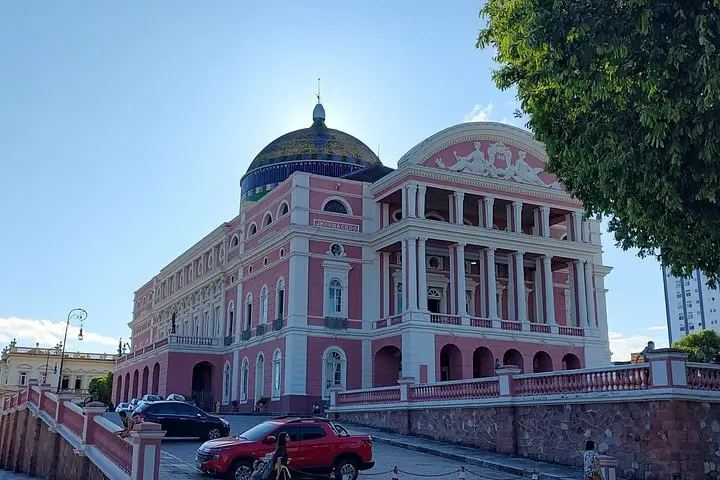
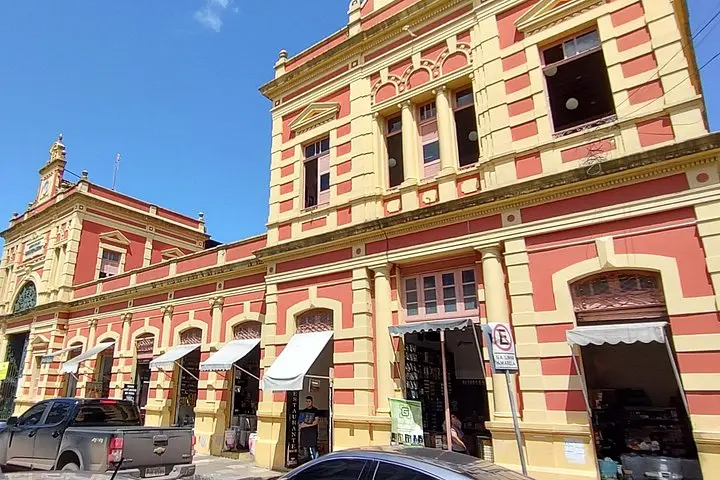
This half-day tour pairs downtown Manaus’s Belle Époque landmarks with a fluvial spectacle. In the city, the Teatro Amazonas — completed in 1896 at the height of the rubber boom — still presides with its painted-tile dome and imported chandeliers, while the Adolpho Lisboa Market hums with fresh fish, açai, and artisan crafts beneath ironwork reportedly sourced from Europe.
Geologically, the Meeting of the Waters is a visible boundary of temperature, speed and sediment load: darker tannin-rich water from the Rio Negro flows alongside the sediment-heavy Solimões before the two gradually blend to form the Amazon. Cultural life on the river includes floating communities that farm, fish and maintain longboat traditions.
Practical notes: expect 4–4.5 hours including hotel transfer and boat time; bring insect repellent, a light rain jacket, and cash for market stalls. The opera house enforces smart-casual dress; there are steps and some uneven surfaces on piers and in the market. Morning light sharpens contrasts on the confluence, but the experience remains striking any time of day. Pace yourself — the river moves slowly, but it makes a strong impression.
The tour runs about 4–4.5 hours and typically includes hotel pickup/drop-off, a guided city tour, opera house entry, speedboat and pilot to the Meeting of the Waters.
Yes — the visual contrast between the rivers is year-round, though water levels and turbidity vary with seasonal rainfall which can affect the contrast.
Children are allowed but the operator requires they be accompanied by two adults; boat travel and steps may be challenging for very young kids.
City stops include the market and central neighborhoods with food options; boats typically have limited facilities—use restrooms in town before departing.
Amazon Destinations operates guided outdoor trips and adventures with an emphasis on safety, stewardship, and memorable experiences.
You step off a shaded pier in Manaus and the river reaches out like two different moods arguing for attention — one glassy and black, the other churned with clay-colored sediment. A speedboat lifts you past floating houses and battered fishing skiffs; the Rio Negro and Solimões run side by side, each refusing to mix as if the rivers themselves have stubborn personalities.
You step off a shaded pier in Manaus and the river reaches out like two different moods arguing for attention — one glassy and black, the other churned with clay-colored sediment. A speedboat lifts you past floating houses and battered fishing skiffs; the Rio Negro and Solimões run side by side, each refusing to mix as if the rivers themselves have stubborn personalities.
This half-day tour pairs downtown Manaus’s Belle Époque landmarks with a fluvial spectacle. In the city, the Teatro Amazonas — completed in 1896 at the height of the rubber boom — still presides with its painted-tile dome and imported chandeliers, while the Adolpho Lisboa Market hums with fresh fish, açai, and artisan crafts beneath ironwork reportedly sourced from Europe.
Geologically, the Meeting of the Waters is a visible boundary of temperature, speed and sediment load: darker tannin-rich water from the Rio Negro flows alongside the sediment-heavy Solimões before the two gradually blend to form the Amazon. Cultural life on the river includes floating communities that farm, fish and maintain longboat traditions.
Practical notes: expect 4–4.5 hours including hotel transfer and boat time; bring insect repellent, a light rain jacket, and cash for market stalls. The opera house enforces smart-casual dress; there are steps and some uneven surfaces on piers and in the market. Morning light sharpens contrasts on the confluence, but the experience remains striking any time of day. Pace yourself — the river moves slowly, but it makes a strong impression.