THE ADVENTURE COLLECTIVE® · Independent discovery and booking for outdoor travel

Drive east from Swakopmund into a lunar expanse of eroded ridges and plains where ancient Welwitschia plants cling to life. This four-hour tour pairs dramatic desert geology with rare botany and practical stops for photos and short walks.
Drive east from Swakopmund into a lunar expanse of eroded ridges and plains where ancient Welwitschia plants cling to life. This four-hour tour pairs dramatic desert geology with rare botany and practical stops for photos and short walks.
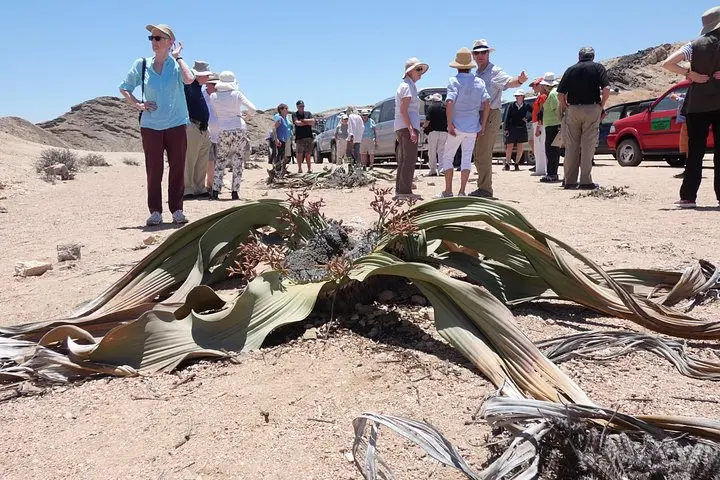
A low, dry wind meets the vehicle as you leave Swakopmund and head inland; the asphalt surrenders to red gravel and a horizon of ridges that look as if the moon spat them out. The Moon Landscape unspools in terraces and gullies—hard-baked sediment carved by ancient rains—then the road opens onto plains where individual Welwitschia plants squat like stubborn survivors, two leathery leaves draping across millennia.
Verified experiences and guided adventures in the surrounding area.
Operated by Explorer Cultural Township Tours in Swakopmund /WalvisBay · Swakopmund, Erongo Region
A low, dry wind meets the vehicle as you leave Swakopmund and head inland; the asphalt surrenders to red gravel and a horizon of ridges that look as if the moon spat them out. The Moon Landscape unspools in terraces and gullies—hard-baked sediment carved by ancient rains—then the road opens onto plains where individual Welwitschia plants squat like stubborn survivors, two leathery leaves draping across millennia.
Geology here reads like a slow-motion film: the Namib Desert is among the world’s oldest, its sand and sandstone shaped by wind and intermittent rivers over millions of years. Welwitschia mirabilis is a botanical oddity endemic to this belt—some specimens are estimated to be hundreds to thousands of years old, their gnarled trunks marking time in an otherwise shifting landscape. Local Nama and Herero communities have long known these places; the human story runs parallel to the desert’s harsh economy of water and shade.
Practical guidance: expect a roughly four-hour excursion with short walks on uneven, rocky ground and sightseeing stops for photography and plant viewing. Lunch and national park fees are typically included, but bring 1–2 liters of water per person, sun protection, and sturdy shoes. Morning and late-afternoon departures offer the best light and cooler temperatures; midday can be uncomfortably hot, especially in summer. Keep a respectful distance from Welwitschia and other fragile desert life—these plants are slow to recover from disturbance. A compact field guide or local naturalist will deepen the visit, pointing out geological layers, adapted wildlife, and why the Namib’s dry logic still supports such tenacity.
The tour is about four hours; most operators include transport from Swakopmund, lunch, and national park fees—confirm at booking.
No—Welwitschia are ancient and fragile; viewing from a respectful distance preserves them for future visitors.
Short walks are optional; children and seniors who can manage uneven ground and heat can join, but notify the operator about mobility needs.
Morning or late afternoon offers cooler temperatures and softer light for photography; midday can be very hot, particularly in summer.
Explorer Cultural Township Tours in Swakopmund /WalvisBay operates guided outdoor trips and adventures with an emphasis on safety, stewardship, and memorable experiences.

A low, dry wind meets the vehicle as you leave Swakopmund and head inland; the asphalt surrenders to red gravel and a horizon of ridges that look as if the moon spat them out. The Moon Landscape unspools in terraces and gullies—hard-baked sediment carved by ancient rains—then the road opens onto plains where individual Welwitschia plants squat like stubborn survivors, two leathery leaves draping across millennia.
A low, dry wind meets the vehicle as you leave Swakopmund and head inland; the asphalt surrenders to red gravel and a horizon of ridges that look as if the moon spat them out. The Moon Landscape unspools in terraces and gullies—hard-baked sediment carved by ancient rains—then the road opens onto plains where individual Welwitschia plants squat like stubborn survivors, two leathery leaves draping across millennia.
Geology here reads like a slow-motion film: the Namib Desert is among the world’s oldest, its sand and sandstone shaped by wind and intermittent rivers over millions of years. Welwitschia mirabilis is a botanical oddity endemic to this belt—some specimens are estimated to be hundreds to thousands of years old, their gnarled trunks marking time in an otherwise shifting landscape. Local Nama and Herero communities have long known these places; the human story runs parallel to the desert’s harsh economy of water and shade.
Practical guidance: expect a roughly four-hour excursion with short walks on uneven, rocky ground and sightseeing stops for photography and plant viewing. Lunch and national park fees are typically included, but bring 1–2 liters of water per person, sun protection, and sturdy shoes. Morning and late-afternoon departures offer the best light and cooler temperatures; midday can be uncomfortably hot, especially in summer. Keep a respectful distance from Welwitschia and other fragile desert life—these plants are slow to recover from disturbance. A compact field guide or local naturalist will deepen the visit, pointing out geological layers, adapted wildlife, and why the Namib’s dry logic still supports such tenacity.