THE ADVENTURE COLLECTIVE® · Independent discovery and booking for outdoor travel

Climb the flanks of Mount Etna to 2,000 meters, peer into lateral craters and then cool off in the basalt-carved Alcantara Gorge. This full-day tour from Catania mixes volcanic geology, short walks and a scenic river canyon.
Climb the flanks of Mount Etna to 2,000 meters, peer into lateral craters and then cool off in the basalt-carved Alcantara Gorge. This full-day tour from Catania mixes volcanic geology, short walks and a scenic river canyon.
You step off the minivan and the air changes: thinner, cooler, and scented faintly of sulfur and rosemary. Ahead, the flank craters climb like broken teeth against a bright Sicilian sky; behind them, older lava fields smear across terraces toward the Ionian Sea. This tour threads the high, raw slopes of Mount Etna with a softer counterpoint — the Alcantara River, where basalt columns rise vertically like a man-made cathedral carved by ancient fire and cold water.
Verified experiences and guided adventures in the surrounding area.
Operated by lemontour · Catania, Sicily
You step off the minivan and the air changes: thinner, cooler, and scented faintly of sulfur and rosemary. Ahead, the flank craters climb like broken teeth against a bright Sicilian sky; behind them, older lava fields smear across terraces toward the Ionian Sea. This tour threads the high, raw slopes of Mount Etna with a softer counterpoint — the Alcantara River, where basalt columns rise vertically like a man-made cathedral carved by ancient fire and cold water.
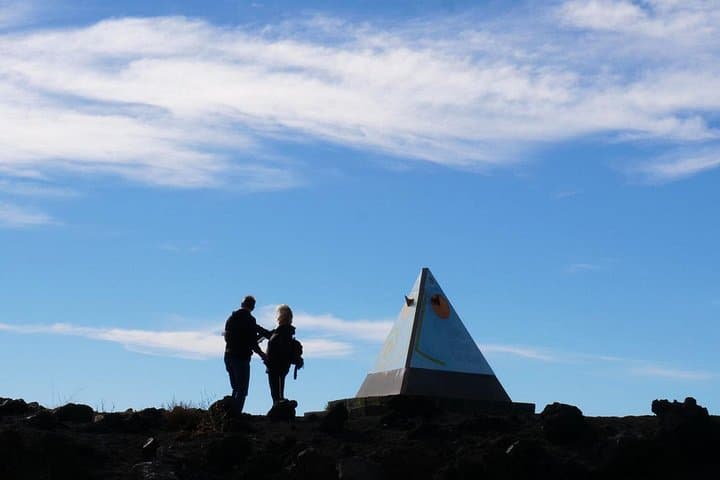
The stage is Etna Natural Park, UNESCO-listed in 2013 for its living geology. The route follows the road from the lemon orchards of the lowlands up through Nicolosi — the village that bore the brunt of Etna’s 1669 eruption — to Rifugio Sapienza at roughly 1,900–2,000 meters. From there you’ll walk to the Crateri Silvestri, late-19th-century lateral cones that offer a close look at ash layers, recent lava flows and pioneering vegetation: broom, heather and endemic shrubs reclaiming black rock.
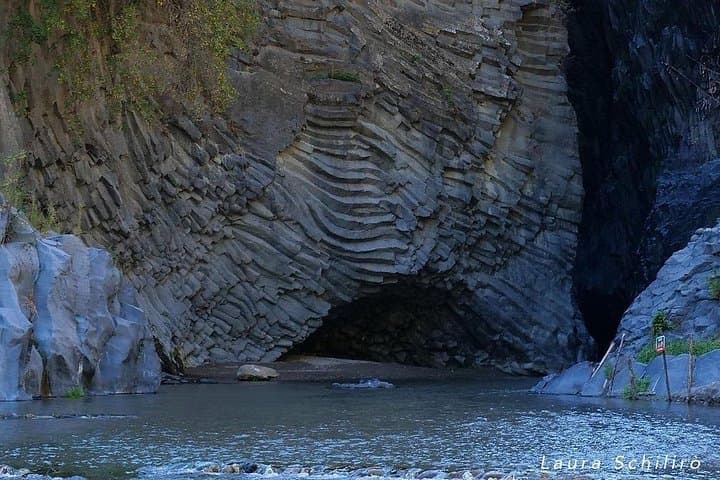
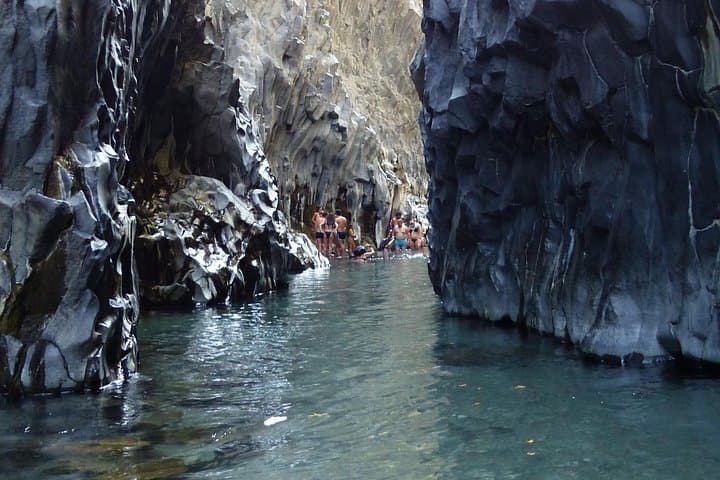
Geologically, Etna is restless: repeated flank eruptions build layered fields of pahoehoe and a’a lava, while cooling basalt sometimes forms the hexagonal columns you’ll see downstream at Alcantara Gorge. That canyon reads like a reverse volcano — instead of lava above, water has cut and sculpted the cooled basalt into towering pillars and pools.
Culturally the day is simple and local. You’ll pass rural farms and roadside stands selling pistachios, arancini and honey. Guides on the tour are certified and work to balance access with safety: the higher you climb, the more exposed and changeable the weather.
Practical guidance: the full program runs about 8–9 hours with hotel pickup in Catania at 8:30. Expect a mix of short guided walks (easy terrain) and time to explore viewpoints. Temperatures at 1,900–2,000 m can be 8–15°C cooler than Catania; wind is common. Bring a windproof layer, sturdy shoes with grip for loose volcanic gravel, and sun protection — high-altitude UV is stronger. Swimming in the Alcantara is possible for bold visitors but the water is cold year-round; wet shoes or sandals with traction and a quick-dry layer are recommended.
Logistics: the tour includes pickup/transfer, an Etna guide, entry to Alcantara, and returns to Catania by late afternoon. If you’re sensitive to altitude or have cardiovascular concerns, check with the operator — the climbs are not technical, but elevation and chilly winds matter.
On balance the day pairs two geologic personalities: Etna’s raw, open slopes daring you up to 2,000 meters, and Alcantara’s cool canyon that rewards slower movement and close-up study. It’s an efficient, sensory-packed introduction to Sicily’s most dramatic landscapes.
Pickup is from your hotel or arranged meeting point in Catania at 8:30; confirm the exact pick-up location when you book.
The guided portion visits the Rifugio Sapienza area at approximately 1,900–2,000 meters above sea level, with short walks to nearby craters.
The walks are short and generally easy, but uneven volcanic terrain can be challenging for limited mobility; infant seats are available for small children in vehicles.
Yes, but the water is very cold year-round; bring appropriate footwear and be cautious on slippery rocks.
The operator may cancel in severe weather; check cancellation terms and plan flexible travel — refunds are available for cancellations 24+ hours ahead.
Yes — guides and drivers are certified under Italian law, and Alcantara river entry is included in the tour price.
lemontour operates guided outdoor trips and adventures with an emphasis on safety, stewardship, and memorable experiences.

You step off the minivan and the air changes: thinner, cooler, and scented faintly of sulfur and rosemary. Ahead, the flank craters climb like broken teeth against a bright Sicilian sky; behind them, older lava fields smear across terraces toward the Ionian Sea. This tour threads the high, raw slopes of Mount Etna with a softer counterpoint — the Alcantara River, where basalt columns rise vertically like a man-made cathedral carved by ancient fire and cold water.
You step off the minivan and the air changes: thinner, cooler, and scented faintly of sulfur and rosemary. Ahead, the flank craters climb like broken teeth against a bright Sicilian sky; behind them, older lava fields smear across terraces toward the Ionian Sea. This tour threads the high, raw slopes of Mount Etna with a softer counterpoint — the Alcantara River, where basalt columns rise vertically like a man-made cathedral carved by ancient fire and cold water.
The stage is Etna Natural Park, UNESCO-listed in 2013 for its living geology. The route follows the road from the lemon orchards of the lowlands up through Nicolosi — the village that bore the brunt of Etna’s 1669 eruption — to Rifugio Sapienza at roughly 1,900–2,000 meters. From there you’ll walk to the Crateri Silvestri, late-19th-century lateral cones that offer a close look at ash layers, recent lava flows and pioneering vegetation: broom, heather and endemic shrubs reclaiming black rock.
Geologically, Etna is restless: repeated flank eruptions build layered fields of pahoehoe and a’a lava, while cooling basalt sometimes forms the hexagonal columns you’ll see downstream at Alcantara Gorge. That canyon reads like a reverse volcano — instead of lava above, water has cut and sculpted the cooled basalt into towering pillars and pools.
Culturally the day is simple and local. You’ll pass rural farms and roadside stands selling pistachios, arancini and honey. Guides on the tour are certified and work to balance access with safety: the higher you climb, the more exposed and changeable the weather.
Practical guidance: the full program runs about 8–9 hours with hotel pickup in Catania at 8:30. Expect a mix of short guided walks (easy terrain) and time to explore viewpoints. Temperatures at 1,900–2,000 m can be 8–15°C cooler than Catania; wind is common. Bring a windproof layer, sturdy shoes with grip for loose volcanic gravel, and sun protection — high-altitude UV is stronger. Swimming in the Alcantara is possible for bold visitors but the water is cold year-round; wet shoes or sandals with traction and a quick-dry layer are recommended.
Logistics: the tour includes pickup/transfer, an Etna guide, entry to Alcantara, and returns to Catania by late afternoon. If you’re sensitive to altitude or have cardiovascular concerns, check with the operator — the climbs are not technical, but elevation and chilly winds matter.
On balance the day pairs two geologic personalities: Etna’s raw, open slopes daring you up to 2,000 meters, and Alcantara’s cool canyon that rewards slower movement and close-up study. It’s an efficient, sensory-packed introduction to Sicily’s most dramatic landscapes.