THE ADVENTURE COLLECTIVE® · Independent discovery and booking for outdoor travel

Spend a day seeing Mount Fuji framed from Lake Ashi, exploring volcanic Owakudani and visiting Hakone Shrine with a private English-speaking guide. This 10-hour, door-to-door tour balances driving with short walks and curated viewpoints to maximize weather-dependent views.
Spend a day seeing Mount Fuji framed from Lake Ashi, exploring volcanic Owakudani and visiting Hakone Shrine with a private English-speaking guide. This 10-hour, door-to-door tour balances driving with short walks and curated viewpoints to maximize weather-dependent views.
You step onto the shuttle in Tokyo before dawn and the city’s glass and neon ease away. Highway miles fall behind you; the air grows crisper, buildings thin, and a snow-capped silhouette sometimes appears on the horizon—Mount Fuji asserting itself between cloud bands. By mid-morning the vehicle eases into Hakone, a compact network of volcanic ridges, steaming valleys and crater lakes where a private English-speaking guide can unspool history, geology and shortcuts that turn a busy day into a coherent experience.
Verified experiences and guided adventures in the surrounding area.
Operated by Tour Guide in Japan · Hakone, Kanagawa
You step onto the shuttle in Tokyo before dawn and the city’s glass and neon ease away. Highway miles fall behind you; the air grows crisper, buildings thin, and a snow-capped silhouette sometimes appears on the horizon—Mount Fuji asserting itself between cloud bands. By mid-morning the vehicle eases into Hakone, a compact network of volcanic ridges, steaming valleys and crater lakes where a private English-speaking guide can unspool history, geology and shortcuts that turn a busy day into a coherent experience.
Hakone sits on the rim of an ancient caldera; Lake Ashi (Ashinoko) fills the crater floor and offers one of the most photographed frames for Fuji. Owakudani, upstream along the ropeway, still vents volcanic gases and boils eggs in sulfur-rich springs. The Hakone Open-Air Museum contrasts the raw earth with curated human-made forms, and Hakone Shrine’s vermillion torii stands shoulder-deep in the lake like a punctuation mark—quiet, photogenic, slightly theatrical.
Geology is visible here: jagged lava flows, fumaroles and the slow tilting of the landscape after the region’s last major eruptions. Culturally, the area has been a transit point for samurai-era travel, a refuge for artists, and a modern onsen destination. Local guides point out Edo-period road markers and tell the origin tales of the black eggs at Owakudani—eggs boiled in sulfur springs, reputed locally to extend life by seven years.
Practical edge: this is a full-day private tour (approx. 10 hours). Most of the itinerary is driven—expect 1.5–2 hours of travel each way from central Tokyo in normal traffic—interspersed with short walks: a 0.5–1.5 km lakeshore stroll at Hakone Shrine, a 1 km boardwalk through Owakudani’s vents, and 1–2 km of paths at the Open-Air Museum. Altitude and temperature change quickly; Owakudani sits above 800–1,000 m and can be noticeably cooler.
Plan for a layered outfit, sturdy walking shoes for volcanic gravel and museum paths, and a camera prepared for wide panoramas. If Mount Fuji is in the clouds, the guide can shift timing or viewpoints—good guides read weather and crowds to maximize visibility. Accessibility is good in many spots, but some viewing platforms and ropeway stations have steps—confirm needs when booking.
In short, the day pairs big cinematic views with short, immersive walks and cultural stops—perfect for travelers who want Mount Fuji’s scale without multi-day trekking. Hydrate, carry small local cash for snacks and shrine offerings, and leave room that evening for an onsen soak if your schedule allows.
The tour is approximately 10 hours and includes private transportation, an English-speaking guide, bottled water, onboard Wi‑Fi and stops at Hakone Shrine, Lake Ashi, Owakudani, the Hakone Ropeway and the Open-Air Museum (admissions noted in itinerary).
Visibility depends on weather. The guide will monitor conditions and adjust timing and viewpoints to maximize chances, but sightings cannot be guaranteed.
Many parts of the tour are accessible and the supplier lists wheelchair options, but some sites have steps—confirm accessibility needs at booking so the operator can plan accordingly.
Lunch is not included; you’ll have time at Hakone or nearby towns to eat. Guides can recommend or take you to local restaurants (cash or card accepted varies by place).
Yes—infant seats are available and the tour is family-friendly. Note that Owakudani fumaroles can smell strongly of sulfur which some children may find unpleasant.
Walking is light to moderate—short shoreline and museum walks typically 0.5–2 km per stop, with opportunities to rest and re-board the vehicle frequently.
Tour Guide in Japan operates guided outdoor trips and adventures with an emphasis on safety, stewardship, and memorable experiences.

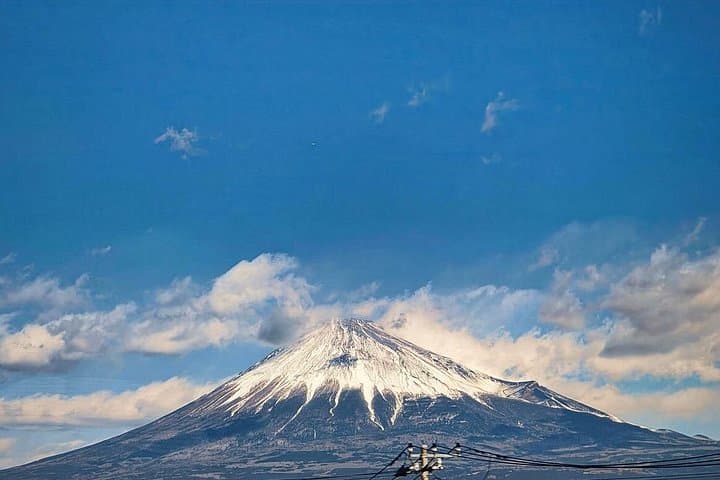


You step onto the shuttle in Tokyo before dawn and the city’s glass and neon ease away. Highway miles fall behind you; the air grows crisper, buildings thin, and a snow-capped silhouette sometimes appears on the horizon—Mount Fuji asserting itself between cloud bands. By mid-morning the vehicle eases into Hakone, a compact network of volcanic ridges, steaming valleys and crater lakes where a private English-speaking guide can unspool history, geology and shortcuts that turn a busy day into a coherent experience.
You step onto the shuttle in Tokyo before dawn and the city’s glass and neon ease away. Highway miles fall behind you; the air grows crisper, buildings thin, and a snow-capped silhouette sometimes appears on the horizon—Mount Fuji asserting itself between cloud bands. By mid-morning the vehicle eases into Hakone, a compact network of volcanic ridges, steaming valleys and crater lakes where a private English-speaking guide can unspool history, geology and shortcuts that turn a busy day into a coherent experience.
Hakone sits on the rim of an ancient caldera; Lake Ashi (Ashinoko) fills the crater floor and offers one of the most photographed frames for Fuji. Owakudani, upstream along the ropeway, still vents volcanic gases and boils eggs in sulfur-rich springs. The Hakone Open-Air Museum contrasts the raw earth with curated human-made forms, and Hakone Shrine’s vermillion torii stands shoulder-deep in the lake like a punctuation mark—quiet, photogenic, slightly theatrical.
Geology is visible here: jagged lava flows, fumaroles and the slow tilting of the landscape after the region’s last major eruptions. Culturally, the area has been a transit point for samurai-era travel, a refuge for artists, and a modern onsen destination. Local guides point out Edo-period road markers and tell the origin tales of the black eggs at Owakudani—eggs boiled in sulfur springs, reputed locally to extend life by seven years.
Practical edge: this is a full-day private tour (approx. 10 hours). Most of the itinerary is driven—expect 1.5–2 hours of travel each way from central Tokyo in normal traffic—interspersed with short walks: a 0.5–1.5 km lakeshore stroll at Hakone Shrine, a 1 km boardwalk through Owakudani’s vents, and 1–2 km of paths at the Open-Air Museum. Altitude and temperature change quickly; Owakudani sits above 800–1,000 m and can be noticeably cooler.
Plan for a layered outfit, sturdy walking shoes for volcanic gravel and museum paths, and a camera prepared for wide panoramas. If Mount Fuji is in the clouds, the guide can shift timing or viewpoints—good guides read weather and crowds to maximize visibility. Accessibility is good in many spots, but some viewing platforms and ropeway stations have steps—confirm needs when booking.
In short, the day pairs big cinematic views with short, immersive walks and cultural stops—perfect for travelers who want Mount Fuji’s scale without multi-day trekking. Hydrate, carry small local cash for snacks and shrine offerings, and leave room that evening for an onsen soak if your schedule allows.