THE ADVENTURE COLLECTIVE® · Independent discovery and booking for outdoor travel

A practical day trip from Hoi An or Da Nang that pairs the Champa ruins of My Son with the limestone caves and stone-carving villages of the Marble Mountains. Expect archaeological ruins, steep steps, and working craft villages.
A practical day trip from Hoi An or Da Nang that pairs the Champa ruins of My Son with the limestone caves and stone-carving villages of the Marble Mountains. Expect archaeological ruins, steep steps, and working craft villages.
You step out of the car into a valley where cracked red bricks and the scent of damp earth anchor centuries of devotion to the Champa kings. Morning light warms the low range around My Son sanctuary, where selectively restored towers and plinths stand amid grass and scrub. Guides point out lintels carved with Hindu deities while cicadas mark the air — the site still reads like an open-air architectural archive.
Verified experiences and guided adventures in the surrounding area.
Operated by Local guide in Da Nang city, Vietnam · Hoi An, Quang Nam
You step out of the car into a valley where cracked red bricks and the scent of damp earth anchor centuries of devotion to the Champa kings. Morning light warms the low range around My Son sanctuary, where selectively restored towers and plinths stand amid grass and scrub. Guides point out lintels carved with Hindu deities while cicadas mark the air — the site still reads like an open-air architectural archive.
My Son was the spiritual and political center of the Champa kingdom from the 4th–12th centuries. Built from fired brick and local sandstone, the temples reveal ancient masonry techniques and religious links across Southeast Asia. The Marble Mountains — five limestone and marble hills named for the five elements — offer a contrasting geology: caves, steep staircases, and working stone-carving villages such as Dong Hai where families craft statues and souvenirs.
Expect about a half-day at each site plus drive time from Hoi An or Da Nang; travel is along lowland roads with occasional traffic. Wear sturdy shoes for uneven temple platforms and steep steps at Marble Mountain caves; carry sun protection and water for heat and humidity. Admission is typically not included on private-car packages; check in advance for temple conservation schedules and guided-tour options. Photographs are welcome, but respect restricted areas and quiet zones.
This loop blends tangible history with hands-on craft culture and easy-access hiking: it’s as much archaeology and geology as it is a practical, photo-ready day in central Vietnam.
Admission to My Son and Marble Mountains is often not included in private-car packages; confirm with the operator before you go.
My Son is roughly 45–60 minutes from Hoi An by car (about 50 km); Marble Mountains are closer to Da Nang at around 20–30 minutes depending on traffic.
Children are welcome but must be supervised; sites include uneven ground and many stairs, so it’s not recommended for travelers with serious mobility or spinal issues.
Yes — Dong Hai village houses many family-run workshops selling marble and stone carvings; haggle respectfully and check items for export restrictions.
Local guide in Da Nang city, Vietnam operates guided outdoor trips and adventures with an emphasis on safety, stewardship, and memorable experiences.

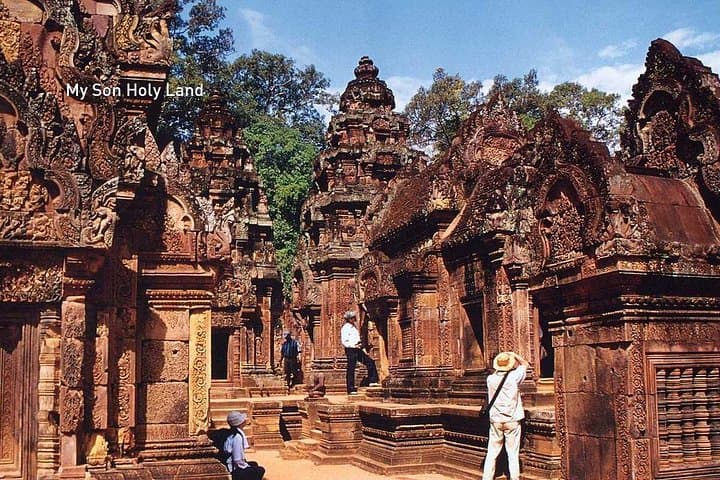

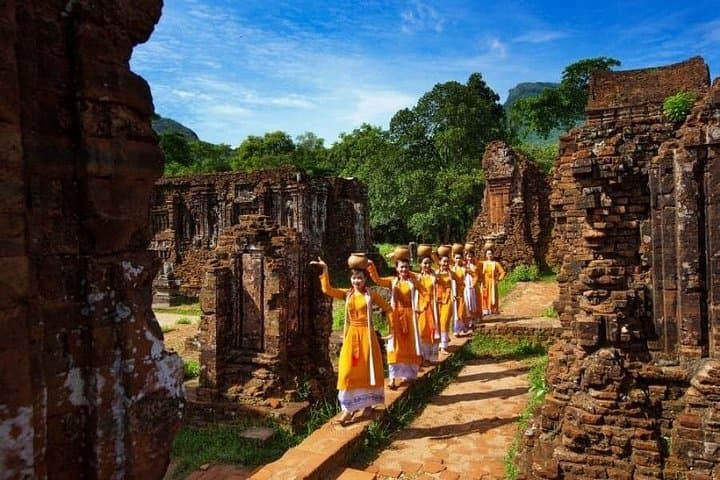
You step out of the car into a valley where cracked red bricks and the scent of damp earth anchor centuries of devotion to the Champa kings. Morning light warms the low range around My Son sanctuary, where selectively restored towers and plinths stand amid grass and scrub. Guides point out lintels carved with Hindu deities while cicadas mark the air — the site still reads like an open-air architectural archive.
You step out of the car into a valley where cracked red bricks and the scent of damp earth anchor centuries of devotion to the Champa kings. Morning light warms the low range around My Son sanctuary, where selectively restored towers and plinths stand amid grass and scrub. Guides point out lintels carved with Hindu deities while cicadas mark the air — the site still reads like an open-air architectural archive.
My Son was the spiritual and political center of the Champa kingdom from the 4th–12th centuries. Built from fired brick and local sandstone, the temples reveal ancient masonry techniques and religious links across Southeast Asia. The Marble Mountains — five limestone and marble hills named for the five elements — offer a contrasting geology: caves, steep staircases, and working stone-carving villages such as Dong Hai where families craft statues and souvenirs.
Expect about a half-day at each site plus drive time from Hoi An or Da Nang; travel is along lowland roads with occasional traffic. Wear sturdy shoes for uneven temple platforms and steep steps at Marble Mountain caves; carry sun protection and water for heat and humidity. Admission is typically not included on private-car packages; check in advance for temple conservation schedules and guided-tour options. Photographs are welcome, but respect restricted areas and quiet zones.
This loop blends tangible history with hands-on craft culture and easy-access hiking: it’s as much archaeology and geology as it is a practical, photo-ready day in central Vietnam.