THE ADVENTURE COLLECTIVE® · Independent discovery and booking for outdoor travel

Explore the ancient Cham temples of My Son on a private morning tour from Hoi An or Da Nang. Visit multiple temple groups with an English-speaking guide, beat the heat, and return by midday.
Explore the ancient Cham temples of My Son on a private morning tour from Hoi An or Da Nang. Visit multiple temple groups with an English-speaking guide, beat the heat, and return by midday.
Dawn breaks over a low valley of red brick towers and green jungle as a private minivan carries you away from Hoi An toward My Son. Arriving before the heat swells, you step from the buggy onto compacted dirt paths, the silhouette of Cham towers cutting into a pale sky while distant karst ridgelines frame the valley.
Verified experiences and guided adventures in the surrounding area.
Operated by Golden Bridge Tour Da Nang · Duy Xuyen, Quang Nam
Dawn breaks over a low valley of red brick towers and green jungle as a private minivan carries you away from Hoi An toward My Son. Arriving before the heat swells, you step from the buggy onto compacted dirt paths, the silhouette of Cham towers cutting into a pale sky while distant karst ridgelines frame the valley.
This UNESCO site preserves the ruins of the Champa Kingdom, active between roughly the 4th and 13th centuries. The temples—built of fired brick and fitted together without modern mortar—hold carvings and lintels that recall Hindu iconography and a maritime culture that traded across Southeast Asia. The layout, grouped into labeled blocks, reflects centuries of rebuilding and ritual use; your guide will move you through Groups B, C, D and beyond, explaining inscriptions, restoration efforts and the site's wartime damage and recovery.
Geology shows in the red clay bricks and the shallow valley soils; culturally, the place still quietly connects to Cham descendants and local farmers grazing water buffalo in the surrounding fields. Birds and butterflies frequent the edges of the ruins, and a small on-site museum gathers fragments and artifacts.
Practical side: the tour is low-impact walking but uneven underfoot—sturdy shoes and sun protection are wise. Morning visits avoid the midday heat and afternoon storms. Carry water, dress respectfully for religious sites, and leave time for photos at the viewpoint across the valley. Entrance and guide are typically included in a private tour, making it a compact cultural half-day that balances storytelling with tangible, hands-on history.
The advertised pickup-to-drop-off window is about 4 to 4.5 hours, including transport, a guided 90-minute site visit, and return to Hoi An or Da Nang.
Yes—walking is gentle and distance short, but there are uneven surfaces and low steps; request a buggy or reduced walking pace if mobility is limited.
Private tours commonly include entrance tickets and an English-speaking licensed guide; confirm at booking for your specific tour.
Dress modestly: cover shoulders and knees when entering sacred areas, and wear comfortable shoes for uneven terrain.
Golden Bridge Tour Da Nang operates guided outdoor trips and adventures with an emphasis on safety, stewardship, and memorable experiences.
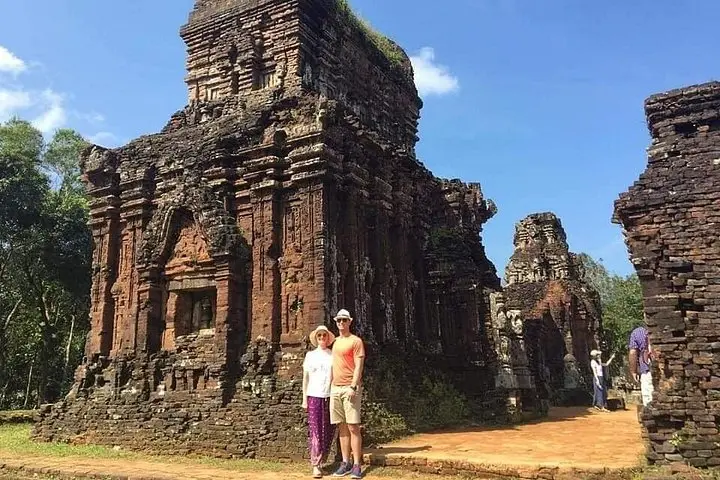

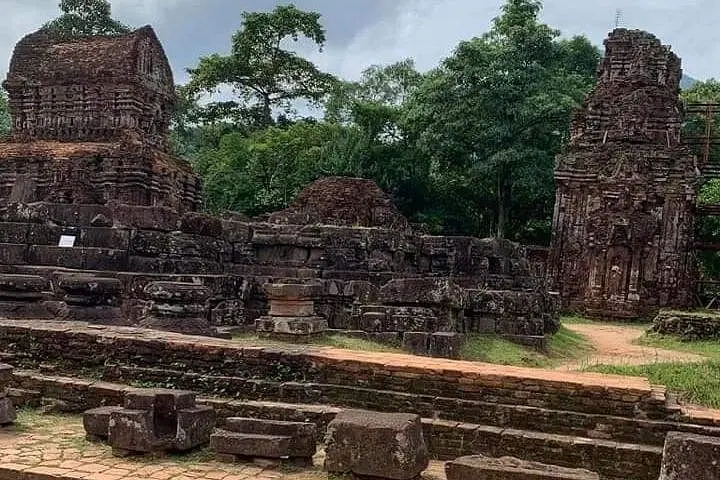
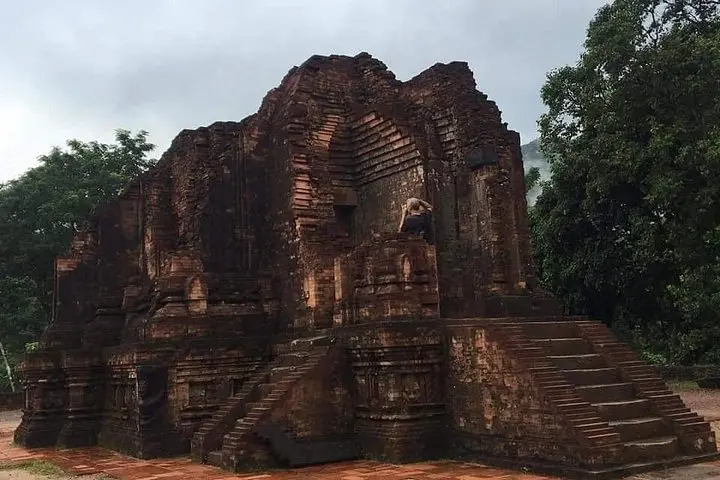
Dawn breaks over a low valley of red brick towers and green jungle as a private minivan carries you away from Hoi An toward My Son. Arriving before the heat swells, you step from the buggy onto compacted dirt paths, the silhouette of Cham towers cutting into a pale sky while distant karst ridgelines frame the valley.
Dawn breaks over a low valley of red brick towers and green jungle as a private minivan carries you away from Hoi An toward My Son. Arriving before the heat swells, you step from the buggy onto compacted dirt paths, the silhouette of Cham towers cutting into a pale sky while distant karst ridgelines frame the valley.
This UNESCO site preserves the ruins of the Champa Kingdom, active between roughly the 4th and 13th centuries. The temples—built of fired brick and fitted together without modern mortar—hold carvings and lintels that recall Hindu iconography and a maritime culture that traded across Southeast Asia. The layout, grouped into labeled blocks, reflects centuries of rebuilding and ritual use; your guide will move you through Groups B, C, D and beyond, explaining inscriptions, restoration efforts and the site's wartime damage and recovery.
Geology shows in the red clay bricks and the shallow valley soils; culturally, the place still quietly connects to Cham descendants and local farmers grazing water buffalo in the surrounding fields. Birds and butterflies frequent the edges of the ruins, and a small on-site museum gathers fragments and artifacts.
Practical side: the tour is low-impact walking but uneven underfoot—sturdy shoes and sun protection are wise. Morning visits avoid the midday heat and afternoon storms. Carry water, dress respectfully for religious sites, and leave time for photos at the viewpoint across the valley. Entrance and guide are typically included in a private tour, making it a compact cultural half-day that balances storytelling with tangible, hands-on history.