THE ADVENTURE COLLECTIVE® · Independent discovery and booking for outdoor travel

A focused 2½-hour guided tour of London’s Natural History Museum that covers flagship exhibits—Sophie the Stegosaurus, Archaeopteryx, gemstones and lunar samples—blending geology, paleontology and cultural history with practical tips for visiting.
A focused 2½-hour guided tour of London’s Natural History Museum that covers flagship exhibits—Sophie the Stegosaurus, Archaeopteryx, gemstones and lunar samples—blending geology, paleontology and cultural history with practical tips for visiting.
You step off Cromwell Road into the vaulted Hall where a blue whale skeleton hovers overhead and the hush of museums slides into a purposeful curiosity. The guided highlights tour moves at a steady pace—2½ hours of fossil giants, tiny mineral crystals that catch the light, and specimens that map life from deep time to the present.
Verified experiences and guided adventures in the surrounding area.
Operated by The Great Weekender Experiences · London, England
You step off Cromwell Road into the vaulted Hall where a blue whale skeleton hovers overhead and the hush of museums slides into a purposeful curiosity. The guided highlights tour moves at a steady pace—2½ hours of fossil giants, tiny mineral crystals that catch the light, and specimens that map life from deep time to the present.
The Natural History Museum opened in 1881 and grew from collections amassed during the 18th and 19th centuries; its red-brick building by Alfred Waterhouse reads like an exhibition in itself. Geology and paleontology dominate many galleries: the Sequoia cross-section on display spans over a millennium of growth, while fossils like Archaeopteryx and mounts such as Sophie the Stegosaurus show the transitions that define evolutionary history. Cultural threads run through the displays too—Pompeii casts and collections that trace scientific practice and empire-era collecting.
For visitors, the tour balances spectacle with substance. Expect clear explanations of fossil formation, how gemstones differ chemically, and why lunar and Martian rocks matter to Earth science. Practicalities are straightforward: the tour lasts about 150 minutes, admission and highlights access are included, and groups are limited to keep conversation focused.
Plan to arrive early to avoid crowds, carry a light layer (galleries can be cool), and give yourself extra time to linger in the Mineral Vault or the Darwin Centre afterward. Whether you’re with a family or a curious traveler, this tour translates deep time and complex geology into memorable, accessible moments.
Yes—the highlights tour includes access to the museum’s main exhibits for the scheduled 150-minute tour.
This listing runs as a guided highlights tour with up to 15 participants rather than a private-only booking; capacity may vary by operator.
Yes—the museum and major galleries are wheelchair and stroller accessible; if you have specific needs, indicate them at booking.
Photography for personal use is generally allowed in most galleries, but flash or tripods may be restricted—follow staff guidance in exhibit areas.
The Great Weekender Experiences operates guided outdoor trips and adventures with an emphasis on safety, stewardship, and memorable experiences.
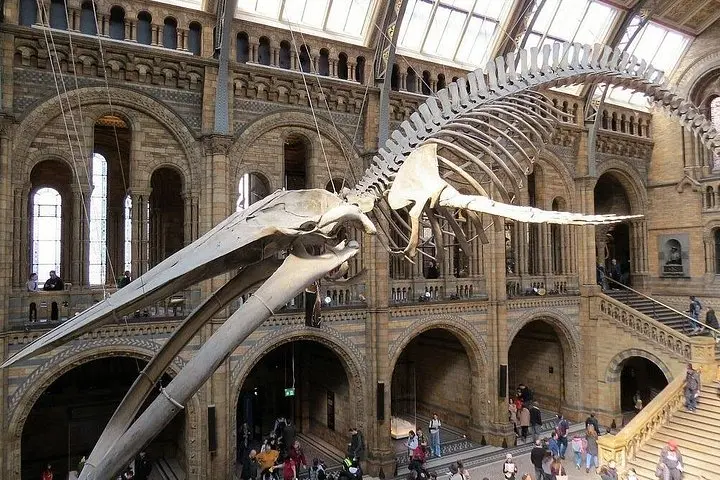
You step off Cromwell Road into the vaulted Hall where a blue whale skeleton hovers overhead and the hush of museums slides into a purposeful curiosity. The guided highlights tour moves at a steady pace—2½ hours of fossil giants, tiny mineral crystals that catch the light, and specimens that map life from deep time to the present.
You step off Cromwell Road into the vaulted Hall where a blue whale skeleton hovers overhead and the hush of museums slides into a purposeful curiosity. The guided highlights tour moves at a steady pace—2½ hours of fossil giants, tiny mineral crystals that catch the light, and specimens that map life from deep time to the present.
The Natural History Museum opened in 1881 and grew from collections amassed during the 18th and 19th centuries; its red-brick building by Alfred Waterhouse reads like an exhibition in itself. Geology and paleontology dominate many galleries: the Sequoia cross-section on display spans over a millennium of growth, while fossils like Archaeopteryx and mounts such as Sophie the Stegosaurus show the transitions that define evolutionary history. Cultural threads run through the displays too—Pompeii casts and collections that trace scientific practice and empire-era collecting.
For visitors, the tour balances spectacle with substance. Expect clear explanations of fossil formation, how gemstones differ chemically, and why lunar and Martian rocks matter to Earth science. Practicalities are straightforward: the tour lasts about 150 minutes, admission and highlights access are included, and groups are limited to keep conversation focused.
Plan to arrive early to avoid crowds, carry a light layer (galleries can be cool), and give yourself extra time to linger in the Mineral Vault or the Darwin Centre afterward. Whether you’re with a family or a curious traveler, this tour translates deep time and complex geology into memorable, accessible moments.