THE ADVENTURE COLLECTIVE® · Independent discovery and booking for outdoor travel

Drive into the Andes for a private observatory session where daytime demonstrations and true dark-sky stargazing meet. Learn local astronomy from an expert and prepare for cold mountain nights and weather-dependent scheduling.
Drive into the Andes for a private observatory session where daytime demonstrations and true dark-sky stargazing meet. Learn local astronomy from an expert and prepare for cold mountain nights and weather-dependent scheduling.
You step out of the van and the city’s glow falls away; the Andes press in, their dark slopes swallowing the horizon while the sky opens like an invitation. A private observatory perches at the edge of dry mountain air, where telescopes point like outstretched hands and an eccentric astronomer guides you through constellations that feel close enough to touch. Unusually, part of the experience includes daytime demonstrations—optical displays and solar viewing—before temperature drops and the main show begins.
Verified experiences and guided adventures in the surrounding area.
You step out of the van and the city’s glow falls away; the Andes press in, their dark slopes swallowing the horizon while the sky opens like an invitation. A private observatory perches at the edge of dry mountain air, where telescopes point like outstretched hands and an eccentric astronomer guides you through constellations that feel close enough to touch. Unusually, part of the experience includes daytime demonstrations—optical displays and solar viewing—before temperature drops and the main show begins.
Chile’s reputation as a global astronomy hub comes from the high, arid Andes and stable skies stretching north into the Atacama. Observing here means clear seeing, low humidity, and less atmospheric shimmer; geology has carved away moisture and light, leaving an honest view of the stars. Culturally, stargazing has become an accessible form of eco-tourism around Santiago, blending scientific explanation with folklore about southern constellations.
Practically, expect a 4–5 hour excursion with short drives on mountain roads, modest walking around the observatory platform, and a strict reliance on clear weather. The astronomer may ask visitors to download the SkySafari app (paid) to augment the live tour; cameras and phones are welcome but astrophotography beyond phone snaps usually requires permits or specialized gear. Dress in thermal layers, bring water and a headlamp with a red filter, and plan for last-minute date changes—mountain weather and cloud cover dictate success. This is a calm, education-forward night under a sky that dares you to look up and keeps offering answers.
Most tours are roughly a 30–60 minute drive from central Santiago depending on traffic and the chosen private observatory near the Andes.
No—tours are designed for beginners and curious travelers; the astronomer provides explanations and points out highlights for all skill levels.
Basic photos with phones are usually allowed; advanced astrophotography may require special permission or equipment—ask the operator ahead of time.
Tour operators will often reschedule, offer a gourmet indoor alternative, or provide refunds depending on their cancellation policy and availability.
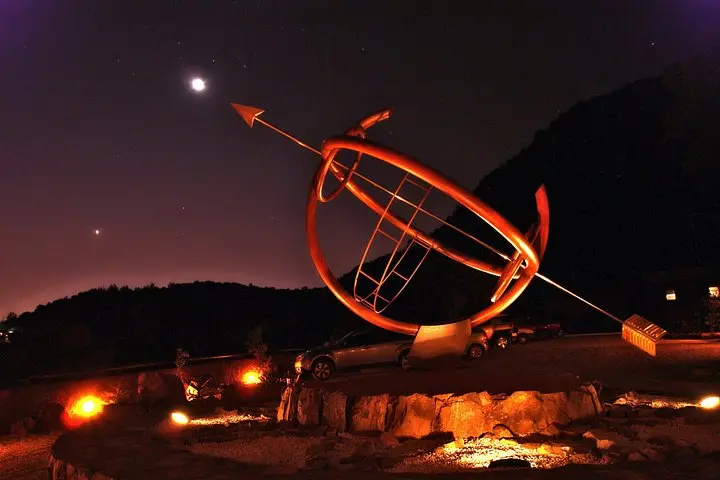
You step out of the van and the city’s glow falls away; the Andes press in, their dark slopes swallowing the horizon while the sky opens like an invitation. A private observatory perches at the edge of dry mountain air, where telescopes point like outstretched hands and an eccentric astronomer guides you through constellations that feel close enough to touch. Unusually, part of the experience includes daytime demonstrations—optical displays and solar viewing—before temperature drops and the main show begins.
You step out of the van and the city’s glow falls away; the Andes press in, their dark slopes swallowing the horizon while the sky opens like an invitation. A private observatory perches at the edge of dry mountain air, where telescopes point like outstretched hands and an eccentric astronomer guides you through constellations that feel close enough to touch. Unusually, part of the experience includes daytime demonstrations—optical displays and solar viewing—before temperature drops and the main show begins.
Chile’s reputation as a global astronomy hub comes from the high, arid Andes and stable skies stretching north into the Atacama. Observing here means clear seeing, low humidity, and less atmospheric shimmer; geology has carved away moisture and light, leaving an honest view of the stars. Culturally, stargazing has become an accessible form of eco-tourism around Santiago, blending scientific explanation with folklore about southern constellations.
Practically, expect a 4–5 hour excursion with short drives on mountain roads, modest walking around the observatory platform, and a strict reliance on clear weather. The astronomer may ask visitors to download the SkySafari app (paid) to augment the live tour; cameras and phones are welcome but astrophotography beyond phone snaps usually requires permits or specialized gear. Dress in thermal layers, bring water and a headlamp with a red filter, and plan for last-minute date changes—mountain weather and cloud cover dictate success. This is a calm, education-forward night under a sky that dares you to look up and keeps offering answers.