THE ADVENTURE COLLECTIVE® · Independent discovery and booking for outdoor travel

Scan moonlit outcrops and tailing piles in Bisbee with a UV lamp and watch calcite, azurite and turquoise fluoresce. This two‑hour, car‑based rockhounding tour pairs hands‑on mineral hunting with local mining history.
Scan moonlit outcrops and tailing piles in Bisbee with a UV lamp and watch calcite, azurite and turquoise fluoresce. This two‑hour, car‑based rockhounding tour pairs hands‑on mineral hunting with local mining history.
The night air in the Mule Mountains is cool and clear as headlights carve ribbons across dirt roads. Under a moonlit sky, small outcrops and mine dumps take on a new life—the pale faces of calcite, azurite and malachite blink when hit with a UV lamp, turning the dark into a map of glowing veins. This two‑hour, car‑based outing meets outside the Copper Queen Library in historic Bisbee and visits three nearby collecting spots, so most of your time is spent scanning rock faces, not hiking long distances.
Verified experiences and guided adventures in the surrounding area.
The night air in the Mule Mountains is cool and clear as headlights carve ribbons across dirt roads. Under a moonlit sky, small outcrops and mine dumps take on a new life—the pale faces of calcite, azurite and malachite blink when hit with a UV lamp, turning the dark into a map of glowing veins. This two‑hour, car‑based outing meets outside the Copper Queen Library in historic Bisbee and visits three nearby collecting spots, so most of your time is spent scanning rock faces, not hiking long distances.
Bisbee’s story is written in copper: 19th‑century booms left open cuts and tailing piles rich in secondary minerals from hydrothermal, porphyry‑style mineralization. The geology yields turquoise, jasper, agate, quartz and fluorescent calcite—minerals deposited when hot fluids altered host rock and cracked open cavities for crystals to grow. Culturally, Bisbee shifted from mine town to arts enclave; guides often weave mining lore and local anecdotes into the walk, and the Copper Queen Library—one of Arizona’s oldest—anchors the route.
Practical guidance: the tour is vehicle‑led with short, uneven walks at night—sturdy closed‑toe shoes, a warm layer and a charged phone are essential. UV lamps reveal hidden colors but can be harsh on eyes; never shine them at people. Bring water, a headlamp for walking, and be prepared to follow your car on narrow roads. Expect minimal elevation gain but loose scree and historic mine features; respect posted private land and leave large specimens. For travelers wanting a quick, sensory geology lesson in an atmospheric setting, this night hunt is efficient, educational and memorable.
No — guides provide UV lights for group use, but bringing a small personal UV torch helps you examine specimens more closely.
Collecting rules vary by site; guides will point out whether a spot allows takeaways—respect private property and public‑land regulations.
It’s family‑friendly for supervised children but uneven footing and night conditions require vigilance; service animals are allowed, but pets may not be safe in the dark.
The tour is car‑based with short walks at each stop; participants generally follow in their own vehicles while the guide leads and offers room in their vehicle if needed.
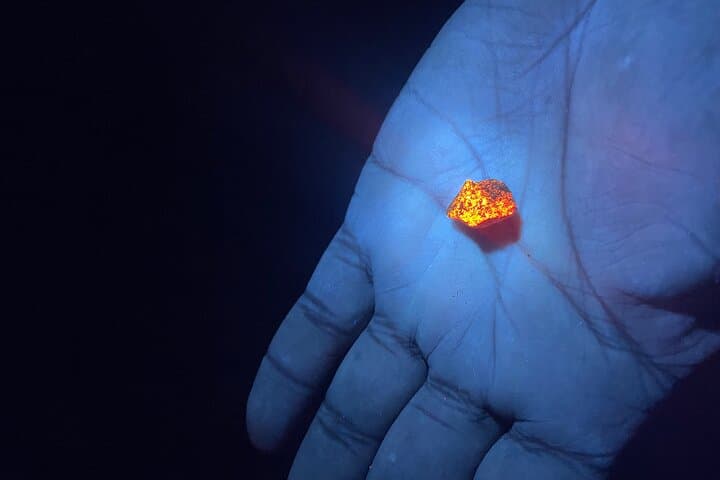
The night air in the Mule Mountains is cool and clear as headlights carve ribbons across dirt roads. Under a moonlit sky, small outcrops and mine dumps take on a new life—the pale faces of calcite, azurite and malachite blink when hit with a UV lamp, turning the dark into a map of glowing veins. This two‑hour, car‑based outing meets outside the Copper Queen Library in historic Bisbee and visits three nearby collecting spots, so most of your time is spent scanning rock faces, not hiking long distances.
The night air in the Mule Mountains is cool and clear as headlights carve ribbons across dirt roads. Under a moonlit sky, small outcrops and mine dumps take on a new life—the pale faces of calcite, azurite and malachite blink when hit with a UV lamp, turning the dark into a map of glowing veins. This two‑hour, car‑based outing meets outside the Copper Queen Library in historic Bisbee and visits three nearby collecting spots, so most of your time is spent scanning rock faces, not hiking long distances.
Bisbee’s story is written in copper: 19th‑century booms left open cuts and tailing piles rich in secondary minerals from hydrothermal, porphyry‑style mineralization. The geology yields turquoise, jasper, agate, quartz and fluorescent calcite—minerals deposited when hot fluids altered host rock and cracked open cavities for crystals to grow. Culturally, Bisbee shifted from mine town to arts enclave; guides often weave mining lore and local anecdotes into the walk, and the Copper Queen Library—one of Arizona’s oldest—anchors the route.
Practical guidance: the tour is vehicle‑led with short, uneven walks at night—sturdy closed‑toe shoes, a warm layer and a charged phone are essential. UV lamps reveal hidden colors but can be harsh on eyes; never shine them at people. Bring water, a headlamp for walking, and be prepared to follow your car on narrow roads. Expect minimal elevation gain but loose scree and historic mine features; respect posted private land and leave large specimens. For travelers wanting a quick, sensory geology lesson in an atmospheric setting, this night hunt is efficient, educational and memorable.