THE ADVENTURE COLLECTIVE® · Independent discovery and booking for outdoor travel

Venture into Lapland’s dark woods on snowshoes and hunt for the Aurora Borealis with expert guides. This three-hour winter hike offers a quiet, accessible way to experience Arctic night skies and learn about the region’s natural and cultural landscape.
Venture into Lapland’s dark woods on snowshoes and hunt for the Aurora Borealis with expert guides. This three-hour winter hike offers a quiet, accessible way to experience Arctic night skies and learn about the region’s natural and cultural landscape.
The forest exhales cold and clear; each breath shows as a quick white puff while your snowshoes whisper over packed snow. Under a wide Arctic sky you push away from town lights and into a dark wood where the pines lean like watchful companions. Guides set the pace, and the trail—soft, steady, low-angled—winds through birch and spruce toward hilltops that open the horizon to the night.
Verified experiences and guided adventures in the surrounding area.
Operated by Access Lapland · Rovaniemi, Lapland
The forest exhales cold and clear; each breath shows as a quick white puff while your snowshoes whisper over packed snow. Under a wide Arctic sky you push away from town lights and into a dark wood where the pines lean like watchful companions. Guides set the pace, and the trail—soft, steady, low-angled—winds through birch and spruce toward hilltops that open the horizon to the night.
This short winter hike sits in Finnish Lapland, a landscape shaped by glacial scouring and river valleys, where Sámi reindeer culture remains part of daily life. Geologically, the area is ancient Fennoscandian bedrock smoothed by ice; culturally, the night sky has long been a compass and a storybook for northern communities.
Expect roughly 3–5 km of walking on packed snow with minimal elevation gain—gentle ridges rather than steep climbs. Temperatures can drop well below freezing; the forest muffles sound and makes the aurora’s curtains feel closer. Even without bright auroras, the silence and starfields are memorable.
Practical notes: tours run about three hours, include snowshoe equipment and thermal overalls, and require moderate fitness and steady footing. Dress in insulating layers, protect extremities, and carry a headlamp with red-light mode to preserve night vision. Stay with your guide, keep movements measured to conserve heat, and bring a camera with manual settings if you want to photograph the aurora. Be prepared for cancellations in poor weather—clear skies are the key to sighting the lights.
No—auroras depend on solar activity and clear skies; guides choose dark locations to maximize chances but sightings cannot be promised.
Yes—operators typically provide snowshoes, thermal overalls, gloves and boots (confirm at booking for sizes and availability).
Temperatures can drop well below freezing; wear layered clothing, thermal base layers, insulated mid-layers, and a warm hat and gloves even if overalls are provided.
This tour requires moderate fitness and is not recommended for those with serious heart or spinal issues or for pregnant travelers; check booking conditions for specific age limits.
Access Lapland operates guided outdoor trips and adventures with an emphasis on safety, stewardship, and memorable experiences.
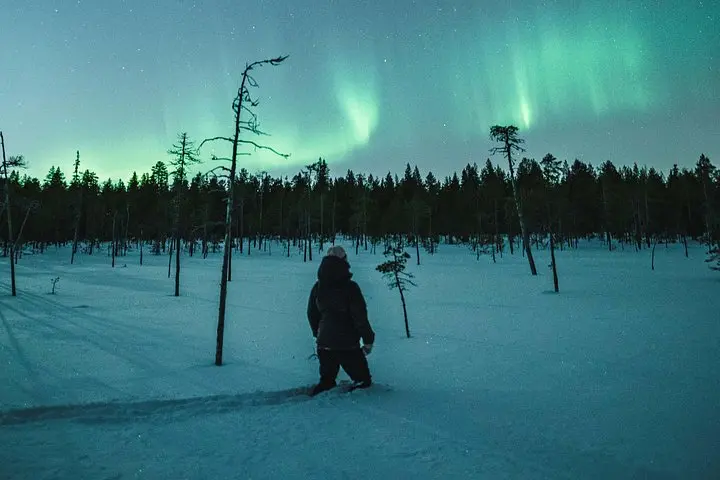
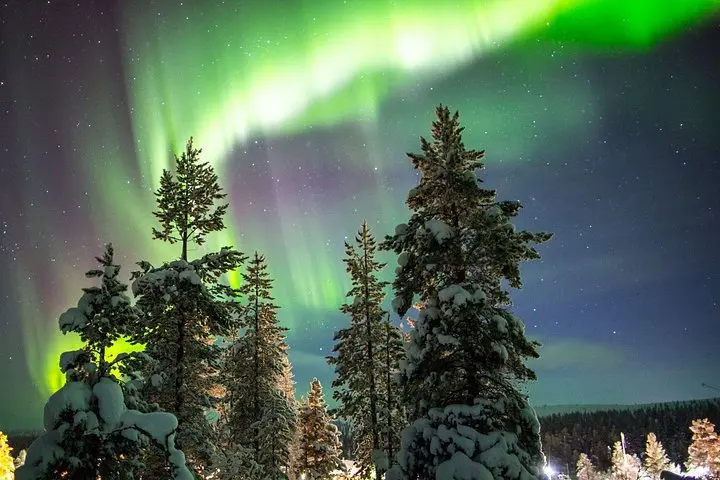
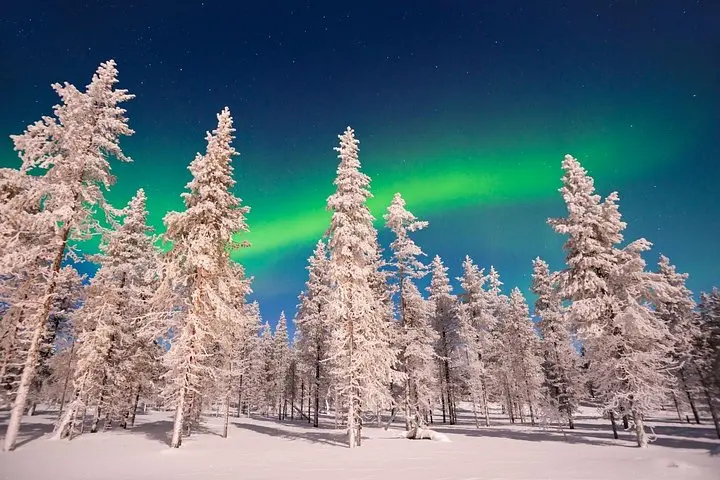
The forest exhales cold and clear; each breath shows as a quick white puff while your snowshoes whisper over packed snow. Under a wide Arctic sky you push away from town lights and into a dark wood where the pines lean like watchful companions. Guides set the pace, and the trail—soft, steady, low-angled—winds through birch and spruce toward hilltops that open the horizon to the night.
The forest exhales cold and clear; each breath shows as a quick white puff while your snowshoes whisper over packed snow. Under a wide Arctic sky you push away from town lights and into a dark wood where the pines lean like watchful companions. Guides set the pace, and the trail—soft, steady, low-angled—winds through birch and spruce toward hilltops that open the horizon to the night.
This short winter hike sits in Finnish Lapland, a landscape shaped by glacial scouring and river valleys, where Sámi reindeer culture remains part of daily life. Geologically, the area is ancient Fennoscandian bedrock smoothed by ice; culturally, the night sky has long been a compass and a storybook for northern communities.
Expect roughly 3–5 km of walking on packed snow with minimal elevation gain—gentle ridges rather than steep climbs. Temperatures can drop well below freezing; the forest muffles sound and makes the aurora’s curtains feel closer. Even without bright auroras, the silence and starfields are memorable.
Practical notes: tours run about three hours, include snowshoe equipment and thermal overalls, and require moderate fitness and steady footing. Dress in insulating layers, protect extremities, and carry a headlamp with red-light mode to preserve night vision. Stay with your guide, keep movements measured to conserve heat, and bring a camera with manual settings if you want to photograph the aurora. Be prepared for cancellations in poor weather—clear skies are the key to sighting the lights.