THE ADVENTURE COLLECTIVE® · Independent discovery and booking for outdoor travel

Walk the winding lanes of Al Fahidi, cross Dubai Creek on a traditional abra, and explore souks where spices and gold remain central to daily life. This three-hour guided tour reveals the history and practical realities of Old Dubai.
Walk the winding lanes of Al Fahidi, cross Dubai Creek on a traditional abra, and explore souks where spices and gold remain central to daily life. This three-hour guided tour reveals the history and practical realities of Old Dubai.
Morning light slants through wind towers as the guide leads the group into lanes of packed-earth calm and sudden commerce. You move from shaded courtyards into the bright chaos of the textile souk, then cross Dubai Creek on a wooden abra, the water pulling and pushing the city’s older rhythms.
Verified experiences and guided adventures in the surrounding area.
Operated by Dubai Xcursions by Travinno · Dubai, Dubai
Morning light slants through wind towers as the guide leads the group into lanes of packed-earth calm and sudden commerce. You move from shaded courtyards into the bright chaos of the textile souk, then cross Dubai Creek on a wooden abra, the water pulling and pushing the city’s older rhythms.
Al Fahidi and the nearby souks grew from a late-19th-century trade hub—pearling, dhow commerce and Persian merchant families shaped the architecture and social life. Geologically the creek is an estuarine inlet carved by tidal flows; its margins host mangal fragments and mudflats that once fed a working waterfront and now frame the city’s oldest streets.
Culturally the tour surfaces Emirati everyday life: fragrant spice stalls, gold traders who still display wares by hand, and the simple schoolhouse markings of Al Ahmadiya School. Local insights include how wind towers reflect pre-air-conditioning climate design and how abra crossings remain the most efficient short-commute on the creek.
Practical guidance: plan this 3‑hour loop for early morning or late afternoon to avoid peak heat and busiest market hours. Wear supportive closed-toe shoes for uneven pavements, carry sunscreen and a refillable water bottle, and keep a small amount of cash for market purchases and the abra ticket. Respect prayer times and local dress norms—shoulders and knees covered in conservative areas—and listen to guides when navigating narrow lanes. The route is low‑elevation and flat but active walking on hot days can be tiring; pace yourself, pause at a café for strong Arabic coffee, and let the creek’s steady current reset your sense of Dubai from towering new glass to its older, human-scale pulse.
Yes—this tour includes the short traditional abra crossing ticket as part of the itinerary.
The area has narrow lanes and some uneven surfaces; accessibility is limited—check with the operator about alternative arrangements.
Guided tours are typically in English; confirm availability of other languages at booking.
Bring small notes for bargaining, and be prepared to inspect fabrics and jewelry closely; most vendors accept cash and some accept cards.
Dubai Xcursions by Travinno operates guided outdoor trips and adventures with an emphasis on safety, stewardship, and memorable experiences.
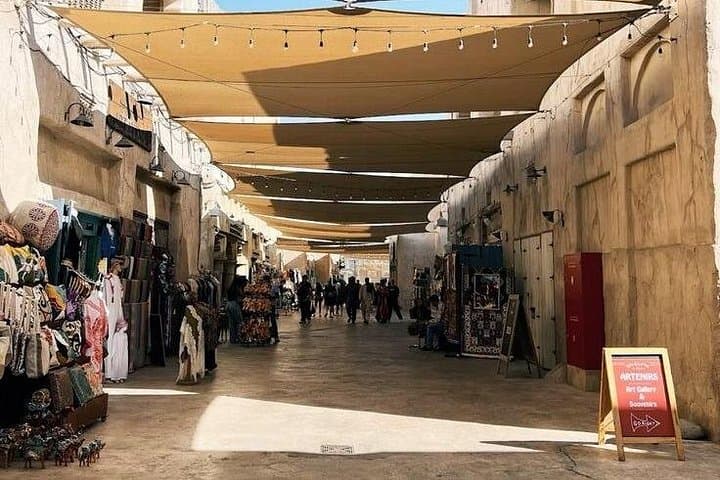

Morning light slants through wind towers as the guide leads the group into lanes of packed-earth calm and sudden commerce. You move from shaded courtyards into the bright chaos of the textile souk, then cross Dubai Creek on a wooden abra, the water pulling and pushing the city’s older rhythms.
Morning light slants through wind towers as the guide leads the group into lanes of packed-earth calm and sudden commerce. You move from shaded courtyards into the bright chaos of the textile souk, then cross Dubai Creek on a wooden abra, the water pulling and pushing the city’s older rhythms.
Al Fahidi and the nearby souks grew from a late-19th-century trade hub—pearling, dhow commerce and Persian merchant families shaped the architecture and social life. Geologically the creek is an estuarine inlet carved by tidal flows; its margins host mangal fragments and mudflats that once fed a working waterfront and now frame the city’s oldest streets.
Culturally the tour surfaces Emirati everyday life: fragrant spice stalls, gold traders who still display wares by hand, and the simple schoolhouse markings of Al Ahmadiya School. Local insights include how wind towers reflect pre-air-conditioning climate design and how abra crossings remain the most efficient short-commute on the creek.
Practical guidance: plan this 3‑hour loop for early morning or late afternoon to avoid peak heat and busiest market hours. Wear supportive closed-toe shoes for uneven pavements, carry sunscreen and a refillable water bottle, and keep a small amount of cash for market purchases and the abra ticket. Respect prayer times and local dress norms—shoulders and knees covered in conservative areas—and listen to guides when navigating narrow lanes. The route is low‑elevation and flat but active walking on hot days can be tiring; pace yourself, pause at a café for strong Arabic coffee, and let the creek’s steady current reset your sense of Dubai from towering new glass to its older, human-scale pulse.