THE ADVENTURE COLLECTIVE® · Independent discovery and booking for outdoor travel

Head from Salalah into the Rub' al Khali for an overnight that pairs living frankincense groves with the ruins of Ubar. Expect long drives, stark desert vistas, simple camping comforts, and a deep dive into Dhofar’s trade history.
Head from Salalah into the Rub' al Khali for an overnight that pairs living frankincense groves with the ruins of Ubar. Expect long drives, stark desert vistas, simple camping comforts, and a deep dive into Dhofar’s trade history.
Night falls early in the Empty Quarter and the first stars appear like campfires laid across the sky. The 4x4 hums along the mountain’s lee, and dunes begin to assert themselves—shifting ridges that push and cradle the vehicle as the guide threads a route through ancient sand.
Verified experiences and guided adventures in the surrounding area.
Operated by Visit Our Salalah · Salalah, Dhofar
Night falls early in the Empty Quarter and the first stars appear like campfires laid across the sky. The 4x4 hums along the mountain’s lee, and dunes begin to assert themselves—shifting ridges that push and cradle the vehicle as the guide threads a route through ancient sand.
This overnight tour takes travelers from Salalah into Dhofar’s stark, wind-sculpted desert to visit Wadi Dawka — home to naturally grown frankincense trees — and the archaeological remains of Ubar, a once-thriving trade center for resin that linked Arabia to the Mediterranean and beyond. Geologically, the trip crosses the escarpment foothills into the Rub' al Khali’s broad sand seas: limestone and wind-polished silt give way to endless dunes whose forms change with each gust.
Culturally, frankincense shaped local economies for millennia; the trees here are living links to incense caravans that moved goods across Arabia. At the Ubar site a small museum displays finds that help tell the story of a city buried by sand and time.
Practically, guests should expect long dirt-road transfers, short guided walks among the trees and ruins, and a simple desert camp with dinner included. Nights are cold and winds can be brisk; bring layers, sun protection and at least 2 liters of water per person. Footwear with grip helps for walking on soft sand and rubble. Photography is rewarding at dawn and dusk when light sculpts the dunes and highlights the silhouettes of frankincense trees.
Plan pickups from Salalah; allow a full day plus overnight for travel time and slow-paced exploration.
Basic camp facilities and dinner are provided as part of the tour; confirm bedding and tent arrangements with the operator before booking.
Yes. Wadi Dawka and the Ubar area are managed with archaeological sensitivity—visitors should follow site rules and the guide’s instructions to avoid damage.
Expect several hours of driving each way between Salalah and the sites; the full itinerary is approximately 20 hours including transfers and on-site time.
The tour is generally suitable for families, but those with serious mobility limitations or certain medical conditions should check accessibility and vehicle options with the operator.
Visit Our Salalah operates guided outdoor trips and adventures with an emphasis on safety, stewardship, and memorable experiences.
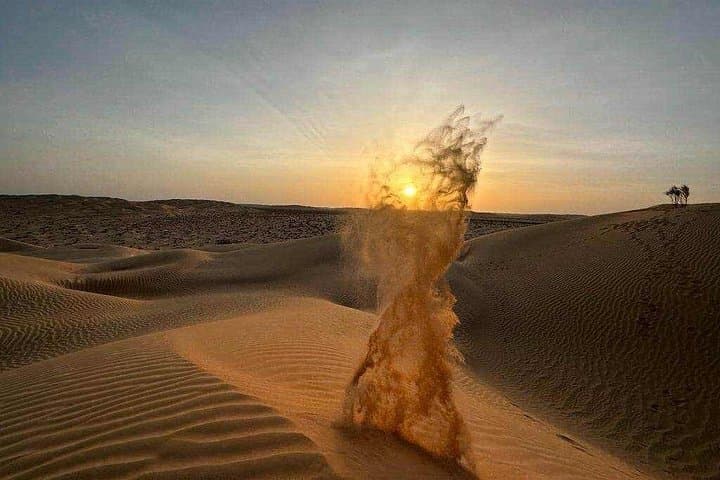


Night falls early in the Empty Quarter and the first stars appear like campfires laid across the sky. The 4x4 hums along the mountain’s lee, and dunes begin to assert themselves—shifting ridges that push and cradle the vehicle as the guide threads a route through ancient sand.
Night falls early in the Empty Quarter and the first stars appear like campfires laid across the sky. The 4x4 hums along the mountain’s lee, and dunes begin to assert themselves—shifting ridges that push and cradle the vehicle as the guide threads a route through ancient sand.
This overnight tour takes travelers from Salalah into Dhofar’s stark, wind-sculpted desert to visit Wadi Dawka — home to naturally grown frankincense trees — and the archaeological remains of Ubar, a once-thriving trade center for resin that linked Arabia to the Mediterranean and beyond. Geologically, the trip crosses the escarpment foothills into the Rub' al Khali’s broad sand seas: limestone and wind-polished silt give way to endless dunes whose forms change with each gust.
Culturally, frankincense shaped local economies for millennia; the trees here are living links to incense caravans that moved goods across Arabia. At the Ubar site a small museum displays finds that help tell the story of a city buried by sand and time.
Practically, guests should expect long dirt-road transfers, short guided walks among the trees and ruins, and a simple desert camp with dinner included. Nights are cold and winds can be brisk; bring layers, sun protection and at least 2 liters of water per person. Footwear with grip helps for walking on soft sand and rubble. Photography is rewarding at dawn and dusk when light sculpts the dunes and highlights the silhouettes of frankincense trees.
Plan pickups from Salalah; allow a full day plus overnight for travel time and slow-paced exploration.