THE ADVENTURE COLLECTIVE® · Independent discovery and booking for outdoor travel

A six-day loop from Dushanbe into the Pamir Highway and Wakhan Valley that pairs remote high passes, ancient fortresses, and homestays. Expect long drives, high-altitude scenery, and intimate cultural exchanges.
A six-day loop from Dushanbe into the Pamir Highway and Wakhan Valley that pairs remote high passes, ancient fortresses, and homestays. Expect long drives, high-altitude scenery, and intimate cultural exchanges.
A diesel engine rumbles to life in Dushanbe as the city’s flat, dusty edge gives way to hairpin roads and mountain silence. The Panj River begins to dictate pace—dark, restless, and daring you to look across toward Afghanistan—while blue-white peaks rise like weathered monuments. By the second day you are high enough to feel the thinness of the air; by the third, the Khargush Pass opens an endless horizon of rock and scree.
Verified experiences and guided adventures in the surrounding area.
Operated by Explore Pamir · Dushanbe, Dushanbe
A diesel engine rumbles to life in Dushanbe as the city’s flat, dusty edge gives way to hairpin roads and mountain silence. The Panj River begins to dictate pace—dark, restless, and daring you to look across toward Afghanistan—while blue-white peaks rise like weathered monuments. By the second day you are high enough to feel the thinness of the air; by the third, the Khargush Pass opens an endless horizon of rock and scree.
This route threads modern history and ancient corridors: Soviet-built roads that trace older Silk Road passages, villages shaped by Pamiri languages and Ismaili traditions, and fortresses like Yamchun that bear witness to centuries of cross-border exchange. Geologically, the Pamirs are a meeting of uplifted plateaus and glacial-carved valleys—stark shelves of shale and granite punctuated by alpine lakes such as Karakul.
Expect long, scenic driving days with short walks and cultural stops—homestays and guesthouses give a close-up of daily life. Weather shifts fast at altitude; mornings can be crystalline and afternoons wind-scoured. Practical planning matters: the GBAO permit is required, cash is king in remote towns, and acclimatization is the best defense against headaches and fatigue.
Bring layered clothing, sun protection, and a basic first-aid kit. Travel with patience—roads are rough but generous with views—and keep your camera ready at every river bend. This is a trip built for curiosity, with nature and local hospitality pushing gently at the edges of comfort and reward.
Yes—the GBAO permit is required for travel in Gorno-Badakhshan; this tour notes the permit is included, but confirm before departure.
Roads are a mix of paved and rough gravel; expect long, bumpy drives with some unpaved high-altitude passes that require a sturdy vehicle.
Yes—passes approach and exceed 4,000 m; follow acclimatization advice, stay hydrated, and inform your guide of symptoms immediately.
Overnights are in local guesthouses and homestays with basic but comfortable facilities; Dushanbe nights are in standard city hotels.
Explore Pamir operates guided outdoor trips and adventures with an emphasis on safety, stewardship, and memorable experiences.
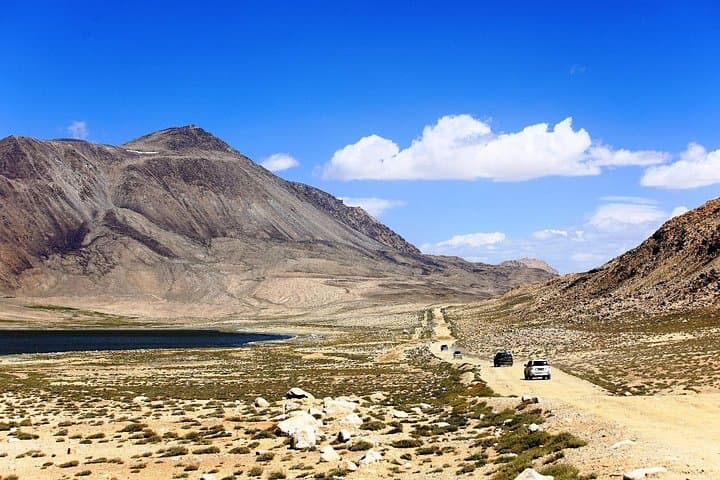


A diesel engine rumbles to life in Dushanbe as the city’s flat, dusty edge gives way to hairpin roads and mountain silence. The Panj River begins to dictate pace—dark, restless, and daring you to look across toward Afghanistan—while blue-white peaks rise like weathered monuments. By the second day you are high enough to feel the thinness of the air; by the third, the Khargush Pass opens an endless horizon of rock and scree.
A diesel engine rumbles to life in Dushanbe as the city’s flat, dusty edge gives way to hairpin roads and mountain silence. The Panj River begins to dictate pace—dark, restless, and daring you to look across toward Afghanistan—while blue-white peaks rise like weathered monuments. By the second day you are high enough to feel the thinness of the air; by the third, the Khargush Pass opens an endless horizon of rock and scree.
This route threads modern history and ancient corridors: Soviet-built roads that trace older Silk Road passages, villages shaped by Pamiri languages and Ismaili traditions, and fortresses like Yamchun that bear witness to centuries of cross-border exchange. Geologically, the Pamirs are a meeting of uplifted plateaus and glacial-carved valleys—stark shelves of shale and granite punctuated by alpine lakes such as Karakul.
Expect long, scenic driving days with short walks and cultural stops—homestays and guesthouses give a close-up of daily life. Weather shifts fast at altitude; mornings can be crystalline and afternoons wind-scoured. Practical planning matters: the GBAO permit is required, cash is king in remote towns, and acclimatization is the best defense against headaches and fatigue.
Bring layered clothing, sun protection, and a basic first-aid kit. Travel with patience—roads are rough but generous with views—and keep your camera ready at every river bend. This is a trip built for curiosity, with nature and local hospitality pushing gently at the edges of comfort and reward.