THE ADVENTURE COLLECTIVE® · Independent discovery and booking for outdoor travel

Spend a long, vivid day visiting Pamukkale’s white travertine terraces and the turquoise shores of Salda Lake. This private full-day tour from Belek or Antalya combines ancient Hierapolis ruins with two distinct geological wonders.
Spend a long, vivid day visiting Pamukkale’s white travertine terraces and the turquoise shores of Salda Lake. This private full-day tour from Belek or Antalya combines ancient Hierapolis ruins with two distinct geological wonders.
You arrive before dawn after hours on the highway; the limestone terraces of Pamukkale appear like a bright ridge under the morning light, their shallow pools holding water like cooled milk. The guide opens the gates, and the air carries a mineral tang while the terraces quietly collect runoff into stepped basins that reflect the sky.
Verified experiences and guided adventures in the surrounding area.
Operated by Vakare Travel Service · Pamukkale, Denizli Province
You arrive before dawn after hours on the highway; the limestone terraces of Pamukkale appear like a bright ridge under the morning light, their shallow pools holding water like cooled milk. The guide opens the gates, and the air carries a mineral tang while the terraces quietly collect runoff into stepped basins that reflect the sky.
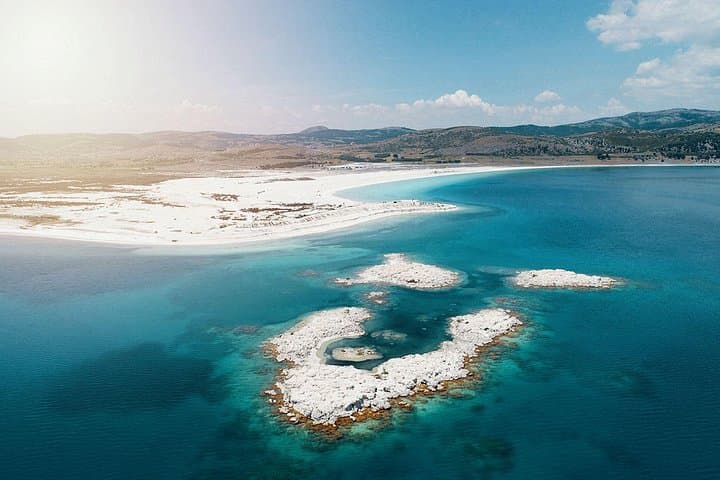
This day pairs two very different natural archives: Pamukkale’s travertines and the ruined spa city of Hierapolis, founded in the Hellenistic era and expanded by the Romans as a healing centre, and Salda Lake’s volcanic basin with its brilliantly blue water and white, magnesium-rich sand. Geologically, Pamukkale’s terraces are living carbonate deposits—hot, mineral-laden springs precipitate calcium carbonate that builds shelves and pools; Salda is fed by groundwater and groundwater-deposited mafic sediments that create powdery shores and are studied as a Mars analog.
Culturally the route feels Anatolian: a quick Turkish lunch, echoes of Roman baths and local families at Salda’s shore. Expect walking on packed paths and irregular stone, some short stair sections in Hierapolis, and easy shoreline strolls at Salda. Practical tips: start early to avoid midday heat, bring non-marking water shoes or bare feet for the terraces where footwear is not allowed, carry sun protection and 1–2 liters water, and allow 11–12 hours for round-trip driving and visits.
This is a long but rewarding day—two ecosystems, ancient ruins, and restorative waters—best for travelers willing to trade a full day for two of Turkey’s signature landscapes.
Expect roughly 3.5–4 hours one way from Antalya or Belek depending on traffic; the full tour is typically 11–12 hours.
Swimming in the designated Cleopatra’s Pool area is usually allowed (entrance fee) while swimming at Salda is permitted but observe local rules—avoid applying sunscreen beforehand to protect water quality.
Travertine can be slippery when wet; walking barefoot on the terraces is required in many zones to protect the formations—move carefully and follow signage.
The tour is family-friendly but involves stairs and uneven ground; guests with limited mobility should consult the operator about access and vehicle pickup options.
Vakare Travel Service operates guided outdoor trips and adventures with an emphasis on safety, stewardship, and memorable experiences.
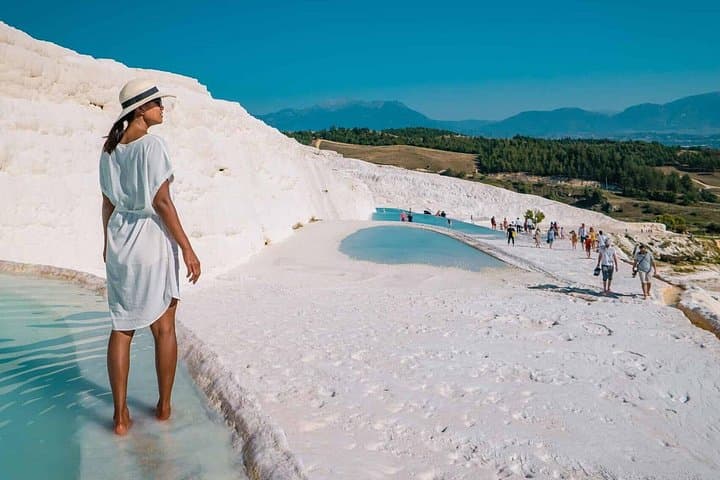
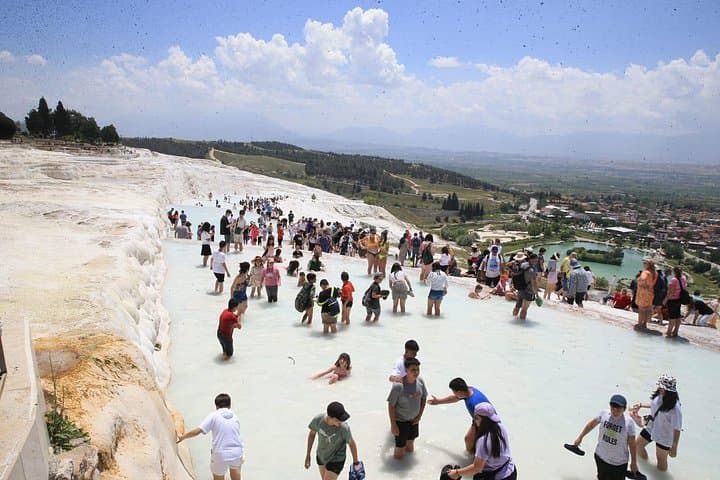

You arrive before dawn after hours on the highway; the limestone terraces of Pamukkale appear like a bright ridge under the morning light, their shallow pools holding water like cooled milk. The guide opens the gates, and the air carries a mineral tang while the terraces quietly collect runoff into stepped basins that reflect the sky.
You arrive before dawn after hours on the highway; the limestone terraces of Pamukkale appear like a bright ridge under the morning light, their shallow pools holding water like cooled milk. The guide opens the gates, and the air carries a mineral tang while the terraces quietly collect runoff into stepped basins that reflect the sky.
This day pairs two very different natural archives: Pamukkale’s travertines and the ruined spa city of Hierapolis, founded in the Hellenistic era and expanded by the Romans as a healing centre, and Salda Lake’s volcanic basin with its brilliantly blue water and white, magnesium-rich sand. Geologically, Pamukkale’s terraces are living carbonate deposits—hot, mineral-laden springs precipitate calcium carbonate that builds shelves and pools; Salda is fed by groundwater and groundwater-deposited mafic sediments that create powdery shores and are studied as a Mars analog.
Culturally the route feels Anatolian: a quick Turkish lunch, echoes of Roman baths and local families at Salda’s shore. Expect walking on packed paths and irregular stone, some short stair sections in Hierapolis, and easy shoreline strolls at Salda. Practical tips: start early to avoid midday heat, bring non-marking water shoes or bare feet for the terraces where footwear is not allowed, carry sun protection and 1–2 liters water, and allow 11–12 hours for round-trip driving and visits.
This is a long but rewarding day—two ecosystems, ancient ruins, and restorative waters—best for travelers willing to trade a full day for two of Turkey’s signature landscapes.