THE ADVENTURE COLLECTIVE® · Independent discovery and booking for outdoor travel
Glide beneath illuminated bridges and past the Eiffel Tower on a one-hour Seine cruise that frames Paris’s iconic monuments against the night. Perfect for first-time visitors and evening strollers who want a compact, scenic introduction to the City of Light.
Glide beneath illuminated bridges and past the Eiffel Tower on a one-hour Seine cruise that frames Paris’s iconic monuments against the night. Perfect for first-time visitors and evening strollers who want a compact, scenic introduction to the City of Light.
The Seine slides past stone quays as the city lowers its shutters and flips on a thousand lamps; from the river, Paris unfolds in a measured choreography of light. On a one-hour evening cruise you sit low to the water while the Eiffel Tower blinks, the Louvre's glass pyramid reflects amber, and Notre-Dame's façade catches the glow of streetlight—each monument stepping into view as the boat rounds a bend.
Verified experiences and guided adventures in the surrounding area.
The Seine slides past stone quays as the city lowers its shutters and flips on a thousand lamps; from the river, Paris unfolds in a measured choreography of light. On a one-hour evening cruise you sit low to the water while the Eiffel Tower blinks, the Louvre's glass pyramid reflects amber, and Notre-Dame's façade catches the glow of streetlight—each monument stepping into view as the boat rounds a bend.
The Seine is Paris's original highway: a Roman-era artery that shaped neighborhoods on Île de la Cité and the Left and Right Banks. The riverbanks where you glide are lined with stone quays, medieval bridges, and Haussmannian façades; they were inscribed as a UNESCO World Heritage site for their role in urban history and culture. Geologically, the river follows the Seine basin’s alluvial plain, its low, slow channel encouraging quayside life rather than dramatic cliffs.
Culturally, the cruise is as much a Parisian ritual as an espresso at a corner café—an accessible way to absorb architecture, history, and the ritual of the night. Locals use the banks for evening walks; photographers chase the Eiffel Tower’s hourly sparkle after dusk.
Practical guidance: arrive 15–30 minutes early for boarding and a good seat, dress for cool winds off the river even in summer, and plan around the Eiffel Tower’s five-minute hourly light show after sunset if you want the sparkle on your photos. Bring a small tripod or steady your camera on the rail, and expect minimal motion—this is sightseeing, not whitewater. For families, couples, or solo travelers, the cruise packs an efficient, low-effort primer on Paris after dark.
Standard evening cruises run about one hour, giving a concise tour of central Seine landmarks after dark.
Many operators sell light refreshments and drinks onboard, though offerings vary—check the provider’s page if you need a full meal or special provisions.
Accessibility varies by operator and boarding point; many vessels and quays have ramps or lifts but confirm accessibility options when booking.
Book in advance for peak tourist season and evening times; arrive 15–30 minutes before departure to choose a favorable seat on deck.
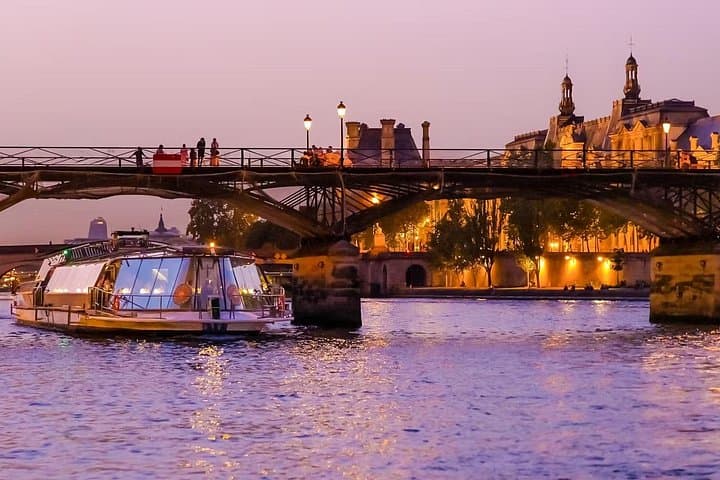
The Seine slides past stone quays as the city lowers its shutters and flips on a thousand lamps; from the river, Paris unfolds in a measured choreography of light. On a one-hour evening cruise you sit low to the water while the Eiffel Tower blinks, the Louvre's glass pyramid reflects amber, and Notre-Dame's façade catches the glow of streetlight—each monument stepping into view as the boat rounds a bend.
The Seine slides past stone quays as the city lowers its shutters and flips on a thousand lamps; from the river, Paris unfolds in a measured choreography of light. On a one-hour evening cruise you sit low to the water while the Eiffel Tower blinks, the Louvre's glass pyramid reflects amber, and Notre-Dame's façade catches the glow of streetlight—each monument stepping into view as the boat rounds a bend.
The Seine is Paris's original highway: a Roman-era artery that shaped neighborhoods on Île de la Cité and the Left and Right Banks. The riverbanks where you glide are lined with stone quays, medieval bridges, and Haussmannian façades; they were inscribed as a UNESCO World Heritage site for their role in urban history and culture. Geologically, the river follows the Seine basin’s alluvial plain, its low, slow channel encouraging quayside life rather than dramatic cliffs.
Culturally, the cruise is as much a Parisian ritual as an espresso at a corner café—an accessible way to absorb architecture, history, and the ritual of the night. Locals use the banks for evening walks; photographers chase the Eiffel Tower’s hourly sparkle after dusk.
Practical guidance: arrive 15–30 minutes early for boarding and a good seat, dress for cool winds off the river even in summer, and plan around the Eiffel Tower’s five-minute hourly light show after sunset if you want the sparkle on your photos. Bring a small tripod or steady your camera on the rail, and expect minimal motion—this is sightseeing, not whitewater. For families, couples, or solo travelers, the cruise packs an efficient, low-effort primer on Paris after dark.
