THE ADVENTURE COLLECTIVE® · Independent discovery and booking for outdoor travel

Spend a full day tracing the history and landscapes east of Antalya: Perge’s Roman ruins, the pine-shaded Kurşunlu Waterfall, and the remarkably preserved Roman amphitheatre at Aspendos. This well-paced circuit pairs archaeology with a refreshing nature walk.
Spend a full day tracing the history and landscapes east of Antalya: Perge’s Roman ruins, the pine-shaded Kurşunlu Waterfall, and the remarkably preserved Roman amphitheatre at Aspendos. This well-paced circuit pairs archaeology with a refreshing nature walk.
It begins on a morning road that leans toward the Anatolian interior, the bus windows glazing over with citrus orchards and low limestone ridges. By the time the columns of Perge come into view, the sun has softened into the warm clarity that makes carved stone read like a page. Visitors step off and into a living classroom of empire-building: a broad colonnaded street, a Roman stadium built for 12,000, and the acropolis that still holds the footprint of Bronze Age occupation.
Verified experiences and guided adventures in the surrounding area.
It begins on a morning road that leans toward the Anatolian interior, the bus windows glazing over with citrus orchards and low limestone ridges. By the time the columns of Perge come into view, the sun has softened into the warm clarity that makes carved stone read like a page. Visitors step off and into a living classroom of empire-building: a broad colonnaded street, a Roman stadium built for 12,000, and the acropolis that still holds the footprint of Bronze Age occupation.
Perge feels like a city-sized fossil—stones that remember foot traffic, markets and military parades. The route through its forum and baths is an easy 1.5–2 km of uneven flagstone, with short flights of steps leading to viewpoints. From there the tour moves to Kursunlu Waterfall, where the mood shifts. Pine-scented air and a short wooden boardwalk lead you along a 1 km loop; the falls are less a single drop than a series of cascades that push and hush the forest around them. The trail gains roughly 40–60 m in elevation but remains gentle—this is the part of the day meant for listening.
After lunch, the tour finishes at Aspendos, where the Roman amphitheatre dominates the plain. Built in the second century AD and famed for its extraordinary acoustics, Aspendos is intact enough that you can imagine choruses and orators filling it. A walk down the marble aisles and onto the stage reveals why performances are still held here; the space resists time.
Geology here is simple and telling: limestone bedrock sculpted by Mediterranean rains, producing the dry hills and the karst springs that feed Kursunlu. Culturally, this corridor—between Antalya and Side—was a crossroads for Greeks, Romans and later Anatolian states; the archaeology is a direct line through those chapters.
Practical details: the full day runs about eight hours with 3–4 km of walking total, mostly on flat or gently sloping surfaces. Bring sturdy walking shoes—the ruins are uneven and the amphitheatre steps can be slick when damp. Expect temperatures to climb in summer; mornings and late afternoons deliver the most comfortable light and the fewest crowds. Note: sites have limited accessibility and no full wheelchair access.
Tips for timing: arrive at Perge with fresh legs to enjoy the open-air ruins, save the waterfall for midday cool-down, and plan for golden-hour photos at Aspendos if the schedule allows. Respect the stone—don’t climb on unmarked sections—and carry water: shade is limited between sites. For travelers who want history with a short nature interlude, this circuit is a clear, well-paced introduction to Antalya’s layered landscape.
Expect about 3–4 km of walking total across mostly flat but uneven terrain, with brief stair sections at the amphitheatre and acropolis.
Yes—children who can handle moderate walking and stairs will enjoy the dramatic ruins and the short waterfall loop.
Lunch is typically included on full-day tours like this; confirm at booking as options can vary by operator.
No—Perge and Aspendos have uneven stone surfaces and stairs; Kurşunlu has boardwalks but access is limited and not fully wheelchair-friendly.
Spring and fall offer the most comfortable temperatures; summer can be hot and crowded while winter is cooler with occasional rain.
Guides are not legally required but a guide greatly enhances understanding of Perge and Aspendos and is usually included on organized tours.
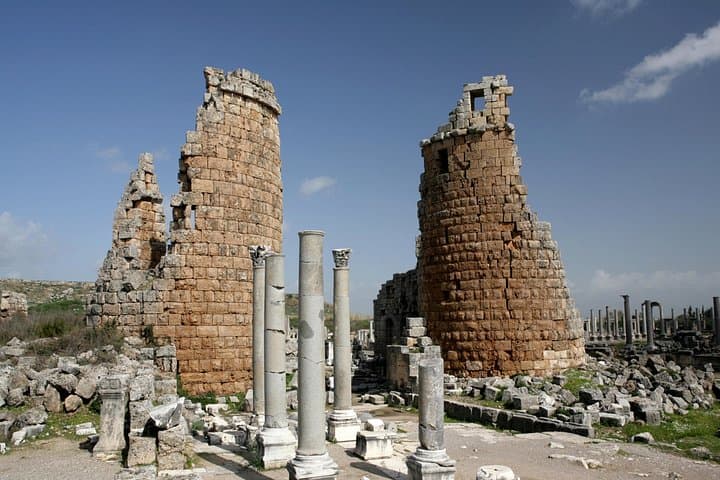
It begins on a morning road that leans toward the Anatolian interior, the bus windows glazing over with citrus orchards and low limestone ridges. By the time the columns of Perge come into view, the sun has softened into the warm clarity that makes carved stone read like a page. Visitors step off and into a living classroom of empire-building: a broad colonnaded street, a Roman stadium built for 12,000, and the acropolis that still holds the footprint of Bronze Age occupation.
It begins on a morning road that leans toward the Anatolian interior, the bus windows glazing over with citrus orchards and low limestone ridges. By the time the columns of Perge come into view, the sun has softened into the warm clarity that makes carved stone read like a page. Visitors step off and into a living classroom of empire-building: a broad colonnaded street, a Roman stadium built for 12,000, and the acropolis that still holds the footprint of Bronze Age occupation.
Perge feels like a city-sized fossil—stones that remember foot traffic, markets and military parades. The route through its forum and baths is an easy 1.5–2 km of uneven flagstone, with short flights of steps leading to viewpoints. From there the tour moves to Kursunlu Waterfall, where the mood shifts. Pine-scented air and a short wooden boardwalk lead you along a 1 km loop; the falls are less a single drop than a series of cascades that push and hush the forest around them. The trail gains roughly 40–60 m in elevation but remains gentle—this is the part of the day meant for listening.
After lunch, the tour finishes at Aspendos, where the Roman amphitheatre dominates the plain. Built in the second century AD and famed for its extraordinary acoustics, Aspendos is intact enough that you can imagine choruses and orators filling it. A walk down the marble aisles and onto the stage reveals why performances are still held here; the space resists time.
Geology here is simple and telling: limestone bedrock sculpted by Mediterranean rains, producing the dry hills and the karst springs that feed Kursunlu. Culturally, this corridor—between Antalya and Side—was a crossroads for Greeks, Romans and later Anatolian states; the archaeology is a direct line through those chapters.
Practical details: the full day runs about eight hours with 3–4 km of walking total, mostly on flat or gently sloping surfaces. Bring sturdy walking shoes—the ruins are uneven and the amphitheatre steps can be slick when damp. Expect temperatures to climb in summer; mornings and late afternoons deliver the most comfortable light and the fewest crowds. Note: sites have limited accessibility and no full wheelchair access.
Tips for timing: arrive at Perge with fresh legs to enjoy the open-air ruins, save the waterfall for midday cool-down, and plan for golden-hour photos at Aspendos if the schedule allows. Respect the stone—don’t climb on unmarked sections—and carry water: shade is limited between sites. For travelers who want history with a short nature interlude, this circuit is a clear, well-paced introduction to Antalya’s layered landscape.