THE ADVENTURE COLLECTIVE® · Independent discovery and booking for outdoor travel

Fly from Tel Aviv to Eilat, cross into Jordan and spend a focused day walking through Petra’s Siq to the iconic Treasury. This full‑day itinerary packs history, geology and desert scenery into a memorable—if long—adventure.
Fly from Tel Aviv to Eilat, cross into Jordan and spend a focused day walking through Petra’s Siq to the iconic Treasury. This full‑day itinerary packs history, geology and desert scenery into a memorable—if long—adventure.
You touch down before dawn at Ramon Airport, the desert light still cool, then slip through customs and cross into Jordan—the road ahead unspools red and ochre. The drive to Petra moves through folded wadis and limestone ridges that seem to dare you to look away; when the Siq narrows you feel the canyon itself guiding you toward the Treasury.
Verified experiences and guided adventures in the surrounding area.
Operated by Bein Harim Ltd · Wadi Musa, Ma'an Governorate
You touch down before dawn at Ramon Airport, the desert light still cool, then slip through customs and cross into Jordan—the road ahead unspools red and ochre. The drive to Petra moves through folded wadis and limestone ridges that seem to dare you to look away; when the Siq narrows you feel the canyon itself guiding you toward the Treasury.
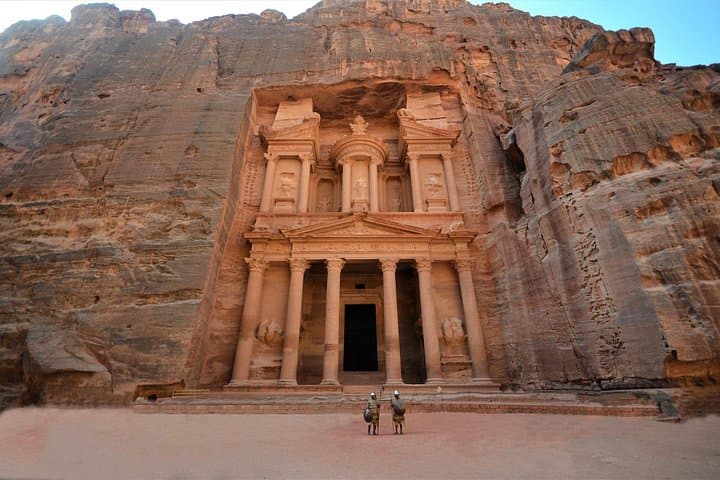
Petra is a Nabataean city carved into sandstone cliffs around 2,300 years ago, its facades weathered into bands of pink, orange and rust. Geologically, the site sits on folded sandstone and conglomerates; the Siq is roughly 1.2 km of sheltered gorge that funnels visitors to Al Khazneh (the Treasury). Cultural layers here run deep—the Nabataeans were skilled traders and water engineers—and today Wadi Musa is the nearest town that serves as basecamp for visitors.
A practical visit on a one-day itinerary gives about 3–4 hours on-site: expect several kilometers of walking over flat stone, packed trails and uneven steps, and a steep climb of roughly 800 steps if you push up to the Monastery (Ad Deir). Border control can add up to an hour, and Jordanian visa fees (paid at the border) are required for many nationalities.
Bring your passport, cash for visas and tips, sturdy footwear, layered sun protection and at least 2–3 liters of water. Start early to avoid midday heat and carry a light daypack; lunch is typically included on this trip. The day is long but compact—history, geology and desert vistas folded into one focused adventure.
Many nationalities require a Jordanian visa; the tour notes a border fee that must be paid in cash (amounts vary). Check your nationality’s entry rules before booking.
Expect several kilometers of walking over uneven ground and stone; the main approach through the Siq to the Treasury is about 1.2 km, and climbing to the Monastery involves roughly 800 steps.
Yes—this tour includes a late lunch at a local restaurant near Petra, timed after your main site visit.
The tour is not recommended for children under 2 and may be difficult for travelers with spinal or serious cardiovascular conditions due to long walking distances and steps.
Bein Harim Ltd operates guided outdoor trips and adventures with an emphasis on safety, stewardship, and memorable experiences.



You touch down before dawn at Ramon Airport, the desert light still cool, then slip through customs and cross into Jordan—the road ahead unspools red and ochre. The drive to Petra moves through folded wadis and limestone ridges that seem to dare you to look away; when the Siq narrows you feel the canyon itself guiding you toward the Treasury.
You touch down before dawn at Ramon Airport, the desert light still cool, then slip through customs and cross into Jordan—the road ahead unspools red and ochre. The drive to Petra moves through folded wadis and limestone ridges that seem to dare you to look away; when the Siq narrows you feel the canyon itself guiding you toward the Treasury.
Petra is a Nabataean city carved into sandstone cliffs around 2,300 years ago, its facades weathered into bands of pink, orange and rust. Geologically, the site sits on folded sandstone and conglomerates; the Siq is roughly 1.2 km of sheltered gorge that funnels visitors to Al Khazneh (the Treasury). Cultural layers here run deep—the Nabataeans were skilled traders and water engineers—and today Wadi Musa is the nearest town that serves as basecamp for visitors.
A practical visit on a one-day itinerary gives about 3–4 hours on-site: expect several kilometers of walking over flat stone, packed trails and uneven steps, and a steep climb of roughly 800 steps if you push up to the Monastery (Ad Deir). Border control can add up to an hour, and Jordanian visa fees (paid at the border) are required for many nationalities.
Bring your passport, cash for visas and tips, sturdy footwear, layered sun protection and at least 2–3 liters of water. Start early to avoid midday heat and carry a light daypack; lunch is typically included on this trip. The day is long but compact—history, geology and desert vistas folded into one focused adventure.