THE ADVENTURE COLLECTIVE® · Independent discovery and booking for outdoor travel

See Petra’s rose-red façades in a long but achievable day trip from Tel Aviv. This practical guide explains what to expect on-site—terrain, timing, and border logistics—so you can focus on the stone-carved wonders.
See Petra’s rose-red façades in a long but achievable day trip from Tel Aviv. This practical guide explains what to expect on-site—terrain, timing, and border logistics—so you can focus on the stone-carved wonders.
You arrive before sunrise, the plane still warm under your feet as the desert air dares you forward. By the time the bus rolls into Wadi Musa the Siq—Petra’s narrow sandstone throat—already narrows into glowing bands of ochre and rose. The Treasury appears like a carved promise, then disappears again as you push deeper where silence presses against the rock.
Verified experiences and guided adventures in the surrounding area.
Operated by Booking-tours.com · Wadi Musa, Ma'an Governorate
You arrive before sunrise, the plane still warm under your feet as the desert air dares you forward. By the time the bus rolls into Wadi Musa the Siq—Petra’s narrow sandstone throat—already narrows into glowing bands of ochre and rose. The Treasury appears like a carved promise, then disappears again as you push deeper where silence presses against the rock.
Petra was the capital of the Nabatean kingdom, carved into Jurassic sandstone and refined by centuries of wind and flash flood. Geology here reads like a layered map—soft, stratified rock that the Nabateans cut with surprising precision. Culturally, the site reflects trade, irrigation ingenuity and Bedouin stewardship; local guides and restaurants still hold Jordanian hospitality at the center of the visit.
Expect uneven stone paths, short steep sections and long, open exposures to sun. The classic walk through the Siq to the Treasury is roughly 1–1.5 km; a climb to the Monastery adds steep stair sections and about 200–300 m of elevation gain if you press on. Most visitors spend 2–4 hours exploring but plan for more if you want quieter vantage points or Little Petra nearby.
Practical notes: carry your passport and allow time for border formalities when traveling from Israel via Eilat/Aqaba; wear sturdy shoes, bring 2–3 liters of water, and layer for desert temperature swings. If you have limited time, prioritize the Siq, Treasury and a viewpoint above the Royal Tombs—each delivers a concentrated sense of Petra’s scale and craftsmanship.
Visa requirements vary by nationality; many visitors obtain a Jordanian visa on arrival, but check entry rules for your passport before travel and ensure passport details are provided at booking.
Yes—the main highlights (Siq, Treasury, Street of Facades) are reachable in a single day, but accessing the Monastery or more remote tombs will require additional time and energy.
Local handlers offer short rides (commonly the first 700m through the Siq) and donkey transport, but tipping and caution are customary; terrain beyond the Siq is better walked for safety.
Jordanian dinar is used in Petra; many vendors accept cards in Wadi Musa, but carry cash for small purchases and tips—small local tips for guides and service staff are customary.
Booking-tours.com operates guided outdoor trips and adventures with an emphasis on safety, stewardship, and memorable experiences.
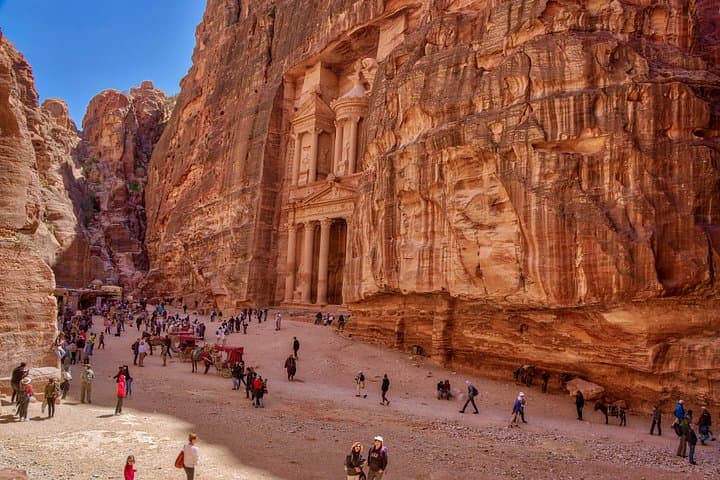


You arrive before sunrise, the plane still warm under your feet as the desert air dares you forward. By the time the bus rolls into Wadi Musa the Siq—Petra’s narrow sandstone throat—already narrows into glowing bands of ochre and rose. The Treasury appears like a carved promise, then disappears again as you push deeper where silence presses against the rock.
You arrive before sunrise, the plane still warm under your feet as the desert air dares you forward. By the time the bus rolls into Wadi Musa the Siq—Petra’s narrow sandstone throat—already narrows into glowing bands of ochre and rose. The Treasury appears like a carved promise, then disappears again as you push deeper where silence presses against the rock.
Petra was the capital of the Nabatean kingdom, carved into Jurassic sandstone and refined by centuries of wind and flash flood. Geology here reads like a layered map—soft, stratified rock that the Nabateans cut with surprising precision. Culturally, the site reflects trade, irrigation ingenuity and Bedouin stewardship; local guides and restaurants still hold Jordanian hospitality at the center of the visit.
Expect uneven stone paths, short steep sections and long, open exposures to sun. The classic walk through the Siq to the Treasury is roughly 1–1.5 km; a climb to the Monastery adds steep stair sections and about 200–300 m of elevation gain if you press on. Most visitors spend 2–4 hours exploring but plan for more if you want quieter vantage points or Little Petra nearby.
Practical notes: carry your passport and allow time for border formalities when traveling from Israel via Eilat/Aqaba; wear sturdy shoes, bring 2–3 liters of water, and layer for desert temperature swings. If you have limited time, prioritize the Siq, Treasury and a viewpoint above the Royal Tombs—each delivers a concentrated sense of Petra’s scale and craftsmanship.