THE ADVENTURE COLLECTIVE® · Independent discovery and booking for outdoor travel

In a single day from Zadar you can walk under curtains of limestone waterfalls, glide across glassy karst lakes by boat, and watch travertine terraces grow before your eyes. This guided day tour packs Plitvice’s highlights into an accessible eight-hour itinerary with transport and entry included.
In a single day from Zadar you can walk under curtains of limestone waterfalls, glide across glassy karst lakes by boat, and watch travertine terraces grow before your eyes. This guided day tour packs Plitvice’s highlights into an accessible eight-hour itinerary with transport and entry included.
You step off the van into a cold pocket of air and the first thing you notice is water: the steady hiss of falls, the gentle slap of lake against boardwalk, the smell of mineral-rich mist. Plitvice Lakes National Park pulls you into a landscape that moves — not because anything here is loud, but because the land is literally rearranging itself. Travertine barriers grow slowly, waterfalls carve new paths, and every wooden boardwalk is laid across a living, evolving shoreline.
Verified experiences and guided adventures in the surrounding area.
Operated by Zagreb Travel · Plitvička Jezera, Lika-Senj
You step off the van into a cold pocket of air and the first thing you notice is water: the steady hiss of falls, the gentle slap of lake against boardwalk, the smell of mineral-rich mist. Plitvice Lakes National Park pulls you into a landscape that moves — not because anything here is loud, but because the land is literally rearranging itself. Travertine barriers grow slowly, waterfalls carve new paths, and every wooden boardwalk is laid across a living, evolving shoreline.
The day tour from Zadar condenses that slow-motion geology into a compact eight-hour loop. After a two-hour coastal-to-karst drive through Lika’s rolling hills, the group threads into Entrance 1. Here the itinerary unfolds: a walking circuit across the Lower Lakes threads past the park’s signature cascades and the plunging Veliki Slap (Big Waterfall), then a short boat ride ferries you across the Upper Lakes to explore quieter basins and mirrored coves. Guides point out travertine formations — porous limestone precipitated by mineral-laden water — and explain how vegetation and water chemistry build the park’s tiered terraces.
Plitvice’s story mixes natural science with human history. Protected in 1949 and declared a UNESCO World Heritage Site in 1979, the park sits in Lika, a region shaped by pastoral life and wartime histories. On the way, many drivers will pass Rastoke, a mill village where water has powered industry for centuries — a neat cultural coda to the park’s water-first narrative.
Practicalities anchor the romance: the tour includes pickup in Zadar, air-conditioned transport, a licensed guide, and entrance tickets; expect roughly four hours inside the park and two hours each way driving. Boardwalks are mostly flat but include steps and slick planks near falls; hikers should be prepared for mud after rain and crowds in peak summer. Facilities and cafés sit close to the main entrances but bring your own water and snacks if you need flexibility.
Timing matters. Early departures score softer light and smaller crowds at Veliki Slap; late afternoons bring warmer tones and quieter upper basins. Respect park rules — no swimming, stay on trails, pack out waste — because the travertine builds only when the ecosystem is left intact.
At day’s end you return toward the Adriatic, pockets full of photographs and the slow, stubborn memory of water reshaping stone. For travelers based in Zadar who want a single-day immersion into Croatia’s most photographed park, this tour pairs accessible logistics with a tangible sense of place: a lesson in geology, a slice of Lika culture, and a straightforward outdoor day that rewards both curiosity and common sense.
Expect about a two-hour drive each way depending on traffic; the full trip runs roughly 6–8 hours including park time.
Yes — this tour includes entrance tickets to Plitvice Lakes National Park in the price.
Yes — the tour is family-friendly; infant seats are available but note that some sections have stairs and uneven surfaces.
Parts of the route use boardwalks that are relatively flat, but there are stairs and some narrow sections; travelers with significant mobility limitations should contact the operator beforehand.
Yes — there are restrooms and cafés near the main entrances and at key stops, but bringing snacks and water is recommended for flexibility.
No — swimming is prohibited to protect the travertine formations and water quality.
Zagreb Travel operates guided outdoor trips and adventures with an emphasis on safety, stewardship, and memorable experiences.
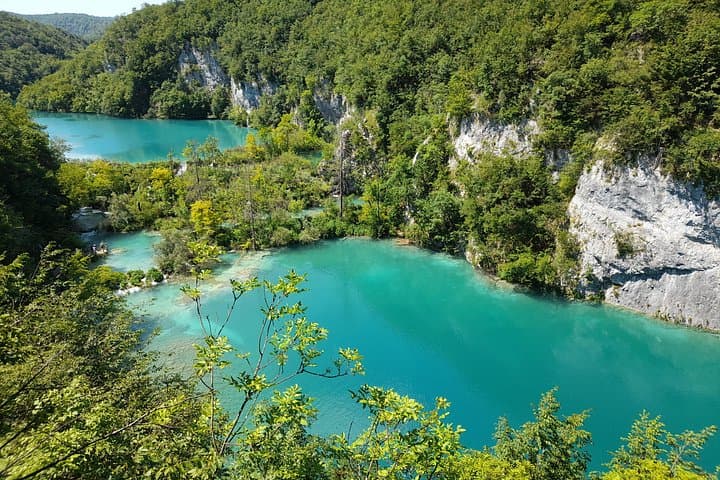


You step off the van into a cold pocket of air and the first thing you notice is water: the steady hiss of falls, the gentle slap of lake against boardwalk, the smell of mineral-rich mist. Plitvice Lakes National Park pulls you into a landscape that moves — not because anything here is loud, but because the land is literally rearranging itself. Travertine barriers grow slowly, waterfalls carve new paths, and every wooden boardwalk is laid across a living, evolving shoreline.
You step off the van into a cold pocket of air and the first thing you notice is water: the steady hiss of falls, the gentle slap of lake against boardwalk, the smell of mineral-rich mist. Plitvice Lakes National Park pulls you into a landscape that moves — not because anything here is loud, but because the land is literally rearranging itself. Travertine barriers grow slowly, waterfalls carve new paths, and every wooden boardwalk is laid across a living, evolving shoreline.
The day tour from Zadar condenses that slow-motion geology into a compact eight-hour loop. After a two-hour coastal-to-karst drive through Lika’s rolling hills, the group threads into Entrance 1. Here the itinerary unfolds: a walking circuit across the Lower Lakes threads past the park’s signature cascades and the plunging Veliki Slap (Big Waterfall), then a short boat ride ferries you across the Upper Lakes to explore quieter basins and mirrored coves. Guides point out travertine formations — porous limestone precipitated by mineral-laden water — and explain how vegetation and water chemistry build the park’s tiered terraces.
Plitvice’s story mixes natural science with human history. Protected in 1949 and declared a UNESCO World Heritage Site in 1979, the park sits in Lika, a region shaped by pastoral life and wartime histories. On the way, many drivers will pass Rastoke, a mill village where water has powered industry for centuries — a neat cultural coda to the park’s water-first narrative.
Practicalities anchor the romance: the tour includes pickup in Zadar, air-conditioned transport, a licensed guide, and entrance tickets; expect roughly four hours inside the park and two hours each way driving. Boardwalks are mostly flat but include steps and slick planks near falls; hikers should be prepared for mud after rain and crowds in peak summer. Facilities and cafés sit close to the main entrances but bring your own water and snacks if you need flexibility.
Timing matters. Early departures score softer light and smaller crowds at Veliki Slap; late afternoons bring warmer tones and quieter upper basins. Respect park rules — no swimming, stay on trails, pack out waste — because the travertine builds only when the ecosystem is left intact.
At day’s end you return toward the Adriatic, pockets full of photographs and the slow, stubborn memory of water reshaping stone. For travelers based in Zadar who want a single-day immersion into Croatia’s most photographed park, this tour pairs accessible logistics with a tangible sense of place: a lesson in geology, a slice of Lika culture, and a straightforward outdoor day that rewards both curiosity and common sense.