THE ADVENTURE COLLECTIVE® · Independent discovery and booking for outdoor travel

An eight-day blend of guided trekking and daily yoga in the Annapurna foothills around Pokhara. Move through forested ridges, traditional villages and ridge-top yoga sessions while gaining panoramic Himalayan views.
An eight-day blend of guided trekking and daily yoga in the Annapurna foothills around Pokhara. Move through forested ridges, traditional villages and ridge-top yoga sessions while gaining panoramic Himalayan views.
Morning in the Annapurna foothills begins with mist unraveling from terraces and a bell-like hush that makes deep breaths feel new.
Verified experiences and guided adventures in the surrounding area.
Morning in the Annapurna foothills begins with mist unraveling from terraces and a bell-like hush that makes deep breaths feel new.
This eight-day Pokhara-based yoga trek threads narrow stone steps, rhododendron forests and small Gurung and Magar villages where morning puja and animal bells are part of the day’s rhythm. The route sits in the southern flank of the Annapurna range—geology of folded sedimentary rock uplifted by the collision of the Indian and Eurasian plates—so ridgelines afford sudden, raw views of snow-capped summits that seem to push the sky aside.
Culturally, the trek moves through communities long linked to trans-Himalayan trade and local agricultural cycles; you’ll encounter simple tea houses, terraced fields and villagers who balance subsistence farming with guesthouse hosting. Yoga and meditation sessions are scheduled to ground long walking days—breathing work for tight legs, gentle flows to open hips after stair-like climbs.
Expect mixed terrain: packed dirt, loose scree on steeper approaches, frequent stone steps and short forest climbs. Typical daily hiking 4–7 hours, with cumulative distance around 40–70 km and single-day elevation changes up to ~1,000–1,200 m on steeper sections. Nights are usually in village guesthouses (simple rooms, shared bathrooms) at 1,000–2,000 m.
Practical notes: arrive in Pokhara to acclimatize a day, carry layered clothing for sun and cold at dawn, bring waterproofs for monsoon season, and plan to use trekking poles on steep descents. The rhythm here is deliberate—trail, breath, village, repeat.
Plan on 4–7 hours of hiking per day depending on the itinerary and acclimatization rest; some days have longer ascents or descents.
Stays are usually in village guesthouses (teahouses) with simple rooms, shared bathrooms and basic hot meals.
No — sessions are designed for a range of abilities, with options for gentle and restorative practices after walks.
Guides lead group logistics, cultural interpretation and safety; hiring a local guide is strongly recommended for navigation and community connection.
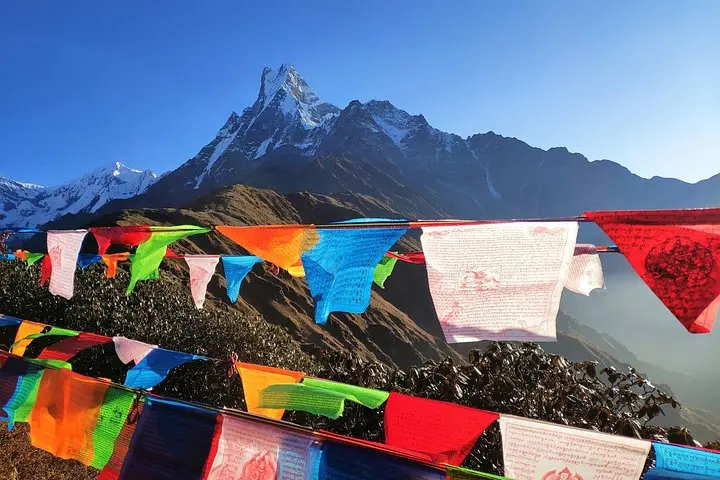
Morning in the Annapurna foothills begins with mist unraveling from terraces and a bell-like hush that makes deep breaths feel new.
Morning in the Annapurna foothills begins with mist unraveling from terraces and a bell-like hush that makes deep breaths feel new.
This eight-day Pokhara-based yoga trek threads narrow stone steps, rhododendron forests and small Gurung and Magar villages where morning puja and animal bells are part of the day’s rhythm. The route sits in the southern flank of the Annapurna range—geology of folded sedimentary rock uplifted by the collision of the Indian and Eurasian plates—so ridgelines afford sudden, raw views of snow-capped summits that seem to push the sky aside.
Culturally, the trek moves through communities long linked to trans-Himalayan trade and local agricultural cycles; you’ll encounter simple tea houses, terraced fields and villagers who balance subsistence farming with guesthouse hosting. Yoga and meditation sessions are scheduled to ground long walking days—breathing work for tight legs, gentle flows to open hips after stair-like climbs.
Expect mixed terrain: packed dirt, loose scree on steeper approaches, frequent stone steps and short forest climbs. Typical daily hiking 4–7 hours, with cumulative distance around 40–70 km and single-day elevation changes up to ~1,000–1,200 m on steeper sections. Nights are usually in village guesthouses (simple rooms, shared bathrooms) at 1,000–2,000 m.
Practical notes: arrive in Pokhara to acclimatize a day, carry layered clothing for sun and cold at dawn, bring waterproofs for monsoon season, and plan to use trekking poles on steep descents. The rhythm here is deliberate—trail, breath, village, repeat.