THE ADVENTURE COLLECTIVE® · Independent discovery and booking for outdoor travel

Walk from Pokhara to Ghorepani for a sunrise over Annapurna and Dhaulagiri, then descend to Tatopani for a soak in natural hot springs. This accessible 9-day itinerary blends teahouse trekking, Gurung villages, and panoramic viewpoints.
Walk from Pokhara to Ghorepani for a sunrise over Annapurna and Dhaulagiri, then descend to Tatopani for a soak in natural hot springs. This accessible 9-day itinerary blends teahouse trekking, Gurung villages, and panoramic viewpoints.
Dawn on Poon Hill arrives like a slow reveal: first a rim of pink, then the cold white teeth of Annapurna and Dhaulagiri catching light. Trekkers rise before the village of Ghorepani and climb a short stone stairway to the viewpoint where the Himalaya push the sky outward and the air tastes of pine smoke and metal-cold altitude.
Verified experiences and guided adventures in the surrounding area.
Operated by himalayan sanctuary adventure private limited · Ghorepani / Tatopani region, Gandaki Province
Dawn on Poon Hill arrives like a slow reveal: first a rim of pink, then the cold white teeth of Annapurna and Dhaulagiri catching light. Trekkers rise before the village of Ghorepani and climb a short stone stairway to the viewpoint where the Himalaya push the sky outward and the air tastes of pine smoke and metal-cold altitude.
The route follows ancient mule tracks through Gurung villages, oak and rhododendron stands, and terraces that recall generations of mountain farming. Geologically the trail skirts the Annapurna massif—a mix of metamorphic and sedimentary rock uplifted by the collision of the Indian and Eurasian plates—giving way to steep, narrow valleys and the deep gorge of the Kali Gandaki below. Culturally the Ghorepani–Tatopani corridor is Gurung country: you’ll pass simple teahouses, chorten markers, and terraced fields where yak and hens share space.
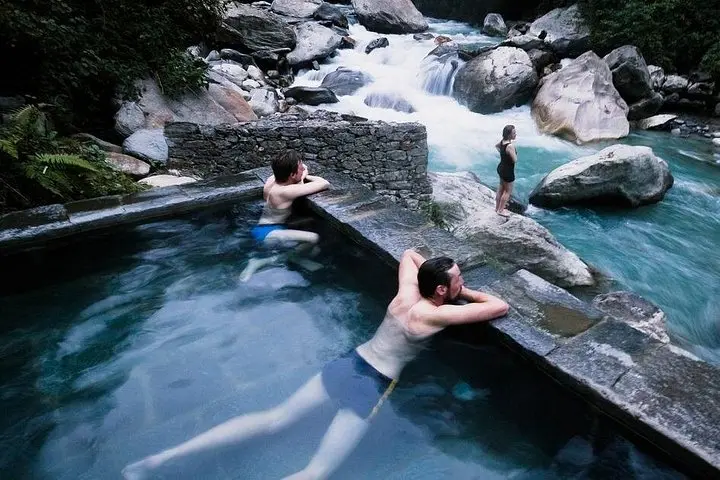
Practicalities matter: expect daily walking of 4–8 hours, sections of steep stone steps and loose scree, and an ascent to Poon Hill at about 3,210 m. Nights are spent in basic teahouses; porters carry up to 15 kg per guest. The payoff is both sunrise panoramas and a soak at Jhinu Danda/Tatopani hot springs—natural pools that feel like a relief valve after dusty miles. Bring warm layers for pre-dawn, waterproofs for monsoon months, and a headlamp for early starts. Hydrate steadily and pace uphill: altitude is moderate but unforgiving to hurried breathing. With simple preparation, this itinerary balances accessible hiking with Himalayan spectacle and a restorative hot-spring finish.
Graded easy to moderate: daily walks range from 4–9 hours with some sustained climbs to Ghorepani and Poon Hill; technical skills are not required.
Jhinu Danda/Tatopani hot springs are year-round, but heavy monsoon rains (July–August) can make trails slippery and access more difficult.
A guide is recommended for logistics and safety; TIMS and Annapurna Conservation Area permits are required and usually arranged by operators.
Basic teahouses offering simple twin rooms and shared bathrooms; meals are hearty local fare, and hot showers may be limited or extra.
himalayan sanctuary adventure private limited operates guided outdoor trips and adventures with an emphasis on safety, stewardship, and memorable experiences.
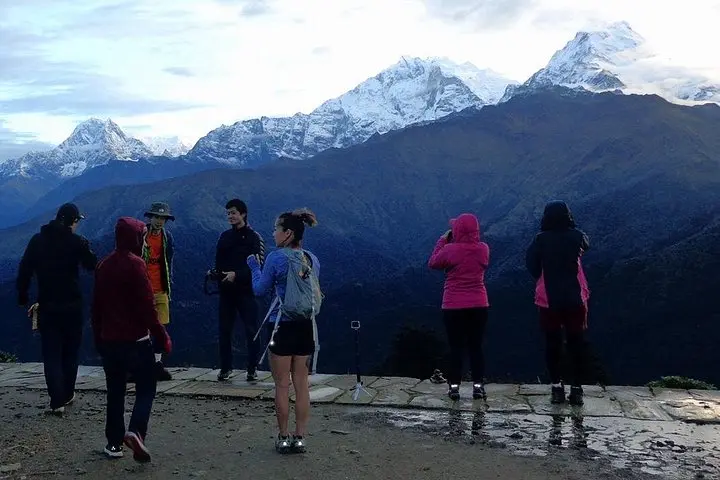
Dawn on Poon Hill arrives like a slow reveal: first a rim of pink, then the cold white teeth of Annapurna and Dhaulagiri catching light. Trekkers rise before the village of Ghorepani and climb a short stone stairway to the viewpoint where the Himalaya push the sky outward and the air tastes of pine smoke and metal-cold altitude.
Dawn on Poon Hill arrives like a slow reveal: first a rim of pink, then the cold white teeth of Annapurna and Dhaulagiri catching light. Trekkers rise before the village of Ghorepani and climb a short stone stairway to the viewpoint where the Himalaya push the sky outward and the air tastes of pine smoke and metal-cold altitude.
The route follows ancient mule tracks through Gurung villages, oak and rhododendron stands, and terraces that recall generations of mountain farming. Geologically the trail skirts the Annapurna massif—a mix of metamorphic and sedimentary rock uplifted by the collision of the Indian and Eurasian plates—giving way to steep, narrow valleys and the deep gorge of the Kali Gandaki below. Culturally the Ghorepani–Tatopani corridor is Gurung country: you’ll pass simple teahouses, chorten markers, and terraced fields where yak and hens share space.
Practicalities matter: expect daily walking of 4–8 hours, sections of steep stone steps and loose scree, and an ascent to Poon Hill at about 3,210 m. Nights are spent in basic teahouses; porters carry up to 15 kg per guest. The payoff is both sunrise panoramas and a soak at Jhinu Danda/Tatopani hot springs—natural pools that feel like a relief valve after dusty miles. Bring warm layers for pre-dawn, waterproofs for monsoon months, and a headlamp for early starts. Hydrate steadily and pace uphill: altitude is moderate but unforgiving to hurried breathing. With simple preparation, this itinerary balances accessible hiking with Himalayan spectacle and a restorative hot-spring finish.