THE ADVENTURE COLLECTIVE® · Independent discovery and booking for outdoor travel

Witness a Himalayan sunrise from Poon Hill on a condensed two-day trek from Pokhara—stone steps, rhododendron forests and guest‑house nights deliver big mountain views with compact logistics. Perfect for travelers seeking a short, high-reward Himalayan experience.
Witness a Himalayan sunrise from Poon Hill on a condensed two-day trek from Pokhara—stone steps, rhododendron forests and guest‑house nights deliver big mountain views with compact logistics. Perfect for travelers seeking a short, high-reward Himalayan experience.
Before dawn, a headlamp-lit line of trekkers threads up the stone steps toward Poon Hill. The air is thin and cold at 3,210 m; stars give way to a raw horizon and, minutes later, a sweep of white peaks—Annapurna South, Hiunchuli, Dhaulagiri—catch the first light. That concentrated sunrise moment is the trip’s reason for being, but the route itself is a concise crash course in Annapurna’s landscape.
Verified experiences and guided adventures in the surrounding area.
Operated by Couch Adventure Nepal (CAN) · Pokhara, Gandaki Province
Before dawn, a headlamp-lit line of trekkers threads up the stone steps toward Poon Hill. The air is thin and cold at 3,210 m; stars give way to a raw horizon and, minutes later, a sweep of white peaks—Annapurna South, Hiunchuli, Dhaulagiri—catch the first light. That concentrated sunrise moment is the trip’s reason for being, but the route itself is a concise crash course in Annapurna’s landscape.
The two-day loop begins with a three-hour jeep ride from Pokhara to Tirkhedhunga (≈1,480 m) and a steady climb through rhododendron forests and terraced villages to Ghorepani (≈2,800 m). The geology here is Himalayan fold and fault: steep valley walls, layered metamorphic rock, and narrow ridgelines that frame broad panoramic bowls. Culturally, the trail passes Gurung and Magar villages where tea houses offer dal bhat and a place to dry boots; these settlements evolved alongside traditional mule and porter routes used for seasonal trade.
Practical guidance: expect long stair sections and uneven stone steps—moderate fitness is required. The climb to Poon Hill is typically started before 4:00 a.m. for sunrise; bring a headlamp, warm layers, and waterproofs. TIMS card and permits are standard and often handled by operators. Accommodation is in basic guest houses—book or confirm transfers as the itinerary includes a 4WD connection back to Pokhara.
Plan for altitude acclimatization even on short treks, hydrate, and pace uphill to reduce strain. Weather shifts quickly: clear sun can give way to wind or fog that hides the view but exposes intimate forest light and birdlife. For travelers wanting a compact, high-reward Himalayan experience, this two-day trek delivers big mountain panoramas with minimal logistics.
Yes—trekkers require a TIMS card and entry to the Annapurna Conservation Area; many operators include these in the package.
The summit trek is steep with many stone steps but short; overall the two-day itinerary is moderate and suitable for hikers with basic fitness.
Clear mountain views are most reliable in spring (March–May) and fall (September–November); winters are cold and summers bring monsoon clouds.
Yes—this trip includes one night in a Ghorepani guest house; expect simple rooms and communal dining.
Couch Adventure Nepal (CAN) operates guided outdoor trips and adventures with an emphasis on safety, stewardship, and memorable experiences.
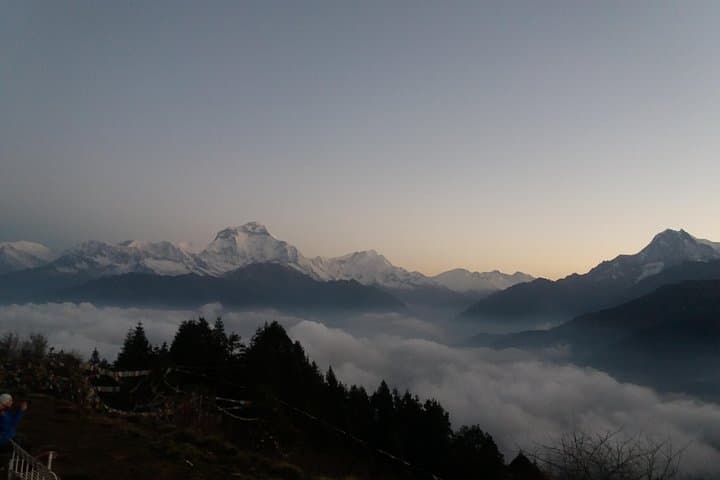


Before dawn, a headlamp-lit line of trekkers threads up the stone steps toward Poon Hill. The air is thin and cold at 3,210 m; stars give way to a raw horizon and, minutes later, a sweep of white peaks—Annapurna South, Hiunchuli, Dhaulagiri—catch the first light. That concentrated sunrise moment is the trip’s reason for being, but the route itself is a concise crash course in Annapurna’s landscape.
Before dawn, a headlamp-lit line of trekkers threads up the stone steps toward Poon Hill. The air is thin and cold at 3,210 m; stars give way to a raw horizon and, minutes later, a sweep of white peaks—Annapurna South, Hiunchuli, Dhaulagiri—catch the first light. That concentrated sunrise moment is the trip’s reason for being, but the route itself is a concise crash course in Annapurna’s landscape.
The two-day loop begins with a three-hour jeep ride from Pokhara to Tirkhedhunga (≈1,480 m) and a steady climb through rhododendron forests and terraced villages to Ghorepani (≈2,800 m). The geology here is Himalayan fold and fault: steep valley walls, layered metamorphic rock, and narrow ridgelines that frame broad panoramic bowls. Culturally, the trail passes Gurung and Magar villages where tea houses offer dal bhat and a place to dry boots; these settlements evolved alongside traditional mule and porter routes used for seasonal trade.
Practical guidance: expect long stair sections and uneven stone steps—moderate fitness is required. The climb to Poon Hill is typically started before 4:00 a.m. for sunrise; bring a headlamp, warm layers, and waterproofs. TIMS card and permits are standard and often handled by operators. Accommodation is in basic guest houses—book or confirm transfers as the itinerary includes a 4WD connection back to Pokhara.
Plan for altitude acclimatization even on short treks, hydrate, and pace uphill to reduce strain. Weather shifts quickly: clear sun can give way to wind or fog that hides the view but exposes intimate forest light and birdlife. For travelers wanting a compact, high-reward Himalayan experience, this two-day trek delivers big mountain panoramas with minimal logistics.