THE ADVENTURE COLLECTIVE® · Independent discovery and booking for outdoor travel

Explore Portland’s high and intimate viewpoints on a three-hour tour that moves from downtown plazas to a newspaper baron’s summit view, through the Rose Test Garden, and along the South Waterfront. Perfect for first-time visitors who want context, smell the roses, and sample a local doughnut.
Explore Portland’s high and intimate viewpoints on a three-hour tour that moves from downtown plazas to a newspaper baron’s summit view, through the Rose Test Garden, and along the South Waterfront. Perfect for first-time visitors who want context, smell the roses, and sample a local doughnut.
A mid-morning drizzle parts as the van eases away from Director Park and the city exhales. Portland presents itself in layers: gridded streets give way to broad, planted plazas, then slopes of forest and manicured terraces. On this three-hour circuit, the guide points out sculpted bike art and the angles of cast-iron buildings before the pavement slopes up toward King’s Heights, where a newspaper baron once held court over the city.
Verified experiences and guided adventures in the surrounding area.
Operated by Around Portland Tours · Portland, Oregon
A mid-morning drizzle parts as the van eases away from Director Park and the city exhales. Portland presents itself in layers: gridded streets give way to broad, planted plazas, then slopes of forest and manicured terraces. On this three-hour circuit, the guide points out sculpted bike art and the angles of cast-iron buildings before the pavement slopes up toward King’s Heights, where a newspaper baron once held court over the city.
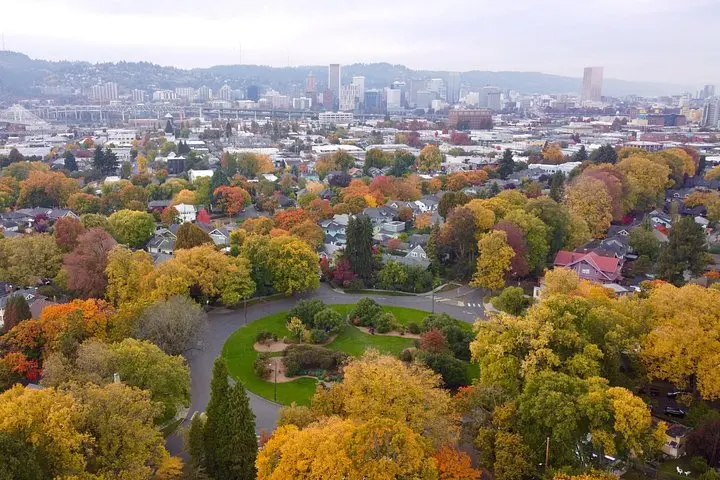
At the summit you step onto a lawn that still reads like a map of civic ambition — sweeping sightlines toward downtown and the Willamette River, the city arranged in human scale below. The mansion’s grounds frame the view; you won’t enter the house, but the panorama does the same work, explaining why Portland developed the way it did: commerce on flat streets, culture on ridgelines.
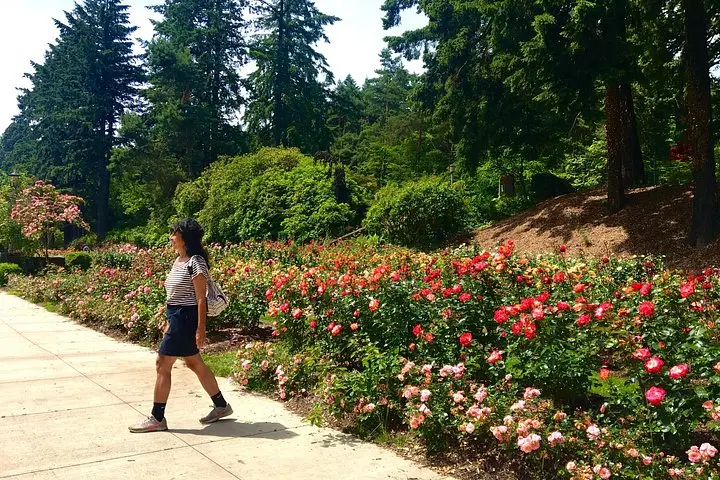
Downhill, the tour moves through Washington Park’s quieter rooms: a secret garden tucked behind hedgerows and the International Rose Test Garden’s terraces. In season the roses insist on attention; their fragrance cuts through the urban air, an olfactory footnote to Portland’s nickname, the Rose City. When blooms are thin, the group may detour to Hoyt Arboretum, where fir and maple trunks tilt like columns in a small cathedral of the Northwest.
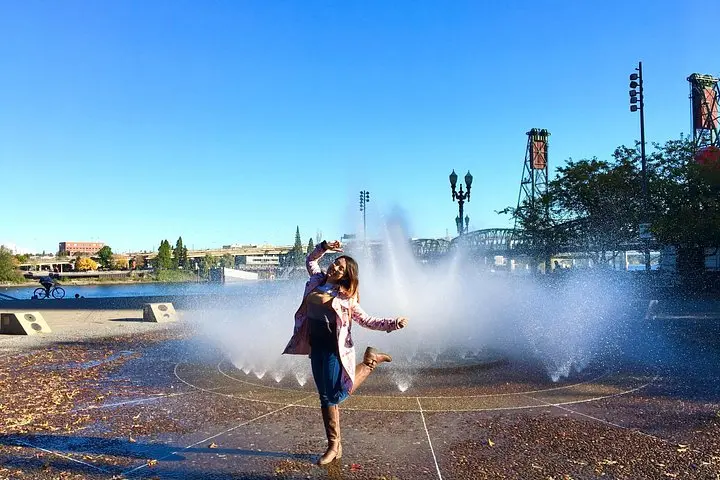
The route finishes with a contrast — South Waterfront’s modern glass and the engineering flourish of the Tilikum Crossing and aerial tram — a telling juxtaposition of an older, human-scaled city and the new, transit-oriented neighborhood reshaping the riverbanks. And, because this is Portland, there’s a stop for a local doughnut and a quick debrief of food and coffee suggestions before you’re returned downtown.
History and geology are threaded through the conversation: the rise of timber and newspapers that built the city’s 19th-century fortunes, the volcanic soils and Pleistocene floods that shaped the river terraces, and civic attempts to keep green space central to urban life. Culturally, the tour reads like a primer — public art, the bookstore culture, and the food-cart scene’s influence on contemporary neighborhoods.
Practical notes: expect light walking (short paved paths and garden steps), roughly 0.5–1.0 mile on foot total and around 150–200 feet of cumulative elevation change at King’s Heights. Wear shoes suitable for city walking and garden paths, bring a light rain layer during cooler months, and carry a camera with a wide-angle option for skyline-to-rose-capture shots. The tour is family-friendly, stroller accessible, includes a morning treat and bottled water, and is paced for travelers who prefer interpretation over long hikes.
Meet and finish at the southeast corner of Director Park (SW Park Ave & SW Taylor St). The guide will wait in the plaza area.
The tour is stroller-accessible and suited for many mobility levels; note that garden paths and some steps exist—contact the operator if full wheelchair access is required.
A morning treat (such as a doughnut) and bottled water are included in the tour price.
The tour runs in light rain—bring a rain layer; cancellations for severe weather follow the operator’s policy and require at least 24-hour notice for refund.
No interior admissions are included; the tour visits mansion grounds and overlooks but does not enter paid buildings.
Yes—Director Park is well-served by downtown transit lines, and the guide can suggest routes for onward travel.
Around Portland Tours operates guided outdoor trips and adventures with an emphasis on safety, stewardship, and memorable experiences.

A mid-morning drizzle parts as the van eases away from Director Park and the city exhales. Portland presents itself in layers: gridded streets give way to broad, planted plazas, then slopes of forest and manicured terraces. On this three-hour circuit, the guide points out sculpted bike art and the angles of cast-iron buildings before the pavement slopes up toward King’s Heights, where a newspaper baron once held court over the city.
A mid-morning drizzle parts as the van eases away from Director Park and the city exhales. Portland presents itself in layers: gridded streets give way to broad, planted plazas, then slopes of forest and manicured terraces. On this three-hour circuit, the guide points out sculpted bike art and the angles of cast-iron buildings before the pavement slopes up toward King’s Heights, where a newspaper baron once held court over the city.
At the summit you step onto a lawn that still reads like a map of civic ambition — sweeping sightlines toward downtown and the Willamette River, the city arranged in human scale below. The mansion’s grounds frame the view; you won’t enter the house, but the panorama does the same work, explaining why Portland developed the way it did: commerce on flat streets, culture on ridgelines.
Downhill, the tour moves through Washington Park’s quieter rooms: a secret garden tucked behind hedgerows and the International Rose Test Garden’s terraces. In season the roses insist on attention; their fragrance cuts through the urban air, an olfactory footnote to Portland’s nickname, the Rose City. When blooms are thin, the group may detour to Hoyt Arboretum, where fir and maple trunks tilt like columns in a small cathedral of the Northwest.
The route finishes with a contrast — South Waterfront’s modern glass and the engineering flourish of the Tilikum Crossing and aerial tram — a telling juxtaposition of an older, human-scaled city and the new, transit-oriented neighborhood reshaping the riverbanks. And, because this is Portland, there’s a stop for a local doughnut and a quick debrief of food and coffee suggestions before you’re returned downtown.
History and geology are threaded through the conversation: the rise of timber and newspapers that built the city’s 19th-century fortunes, the volcanic soils and Pleistocene floods that shaped the river terraces, and civic attempts to keep green space central to urban life. Culturally, the tour reads like a primer — public art, the bookstore culture, and the food-cart scene’s influence on contemporary neighborhoods.
Practical notes: expect light walking (short paved paths and garden steps), roughly 0.5–1.0 mile on foot total and around 150–200 feet of cumulative elevation change at King’s Heights. Wear shoes suitable for city walking and garden paths, bring a light rain layer during cooler months, and carry a camera with a wide-angle option for skyline-to-rose-capture shots. The tour is family-friendly, stroller accessible, includes a morning treat and bottled water, and is paced for travelers who prefer interpretation over long hikes.