THE ADVENTURE COLLECTIVE® · Independent discovery and booking for outdoor travel

Soar above Paestum’s ancient Doric temples and the Cilento shoreline on a powered paraglider. This half-hour flight delivers unique perspectives of Greece’s legacy in Italy and sweeping coastal views—best in calm morning or late-afternoon conditions.
Soar above Paestum’s ancient Doric temples and the Cilento shoreline on a powered paraglider. This half-hour flight delivers unique perspectives of Greece’s legacy in Italy and sweeping coastal views—best in calm morning or late-afternoon conditions.
You lift off from low, grassy dunes and the world opens: Doric columns shrink beneath you while the Tyrrhenian Sea stretches to the horizon, its surface silvered by a coastal breeze that seems to push you forward. The pilot trims the motor; below, the three great temples of Paestum—silent since the Greeks—line up like markers on a map of time.
Verified experiences and guided adventures in the surrounding area.
You lift off from low, grassy dunes and the world opens: Doric columns shrink beneath you while the Tyrrhenian Sea stretches to the horizon, its surface silvered by a coastal breeze that seems to push you forward. The pilot trims the motor; below, the three great temples of Paestum—silent since the Greeks—line up like markers on a map of time.
Paestum began as the Greek colony Poseidonia around the 6th century BCE; its temples are some of the best-preserved Doric structures outside mainland Greece. Geologically the plain is recent alluvial—long, flat fields that meet limestone bluffs along the Cilento coast—so flights feel low, intimate, and panoramic. Local culture still orbits agriculture: buffalo mozzarella dairies, olive groves and small fishing ports. From the air you can sense that relationship—fields, canals and coastal terraces forming a lived landscape.
Practical notes: flights are short (about 30 minutes in the air) but thorough—briefing, setup and photos push the appointment closer to an hour. Operators handle the technical flying; expect to run a few steps for takeoff and a brief run at landing. Weather rules the schedule—sea breezes, gust fronts, and sudden thermals can shift plans.
Bring sturdy shoes, a windproof layer, and a camera with a strap. Book morning or late-afternoon slots for softer light and calmer winds. Respect restricted zones and follow your pilot’s instructions—archaeology and local farms are protected. From sky to shore, this is a flight that reframes Paestum: history below, coast ahead, and the wind urging you onward.
The aerial portion is about 30 minutes; including briefing and setup, expect 45–60 minutes at the site.
Yes—operators commonly enforce minimum age and maximum weight limits for safety; check the provider’s rules when booking.
Flights are weather-dependent; strong winds, rain or low cloud will prompt a reschedule or refund per the operator’s policy.
Yes—most pilots allow passengers to use handheld cameras or phones with straps; ask about helmet mounts if you want hands-free footage.
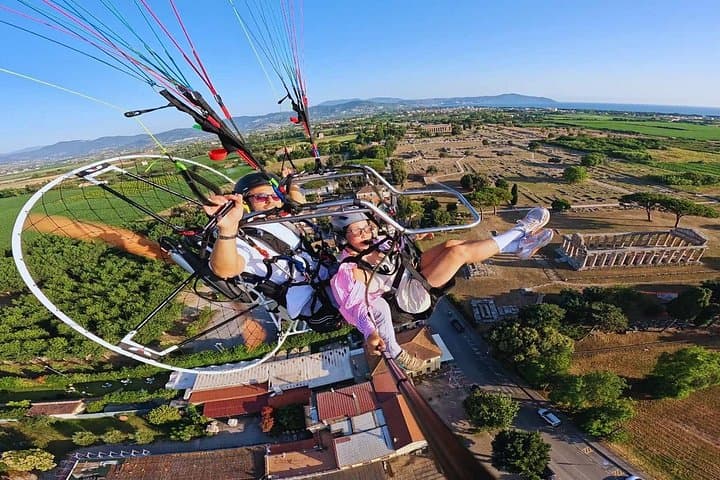
You lift off from low, grassy dunes and the world opens: Doric columns shrink beneath you while the Tyrrhenian Sea stretches to the horizon, its surface silvered by a coastal breeze that seems to push you forward. The pilot trims the motor; below, the three great temples of Paestum—silent since the Greeks—line up like markers on a map of time.
You lift off from low, grassy dunes and the world opens: Doric columns shrink beneath you while the Tyrrhenian Sea stretches to the horizon, its surface silvered by a coastal breeze that seems to push you forward. The pilot trims the motor; below, the three great temples of Paestum—silent since the Greeks—line up like markers on a map of time.
Paestum began as the Greek colony Poseidonia around the 6th century BCE; its temples are some of the best-preserved Doric structures outside mainland Greece. Geologically the plain is recent alluvial—long, flat fields that meet limestone bluffs along the Cilento coast—so flights feel low, intimate, and panoramic. Local culture still orbits agriculture: buffalo mozzarella dairies, olive groves and small fishing ports. From the air you can sense that relationship—fields, canals and coastal terraces forming a lived landscape.
Practical notes: flights are short (about 30 minutes in the air) but thorough—briefing, setup and photos push the appointment closer to an hour. Operators handle the technical flying; expect to run a few steps for takeoff and a brief run at landing. Weather rules the schedule—sea breezes, gust fronts, and sudden thermals can shift plans.
Bring sturdy shoes, a windproof layer, and a camera with a strap. Book morning or late-afternoon slots for softer light and calmer winds. Respect restricted zones and follow your pilot’s instructions—archaeology and local farms are protected. From sky to shore, this is a flight that reframes Paestum: history below, coast ahead, and the wind urging you onward.