THE ADVENTURE COLLECTIVE® · Independent discovery and booking for outdoor travel

Trek across a winter-slicked trail to Preikestolen (Pulpit Rock) with a professional guide, crampons, and a hot meal waiting after the descent. This guided winter hike balances safety and spectacle — ideal for hikers comfortable on icy terrain.
Trek across a winter-slicked trail to Preikestolen (Pulpit Rock) with a professional guide, crampons, and a hot meal waiting after the descent. This guided winter hike balances safety and spectacle — ideal for hikers comfortable on icy terrain.
A low winter sun slices across Lysefjord as your vehicle eases away from Stavanger and the road narrows toward the mountain. By the time you step out at Preikestolen Basecamp the air is clean and metallic; the trail ahead is a series of packed snow steps, low shrubs bending under frost, and the occasional wind that seems to try the soles of your boots.
Verified experiences and guided adventures in the surrounding area.
Operated by Fjord Hikes · Jørpeland, Rogaland
A low winter sun slices across Lysefjord as your vehicle eases away from Stavanger and the road narrows toward the mountain. By the time you step out at Preikestolen Basecamp the air is clean and metallic; the trail ahead is a series of packed snow steps, low shrubs bending under frost, and the occasional wind that seems to try the soles of your boots.
Preikestolen (Pulpit Rock) is an ice-age cliff formed as glaciers scoured the fjord about 10,000 years ago — a sheer 604‑meter drop to the water below. The route climbs roughly 350 meters over about 3.8 km one-way on a mix of rocky trail, wooden stairs, and snowfields. Local guides draw on mountain navigation traditions from Rogaland and can detour to small, lesser-seen viewpoints when conditions allow.
In winter the mountain becomes a different animal: trails harden, edges sharpen, and the fjord below demands your attention. Guides supply crampons and poles, lead at a sensible pace (about 2.5 hours ascent, ~2 hours descent), and stop for hot berry juice and a snack before a hot meal at descent.
Practical guidance: start layered — a breathable base, insulated mid, and waterproof shell — and bring waterproof boots with good traction. Hydrate before and during the hike; fingers and toes cool faster in wind-exposed sections. Check local forecasts and accept that guides will cancel in unsafe conditions. Expect moderate-to-challenging effort: steady uphill, slippery sections, and frequent clothing adjustments. When the weather cooperates, the plateau rewards with wide, immediate views that make the careful approach worthwhile.
Expect about 2.5 hours to reach the top and roughly 2 hours to descend; the route gains ~350 m over ~3.8 km one-way and is considered challenging in winter due to ice and wind.
Yes — guides include crampons and hiking poles in winter trips, but you should know how to use them or listen to the guide’s instructions.
Guides monitor conditions and will cancel or alter the itinerary if weather or trail safety is poor; providers typically offer full refunds if canceled within the stated policy window.
Participants should have prior hiking experience and be comfortable on icy, exposed terrain; guides support less-experienced hikers but basic winter-hiking competence is recommended.
Fjord Hikes operates guided outdoor trips and adventures with an emphasis on safety, stewardship, and memorable experiences.
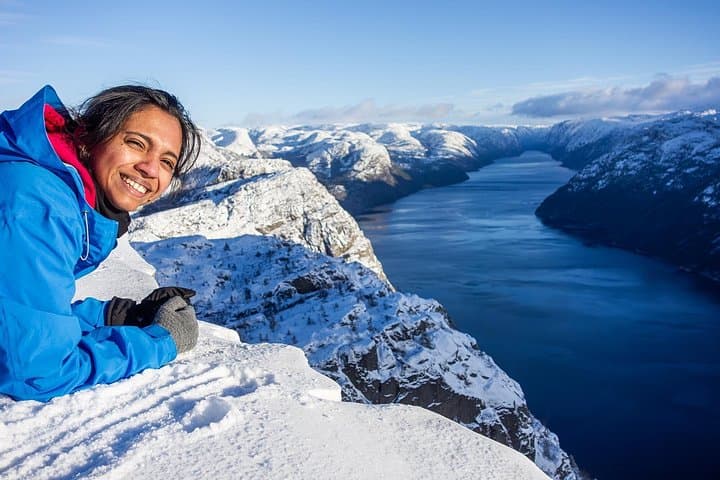


A low winter sun slices across Lysefjord as your vehicle eases away from Stavanger and the road narrows toward the mountain. By the time you step out at Preikestolen Basecamp the air is clean and metallic; the trail ahead is a series of packed snow steps, low shrubs bending under frost, and the occasional wind that seems to try the soles of your boots.
A low winter sun slices across Lysefjord as your vehicle eases away from Stavanger and the road narrows toward the mountain. By the time you step out at Preikestolen Basecamp the air is clean and metallic; the trail ahead is a series of packed snow steps, low shrubs bending under frost, and the occasional wind that seems to try the soles of your boots.
Preikestolen (Pulpit Rock) is an ice-age cliff formed as glaciers scoured the fjord about 10,000 years ago — a sheer 604‑meter drop to the water below. The route climbs roughly 350 meters over about 3.8 km one-way on a mix of rocky trail, wooden stairs, and snowfields. Local guides draw on mountain navigation traditions from Rogaland and can detour to small, lesser-seen viewpoints when conditions allow.
In winter the mountain becomes a different animal: trails harden, edges sharpen, and the fjord below demands your attention. Guides supply crampons and poles, lead at a sensible pace (about 2.5 hours ascent, ~2 hours descent), and stop for hot berry juice and a snack before a hot meal at descent.
Practical guidance: start layered — a breathable base, insulated mid, and waterproof shell — and bring waterproof boots with good traction. Hydrate before and during the hike; fingers and toes cool faster in wind-exposed sections. Check local forecasts and accept that guides will cancel in unsafe conditions. Expect moderate-to-challenging effort: steady uphill, slippery sections, and frequent clothing adjustments. When the weather cooperates, the plateau rewards with wide, immediate views that make the careful approach worthwhile.