THE ADVENTURE COLLECTIVE® · Independent discovery and booking for outdoor travel

Move through Budapest’s greatest hits in one thoughtful, private loop: Heroes’ Square, Parliament, St. Stephen’s, the Castle District and the Gellért Hill panorama. This four-hour tour mixes short walks, local history and practical tips for first-time visitors.
Move through Budapest’s greatest hits in one thoughtful, private loop: Heroes’ Square, Parliament, St. Stephen’s, the Castle District and the Gellért Hill panorama. This four-hour tour mixes short walks, local history and practical tips for first-time visitors.
You meet at the Budapest Eye as the Ferris wheel turns slow arcs against the river-glint. The guide checks names, hands out earbuds, and the city begins to speak in a series of well-timed reveals: a sweep of Parliament’s neo-Gothic spires across the Danube, the fluted dome of St. Stephen’s, the steep, stepped façade of Castle Hill rising over cobblestone streets. In four hours you move at a human pace—walking, short drives in an air-conditioned vehicle, and pauses long enough to make pictures and note the small things—coffee-cup rings on terrace tables, priests lighting candles in a basilica, trams clattering like punctuation through Pest.
Verified experiences and guided adventures in the surrounding area.
Operated by Around Budapest · Budapest, Budapest
You meet at the Budapest Eye as the Ferris wheel turns slow arcs against the river-glint. The guide checks names, hands out earbuds, and the city begins to speak in a series of well-timed reveals: a sweep of Parliament’s neo-Gothic spires across the Danube, the fluted dome of St. Stephen’s, the steep, stepped façade of Castle Hill rising over cobblestone streets. In four hours you move at a human pace—walking, short drives in an air-conditioned vehicle, and pauses long enough to make pictures and note the small things—coffee-cup rings on terrace tables, priests lighting candles in a basilica, trams clattering like punctuation through Pest.
Budapest is a layered city. Geology and empire shaped it: the Danube divides floodplain Pest from the limestone and dolomite folds of hilly Buda. Romans, Ottomans and the Austro-Hungarian monarchy left bricks and stories—Heroes’ Square marks a nation’s nineteenth-century ambitions, while the Parliament building is both a symbol of self-rule and a catalog of 19th-century engineering and ornament.
Culture here moves between steam and song. Thermal baths steam in winter and open-air ruin pubs hum in summer; you’ll get a primer on local habits—how to order pálinka properly, the best times for a chimney cake—and pick up a few Hungarian phrases the guide recommends for restaurants and markets.
Practical edges matter on this itinerary. Expect roughly 3–4 miles (5–7 km) of walking total, with an elevation gain of about 100–150 m when you ascend Castle Hill and later Gellért Hill for the panorama. Terrain is city: paved sidewalks, tram platforms and short flights of stone steps; comfortable walking shoes are nonnegotiable. The tour includes hotel or port pickup in an air-conditioned car, and you’ll close on the Buda side—Fisherman’s Bastion and Gellért Hill—for the best west-facing light over the Danube.
Timing changes everything: morning departures avoid coach crowds at the basilica and Parliament, while late afternoons tighten the light but swell café life. For accessibility, several points require steps; let the operator know in advance if mobility is an issue so they can adjust pickups or route.
Carry a refillable bottle, a compact umbrella, and a card for small purchases—many small vendors accept cards but cash still changes hands at market stalls. Tipping guides around 10–15% is customary if the guide has earned it.
In four hours this private loop leaves you with a clear map in your head: where to return for a deeper dive into museums, where to eat that evening, and how Budapest prefers to be explored—at the bank of the river, with history leaning forward and the city daring you to look closer.
The default meeting point is the Budapest Eye at Erzsébet tér; the guide can arrange hotel, port or airport pickup when requested.
Expect about 5–7 km (3–4 miles) of walking with short uphill sections on Castle Hill and Gellért Hill; vehicle transfers shorten some distances.
Yes—children are welcome but must be accompanied by an adult; strollers are usable on most paved sections though steps may require folding.
Guides typically speak English; confirm language needs at booking for other languages or interpreter requests.
The tour lists interior access to St. Stephen’s Basilica; most exterior visits to monuments are included, but specific museum or Parliament interior entry fees are typically extra.
For a full refund cancel at least 24 hours before the scheduled departure time; within 24 hours there is no refund.
Around Budapest operates guided outdoor trips and adventures with an emphasis on safety, stewardship, and memorable experiences.


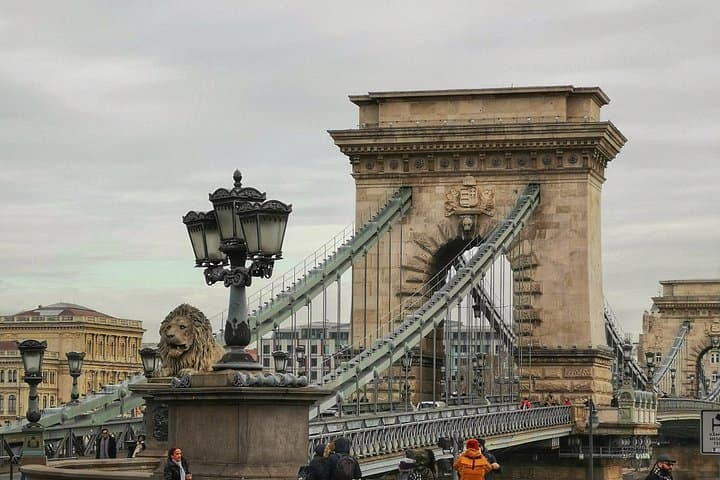
You meet at the Budapest Eye as the Ferris wheel turns slow arcs against the river-glint. The guide checks names, hands out earbuds, and the city begins to speak in a series of well-timed reveals: a sweep of Parliament’s neo-Gothic spires across the Danube, the fluted dome of St. Stephen’s, the steep, stepped façade of Castle Hill rising over cobblestone streets. In four hours you move at a human pace—walking, short drives in an air-conditioned vehicle, and pauses long enough to make pictures and note the small things—coffee-cup rings on terrace tables, priests lighting candles in a basilica, trams clattering like punctuation through Pest.
You meet at the Budapest Eye as the Ferris wheel turns slow arcs against the river-glint. The guide checks names, hands out earbuds, and the city begins to speak in a series of well-timed reveals: a sweep of Parliament’s neo-Gothic spires across the Danube, the fluted dome of St. Stephen’s, the steep, stepped façade of Castle Hill rising over cobblestone streets. In four hours you move at a human pace—walking, short drives in an air-conditioned vehicle, and pauses long enough to make pictures and note the small things—coffee-cup rings on terrace tables, priests lighting candles in a basilica, trams clattering like punctuation through Pest.
Budapest is a layered city. Geology and empire shaped it: the Danube divides floodplain Pest from the limestone and dolomite folds of hilly Buda. Romans, Ottomans and the Austro-Hungarian monarchy left bricks and stories—Heroes’ Square marks a nation’s nineteenth-century ambitions, while the Parliament building is both a symbol of self-rule and a catalog of 19th-century engineering and ornament.
Culture here moves between steam and song. Thermal baths steam in winter and open-air ruin pubs hum in summer; you’ll get a primer on local habits—how to order pálinka properly, the best times for a chimney cake—and pick up a few Hungarian phrases the guide recommends for restaurants and markets.
Practical edges matter on this itinerary. Expect roughly 3–4 miles (5–7 km) of walking total, with an elevation gain of about 100–150 m when you ascend Castle Hill and later Gellért Hill for the panorama. Terrain is city: paved sidewalks, tram platforms and short flights of stone steps; comfortable walking shoes are nonnegotiable. The tour includes hotel or port pickup in an air-conditioned car, and you’ll close on the Buda side—Fisherman’s Bastion and Gellért Hill—for the best west-facing light over the Danube.
Timing changes everything: morning departures avoid coach crowds at the basilica and Parliament, while late afternoons tighten the light but swell café life. For accessibility, several points require steps; let the operator know in advance if mobility is an issue so they can adjust pickups or route.
Carry a refillable bottle, a compact umbrella, and a card for small purchases—many small vendors accept cards but cash still changes hands at market stalls. Tipping guides around 10–15% is customary if the guide has earned it.
In four hours this private loop leaves you with a clear map in your head: where to return for a deeper dive into museums, where to eat that evening, and how Budapest prefers to be explored—at the bank of the river, with history leaning forward and the city daring you to look closer.