THE ADVENTURE COLLECTIVE® · Independent discovery and booking for outdoor travel

Spend a full day from Edinburgh exploring three of Scotland’s most atmospheric castles — Glamis, Dunnottar and Aberdour — with a private driver-guide. Expect coastal cliffs, grand interiors and short walks with historic storytelling.
Spend a full day from Edinburgh exploring three of Scotland’s most atmospheric castles — Glamis, Dunnottar and Aberdour — with a private driver-guide. Expect coastal cliffs, grand interiors and short walks with historic storytelling.
A low, brackish wind from the North Sea meets the hired van as it peels away from Edinburgh, and within an hour the city’s stone gives way to rolling farmland and the first spires of ancestral houses. You step out at Glamis Castle onto a sweep of lawn; slate roofs and ornate chimneys rise like the outline of a paused history.
Verified experiences and guided adventures in the surrounding area.
Operated by Tour Travel & More · Edinburgh, Scotland
A low, brackish wind from the North Sea meets the hired van as it peels away from Edinburgh, and within an hour the city’s stone gives way to rolling farmland and the first spires of ancestral houses. You step out at Glamis Castle onto a sweep of lawn; slate roofs and ornate chimneys rise like the outline of a paused history.
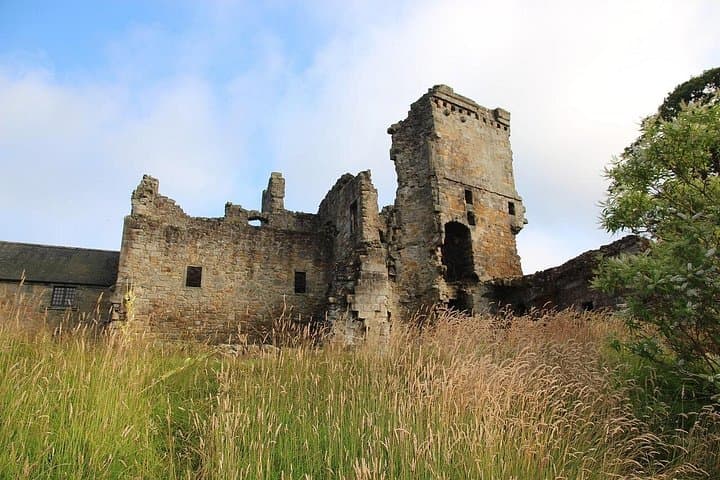
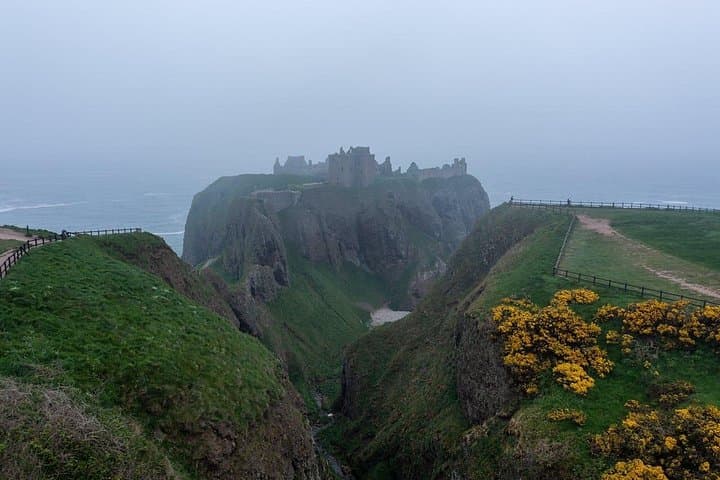
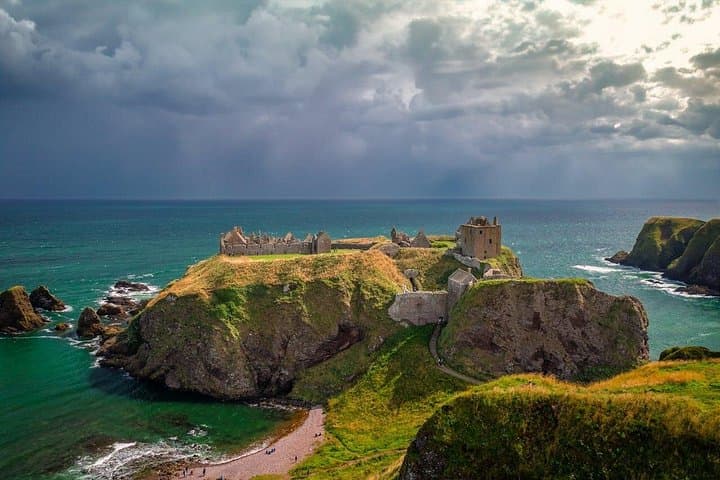
Glamis is domestic grandeur — stately rooms, carved stairways and a lineage that threads to the Queen Mother and Shakespeare’s Macbeth. The geology shifts as you drive: soft agricultural lowlands harden into the weathered dolerite and Old Red Sandstone of the northeast coast. Dunnottar perches on a jagged promontory where waves daringly pry at the cliffs; access involves a short but uneven cliff-top walk and stone steps with sea-spray in the air. Aberdour brings a quieter close — one of Scotland’s oldest standing castles by a small beach and formal garden, where ruin stones slope toward tidal marshes.
Expect about 10 hours on the road with guided commentary, roughly 160–200 miles of driving depending on routing, and three scheduled stops of around 60–120 minutes each. Paths at Dunnottar are uneven and exposed; Glamis has paved grounds and indoor rooms with staircases; Aberdour offers short shoreline walks.
Practical edge: wear waterproof outer layers and sturdy shoes, plan for weather shifts and midges in summer evenings, and bring a camera with a neutral-density filter for coastal light. Lunch is usually independent — budget time for a pub meal in a village or a packed picnic. The tour is cultural and scenic: minimal fitness required but comfortable mobility makes for a fuller day.
Most private tours depart from central Edinburgh (pick-up point arranged at booking) and return to Edinburgh at the end of the approximately 10-hour day.
Yes — tickets to Glamis and Dunnottar are included; Aberdour access is typically external/independent per the itinerary but the guide will advise on entry options.
The tour is family-friendly but some sites (especially Dunnottar) involve steep steps and uneven ground; visitors with limited mobility should check specific access details in advance.
The tour runs in most weather conditions; guides will adjust stops and timing as needed, but refunds are not generally offered for weather-related changes per the booking policy.
Tour Travel & More operates guided outdoor trips and adventures with an emphasis on safety, stewardship, and memorable experiences.

A low, brackish wind from the North Sea meets the hired van as it peels away from Edinburgh, and within an hour the city’s stone gives way to rolling farmland and the first spires of ancestral houses. You step out at Glamis Castle onto a sweep of lawn; slate roofs and ornate chimneys rise like the outline of a paused history.
A low, brackish wind from the North Sea meets the hired van as it peels away from Edinburgh, and within an hour the city’s stone gives way to rolling farmland and the first spires of ancestral houses. You step out at Glamis Castle onto a sweep of lawn; slate roofs and ornate chimneys rise like the outline of a paused history.
Glamis is domestic grandeur — stately rooms, carved stairways and a lineage that threads to the Queen Mother and Shakespeare’s Macbeth. The geology shifts as you drive: soft agricultural lowlands harden into the weathered dolerite and Old Red Sandstone of the northeast coast. Dunnottar perches on a jagged promontory where waves daringly pry at the cliffs; access involves a short but uneven cliff-top walk and stone steps with sea-spray in the air. Aberdour brings a quieter close — one of Scotland’s oldest standing castles by a small beach and formal garden, where ruin stones slope toward tidal marshes.
Expect about 10 hours on the road with guided commentary, roughly 160–200 miles of driving depending on routing, and three scheduled stops of around 60–120 minutes each. Paths at Dunnottar are uneven and exposed; Glamis has paved grounds and indoor rooms with staircases; Aberdour offers short shoreline walks.
Practical edge: wear waterproof outer layers and sturdy shoes, plan for weather shifts and midges in summer evenings, and bring a camera with a neutral-density filter for coastal light. Lunch is usually independent — budget time for a pub meal in a village or a packed picnic. The tour is cultural and scenic: minimal fitness required but comfortable mobility makes for a fuller day.