THE ADVENTURE COLLECTIVE® · Independent discovery and booking for outdoor travel

Make the full‑day pilgrimage from Aswan to Abu Simbel to stand beneath Ramses II’s colossal guardians and walk carved halls saved by one of the 20th century’s great rescue projects. This private tour pairs an Egyptologist guide with round‑trip transport for a focused, comfortable visit.
Make the full‑day pilgrimage from Aswan to Abu Simbel to stand beneath Ramses II’s colossal guardians and walk carved halls saved by one of the 20th century’s great rescue projects. This private tour pairs an Egyptologist guide with round‑trip transport for a focused, comfortable visit.
Before first light you leave Aswan in an air‑conditioned vehicle, the desert stretching ahead with the pale road daring you forward. By mid‑morning the temple façades rise from the sandstone—four colossal seated figures of Ramses II guarding a carved entrance that holds centuries of chiselled stories and silent heat. The light here is sharp; shadows carve the reliefs anew each hour.
Verified experiences and guided adventures in the surrounding area.
Operated by Saray El-Nile · Abu Simbel, Aswan Governorate
Before first light you leave Aswan in an air‑conditioned vehicle, the desert stretching ahead with the pale road daring you forward. By mid‑morning the temple façades rise from the sandstone—four colossal seated figures of Ramses II guarding a carved entrance that holds centuries of chiselled stories and silent heat. The light here is sharp; shadows carve the reliefs anew each hour.
The temples at Abu Simbel date to the 13th century BCE, built by Ramses II to project power into Nubia. In the 1960s their relocation—an international engineering feat to save them from the rising waters of Lake Nasser—moved massive blocks of stone to a higher artificial hill; that modern history sits beside millennia of pharaonic inscription. Geologically the site is late‑Paleogene sandstone, eroded into smooth faces that preserve crisp bas‑reliefs but lose detail if handled.
Local culture ties to Nubian communities along the lake and Aswan’s markets, where an Egyptologist can add context to the iconography and post‑relocation debates. Expect mostly flat driving across desert highways (Aswan → Abu Simbel ~280 km each way, ~3.5–4 hours), short paved approaches and stepped temple interiors with uneven flagstones.
Practical guidance: plan for a full day, start early to avoid the hottest light, carry 2–3 liters of water, strong sun protection and sturdy shoes for temple steps. Photography is allowed but respect signage and do not touch reliefs. The private format gives flexibility for pacing and extra time at viewpoints over Lake Nasser—time well spent where ancient stone meets modern sky.
Road distance is about 280 km each way; expect roughly 3.5–4 hours driving one way and a full‑day itinerary including time at the temples.
This tour description specifies admission is included for the Temple of Ramses II and Nefertari; confirm with the operator at booking for any changes.
The site has paved approaches but includes steps into temple interiors and uneven flooring; wheelchair access is limited—contact the operator to discuss assistance options.
Photography is generally allowed for personal use, but flash and tripods may be restricted—follow onsite signage and your guide’s instructions.
Saray El-Nile operates guided outdoor trips and adventures with an emphasis on safety, stewardship, and memorable experiences.
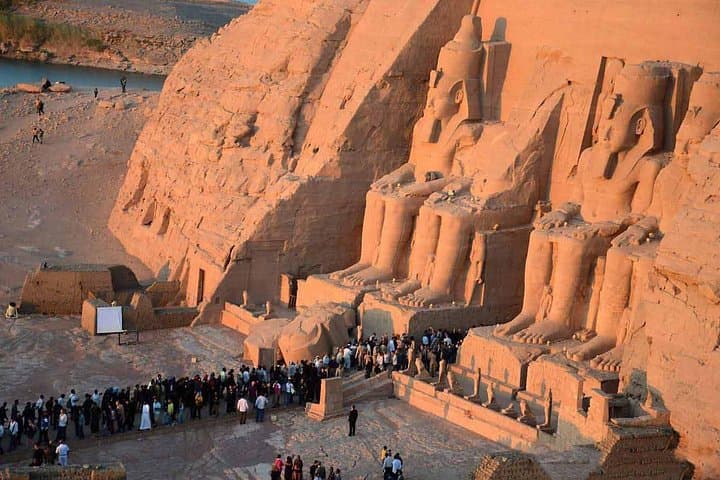
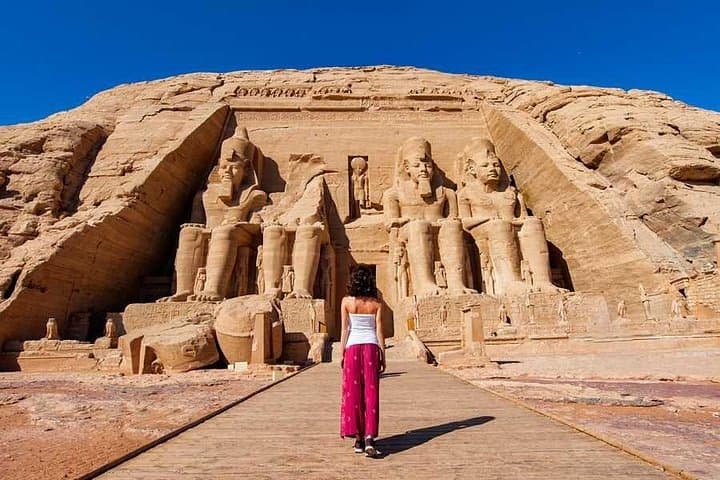


Before first light you leave Aswan in an air‑conditioned vehicle, the desert stretching ahead with the pale road daring you forward. By mid‑morning the temple façades rise from the sandstone—four colossal seated figures of Ramses II guarding a carved entrance that holds centuries of chiselled stories and silent heat. The light here is sharp; shadows carve the reliefs anew each hour.
Before first light you leave Aswan in an air‑conditioned vehicle, the desert stretching ahead with the pale road daring you forward. By mid‑morning the temple façades rise from the sandstone—four colossal seated figures of Ramses II guarding a carved entrance that holds centuries of chiselled stories and silent heat. The light here is sharp; shadows carve the reliefs anew each hour.
The temples at Abu Simbel date to the 13th century BCE, built by Ramses II to project power into Nubia. In the 1960s their relocation—an international engineering feat to save them from the rising waters of Lake Nasser—moved massive blocks of stone to a higher artificial hill; that modern history sits beside millennia of pharaonic inscription. Geologically the site is late‑Paleogene sandstone, eroded into smooth faces that preserve crisp bas‑reliefs but lose detail if handled.
Local culture ties to Nubian communities along the lake and Aswan’s markets, where an Egyptologist can add context to the iconography and post‑relocation debates. Expect mostly flat driving across desert highways (Aswan → Abu Simbel ~280 km each way, ~3.5–4 hours), short paved approaches and stepped temple interiors with uneven flagstones.
Practical guidance: plan for a full day, start early to avoid the hottest light, carry 2–3 liters of water, strong sun protection and sturdy shoes for temple steps. Photography is allowed but respect signage and do not touch reliefs. The private format gives flexibility for pacing and extra time at viewpoints over Lake Nasser—time well spent where ancient stone meets modern sky.