THE ADVENTURE COLLECTIVE® · Independent discovery and booking for outdoor travel

Trace imperial Vietnam from the Perfume River to royal tombs on this private full-day tour of Hue. Expect boat crossings, temple stairs and a measured look at Nguyễn dynasty architecture with local lunch included.
Trace imperial Vietnam from the Perfume River to royal tombs on this private full-day tour of Hue. Expect boat crossings, temple stairs and a measured look at Nguyễn dynasty architecture with local lunch included.
Morning mist rides the Perfume River while a dragon boat parts the glassy water; visitors step ashore beneath the rooflines of the Imperial City and suddenly the past feels immediate. This private full-day tour threads the key sites of Hue — the Imperial City, the Forbidden Purple City precincts, Thien Mu Pagoda, a 30-minute dragon boat crossing, and the tombs of Khai Dinh and Minh Mang — into a single, walkable loop.
Verified experiences and guided adventures in the surrounding area.
Operated by Private Tourguides in Da Nang Hoi An Hue · Hue, Thua Thien-Hue
Morning mist rides the Perfume River while a dragon boat parts the glassy water; visitors step ashore beneath the rooflines of the Imperial City and suddenly the past feels immediate. This private full-day tour threads the key sites of Hue — the Imperial City, the Forbidden Purple City precincts, Thien Mu Pagoda, a 30-minute dragon boat crossing, and the tombs of Khai Dinh and Minh Mang — into a single, walkable loop.
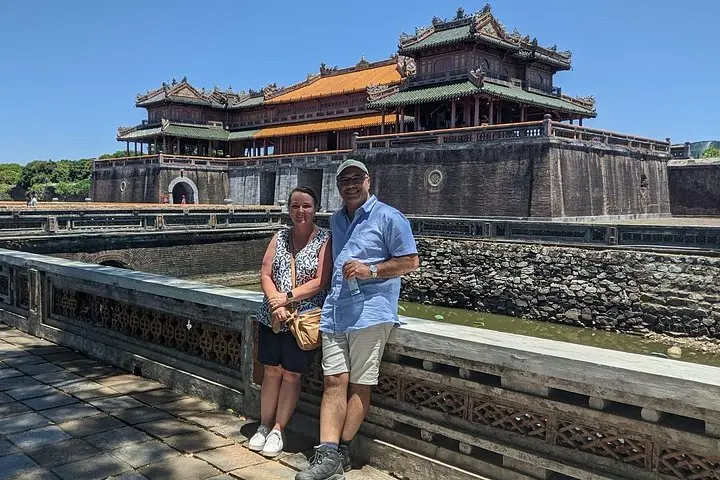
Hue sat at the center of Vietnam’s Nguyễn dynasty (1802–1945), its citadel planned to face the river that supplied commerce and ceremonial life. The complex’s brickwork, lacquered gates and carved pavilions bear both native craft and later colonial-era scars visible in bullet marks and repaired halls. Thien Mu, founded in 1601, still functions as a monastery and gives a clear line to the region’s Buddhist traditions; the royal tombs outside the city show shifts in architectural taste from classical symmetry at Minh Mang to Khai Dinh’s East–West fusion.
Practically, expect several short walks on stone and packed earth, intermittent stairs, and a one-way boat transfer; some gate areas are under restoration and access can change. Wear grippy shoes for temple courtyards, bring sun protection and a refillable bottle (many guides provide water), and plan for an 8-hour day with pauses for a local lunch. Early starts avoid midday heat and crowds on river crossings. This itinerary blends history, riverside calm and architecture — a full day of quiet observation and steady movement through Hue’s imperial landscape.
The guided dragon boat segment lasts about 30 minutes and is typically used to reach Thien Mu Pagoda.
Yes — the tour includes all entrance tickets to the Imperial City and the specified tombs.
Infants and small children can use strollers, but many sites have stairs and uneven ground—infant carriers are often more practical.
This is a private tour and some flexibility is possible, but operators may cancel or adjust the itinerary in severe weather; check cancellation terms.
Private Tourguides in Da Nang Hoi An Hue operates guided outdoor trips and adventures with an emphasis on safety, stewardship, and memorable experiences.
Morning mist rides the Perfume River while a dragon boat parts the glassy water; visitors step ashore beneath the rooflines of the Imperial City and suddenly the past feels immediate. This private full-day tour threads the key sites of Hue — the Imperial City, the Forbidden Purple City precincts, Thien Mu Pagoda, a 30-minute dragon boat crossing, and the tombs of Khai Dinh and Minh Mang — into a single, walkable loop.
Morning mist rides the Perfume River while a dragon boat parts the glassy water; visitors step ashore beneath the rooflines of the Imperial City and suddenly the past feels immediate. This private full-day tour threads the key sites of Hue — the Imperial City, the Forbidden Purple City precincts, Thien Mu Pagoda, a 30-minute dragon boat crossing, and the tombs of Khai Dinh and Minh Mang — into a single, walkable loop.
Hue sat at the center of Vietnam’s Nguyễn dynasty (1802–1945), its citadel planned to face the river that supplied commerce and ceremonial life. The complex’s brickwork, lacquered gates and carved pavilions bear both native craft and later colonial-era scars visible in bullet marks and repaired halls. Thien Mu, founded in 1601, still functions as a monastery and gives a clear line to the region’s Buddhist traditions; the royal tombs outside the city show shifts in architectural taste from classical symmetry at Minh Mang to Khai Dinh’s East–West fusion.
Practically, expect several short walks on stone and packed earth, intermittent stairs, and a one-way boat transfer; some gate areas are under restoration and access can change. Wear grippy shoes for temple courtyards, bring sun protection and a refillable bottle (many guides provide water), and plan for an 8-hour day with pauses for a local lunch. Early starts avoid midday heat and crowds on river crossings. This itinerary blends history, riverside calm and architecture — a full day of quiet observation and steady movement through Hue’s imperial landscape.