THE ADVENTURE COLLECTIVE® · Independent discovery and booking for outdoor travel

Spend a full day in Kruger with a private guide and open safari vehicle, seeking the Big 5 across rivers, grasslands, and rocky kopjes. This tailored experience uses local knowledge and radio networks to maximize wildlife encounters while delivering cultural and natural history along the way.
Spend a full day in Kruger with a private guide and open safari vehicle, seeking the Big 5 across rivers, grasslands, and rocky kopjes. This tailored experience uses local knowledge and radio networks to maximize wildlife encounters while delivering cultural and natural history along the way.
The dawn cuts across the low savanna and the full-day vehicle hums toward the spoor of elephant and lion. On a private Kruger safari you sit higher than the grass, the guide’s radio a steady pulse calling sightings across the plains, and the landscape gradually reveals its actors: giraffe browsing on fever trees, zebra drifting like weather across the floodplain, and a curious bull elephant testing the wind.
Verified experiences and guided adventures in the surrounding area.
The dawn cuts across the low savanna and the full-day vehicle hums toward the spoor of elephant and lion. On a private Kruger safari you sit higher than the grass, the guide’s radio a steady pulse calling sightings across the plains, and the landscape gradually reveals its actors: giraffe browsing on fever trees, zebra drifting like weather across the floodplain, and a curious bull elephant testing the wind.
Kruger was set aside for protection at the turn of the 20th century (initially as game reserves in 1898) and later formalized as Kruger National Park; its geology is ancient—granitic and basaltic foundations uplifted and eroded into ridges and river valleys that concentrate wildlife. Cultural threads run through the park too: local folklore and ranger stories weave human history into the ecology, and private guides often share both natural history and regional heritage.
Practically, expect a full 8–10 hour day in an open safari vehicle with multiple stops for sightings, photography, and short walks when permitted. Wildlife encounters are never guaranteed but private safaris increase chances by focusing on current tracks and radio networks. Pack sun protection, layered clothing for cool mornings and hot midday sun, spare batteries for cameras, and binoculars. Hydrate before you arrive and follow your guide’s safety brief—do not exit the vehicle except in designated areas.
A private guide turns the park into a tailored experience: read the light, watch the behavior, and move where animals lead. This is a day of patient observation, sudden bursts of action, and deep, disciplined listening to the savanna.
Private safaris increase your chances by concentrating on recent sightings and using radio networks, but sightings are never guaranteed—season and luck play roles.
Inclusions vary by operator; confirm whether park entrance fees, bottled water, and lunch are part of your booking before arrival.
Children are usually welcome but operators may set minimum ages; check seatbelt availability in the open vehicle and child-safety rules.
Open safari vehicles are standard, but early-morning cold or rain in wet season may require covered options—ask the operator about vehicle type and weather policy.
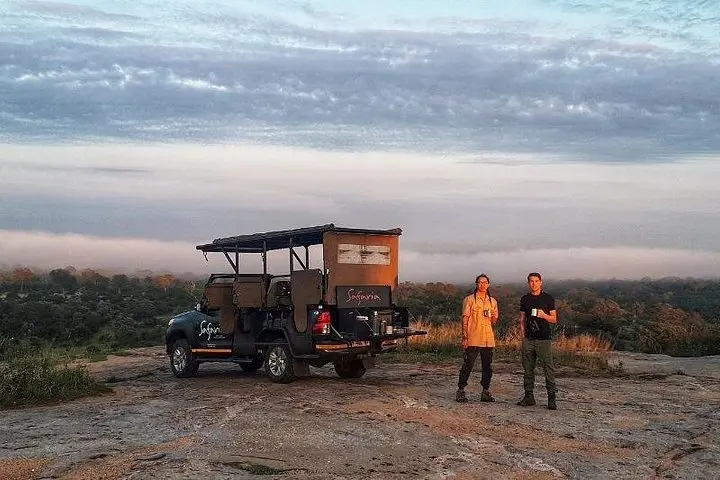
The dawn cuts across the low savanna and the full-day vehicle hums toward the spoor of elephant and lion. On a private Kruger safari you sit higher than the grass, the guide’s radio a steady pulse calling sightings across the plains, and the landscape gradually reveals its actors: giraffe browsing on fever trees, zebra drifting like weather across the floodplain, and a curious bull elephant testing the wind.
The dawn cuts across the low savanna and the full-day vehicle hums toward the spoor of elephant and lion. On a private Kruger safari you sit higher than the grass, the guide’s radio a steady pulse calling sightings across the plains, and the landscape gradually reveals its actors: giraffe browsing on fever trees, zebra drifting like weather across the floodplain, and a curious bull elephant testing the wind.
Kruger was set aside for protection at the turn of the 20th century (initially as game reserves in 1898) and later formalized as Kruger National Park; its geology is ancient—granitic and basaltic foundations uplifted and eroded into ridges and river valleys that concentrate wildlife. Cultural threads run through the park too: local folklore and ranger stories weave human history into the ecology, and private guides often share both natural history and regional heritage.
Practically, expect a full 8–10 hour day in an open safari vehicle with multiple stops for sightings, photography, and short walks when permitted. Wildlife encounters are never guaranteed but private safaris increase chances by focusing on current tracks and radio networks. Pack sun protection, layered clothing for cool mornings and hot midday sun, spare batteries for cameras, and binoculars. Hydrate before you arrive and follow your guide’s safety brief—do not exit the vehicle except in designated areas.
A private guide turns the park into a tailored experience: read the light, watch the behavior, and move where animals lead. This is a day of patient observation, sudden bursts of action, and deep, disciplined listening to the savanna.