THE ADVENTURE COLLECTIVE® · Independent discovery and booking for outdoor travel

Spend a day with an Egyptologist visiting Saqqara, Memphis, Dahshur, and the Giza Plateau. This private full-day tour blends archaeology, skyline views, and a 30-minute camel ride around the pyramids.
Spend a day with an Egyptologist visiting Saqqara, Memphis, Dahshur, and the Giza Plateau. This private full-day tour blends archaeology, skyline views, and a 30-minute camel ride around the pyramids.
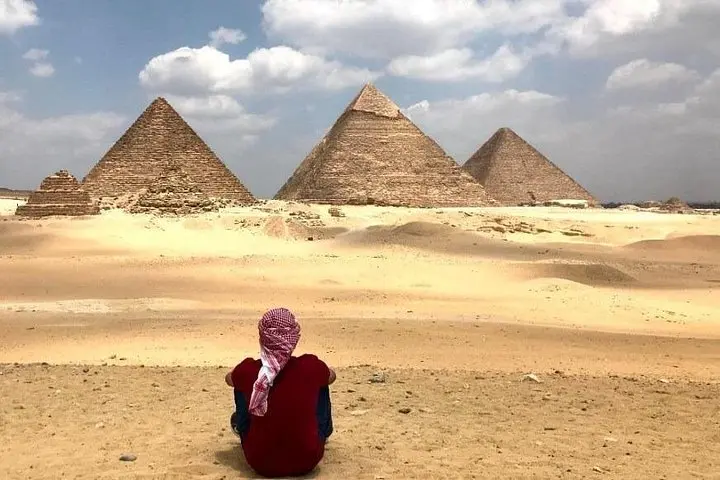
You step out of a cool, air-conditioned minivan onto sun-baked stone and the geometry of millennia. Sand crunches underfoot as the Great Pyramid rises, an ancient block-by-block argument against time. The air is dry and bright; the Sphinx watches as your guide — an Egyptologist — outlines the day’s logic: Saqqara’s stepped profile, Memphis’s ruined columns, Dahshur’s experimental forms, and Giza’s monumental plateau.
Verified experiences and guided adventures in the surrounding area.
Operated by Sheba Tour company · Giza, Cairo Governorate
You step out of a cool, air-conditioned minivan onto sun-baked stone and the geometry of millennia. Sand crunches underfoot as the Great Pyramid rises, an ancient block-by-block argument against time. The air is dry and bright; the Sphinx watches as your guide — an Egyptologist — outlines the day’s logic: Saqqara’s stepped profile, Memphis’s ruined columns, Dahshur’s experimental forms, and Giza’s monumental plateau.
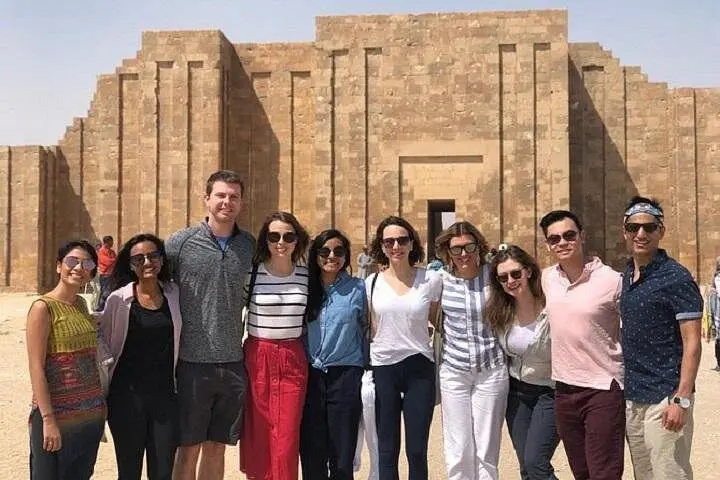
Saqqara holds the Step Pyramid of King Djoser, considered the first large-scale cut stone construction by Imhotep around 2700 B.C.; nearby tombs display finely painted reliefs and the earliest Pyramid Texts. Memphis, founded c. 3200 B.C., preserves fragments of Old Kingdom statuary, including a colossal Ramses II. Dahshur shows architectural evolution — the Bent Pyramid’s awkward angle and the Red Pyramid’s successful slope — both Snefru’s attempts that preceded Khufu’s Great Pyramid at Giza.
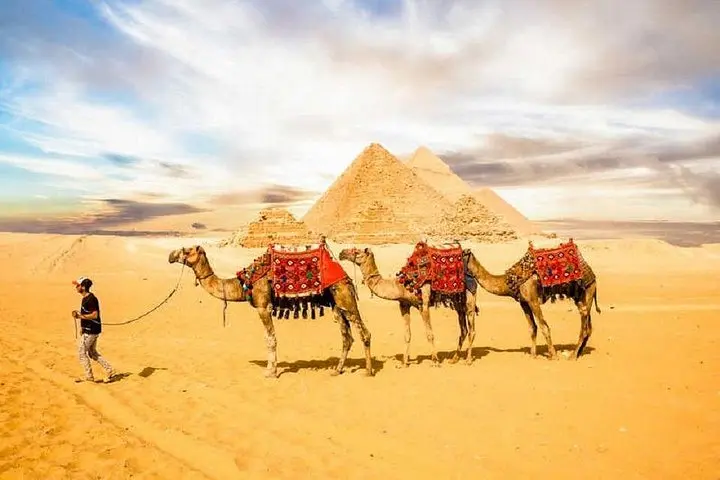
Expect varied terrain: paved paths, packed sand, and uneven archaeological surfaces. Cultural context is immediate — vendors, mosque calls, and modern Cairo’s skyline at the horizon. The private format means fewer crowds and a 30-minute camel ride around the plateau included.
Practical guidance: start early for cooler light and smaller crowds, carry sun protection and refillable water, and wear sturdy closed shoes for uneven footing. Bring photocopies of travel documents and modest clothing for museum and temple entries. Photography is allowed at open sites, but check restrictions inside certain tomb chambers. With an experienced Egyptologist, the day connects names and stones into a readable route through the origins of monumental architecture.
General site entry is included in many tours, but specific internal access to certain pyramids or tombs can require additional tickets—confirm with your operator before travel.
This tour includes a 30-minute camel ride around the Giza plateau as part of the itinerary.
Yes — the tour package typically includes lunch at a restaurant overlooking the pyramids, bottled water, and all local taxes; private transport and guide are also included.
Yes; the itinerary is described as easy with vehicle transfers between sites, but visitors should be able to walk short distances and manage uneven footing.
Sheba Tour company operates guided outdoor trips and adventures with an emphasis on safety, stewardship, and memorable experiences.
You step out of a cool, air-conditioned minivan onto sun-baked stone and the geometry of millennia. Sand crunches underfoot as the Great Pyramid rises, an ancient block-by-block argument against time. The air is dry and bright; the Sphinx watches as your guide — an Egyptologist — outlines the day’s logic: Saqqara’s stepped profile, Memphis’s ruined columns, Dahshur’s experimental forms, and Giza’s monumental plateau.
You step out of a cool, air-conditioned minivan onto sun-baked stone and the geometry of millennia. Sand crunches underfoot as the Great Pyramid rises, an ancient block-by-block argument against time. The air is dry and bright; the Sphinx watches as your guide — an Egyptologist — outlines the day’s logic: Saqqara’s stepped profile, Memphis’s ruined columns, Dahshur’s experimental forms, and Giza’s monumental plateau.
Saqqara holds the Step Pyramid of King Djoser, considered the first large-scale cut stone construction by Imhotep around 2700 B.C.; nearby tombs display finely painted reliefs and the earliest Pyramid Texts. Memphis, founded c. 3200 B.C., preserves fragments of Old Kingdom statuary, including a colossal Ramses II. Dahshur shows architectural evolution — the Bent Pyramid’s awkward angle and the Red Pyramid’s successful slope — both Snefru’s attempts that preceded Khufu’s Great Pyramid at Giza.
Expect varied terrain: paved paths, packed sand, and uneven archaeological surfaces. Cultural context is immediate — vendors, mosque calls, and modern Cairo’s skyline at the horizon. The private format means fewer crowds and a 30-minute camel ride around the plateau included.
Practical guidance: start early for cooler light and smaller crowds, carry sun protection and refillable water, and wear sturdy closed shoes for uneven footing. Bring photocopies of travel documents and modest clothing for museum and temple entries. Photography is allowed at open sites, but check restrictions inside certain tomb chambers. With an experienced Egyptologist, the day connects names and stones into a readable route through the origins of monumental architecture.