THE ADVENTURE COLLECTIVE® · Independent discovery and booking for outdoor travel

Stand within sight of the Great Pyramid on a private 4–5 hour tour from Cairo that pairs a local English-speaking guide with private transport. Learn the archaeology, geological context, and practical tips to make the visit comfortable and respectful.
Stand within sight of the Great Pyramid on a private 4–5 hour tour from Cairo that pairs a local English-speaking guide with private transport. Learn the archaeology, geological context, and practical tips to make the visit comfortable and respectful.
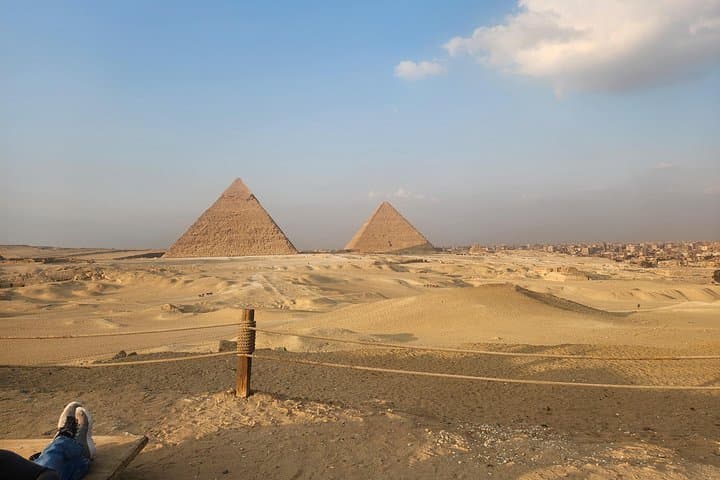
You step from Cairo traffic onto sunbaked stone, the desert air pushing at the edges of the plaza as three great pyramids loom ahead—calm, immense, and older than most histories.
Verified experiences and guided adventures in the surrounding area.
Operated by Ayatours · Giza, Giza Governorate
You step from Cairo traffic onto sunbaked stone, the desert air pushing at the edges of the plaza as three great pyramids loom ahead—calm, immense, and older than most histories.
These limestone giants on the Giza Plateau were raised in the Fourth Dynasty (around 2600–2500 BCE) as tombs for pharaohs. Geologically the plateau is a raised bedrock of Eocene limestone; quarrying here produced the very blocks that built the complex. Culturally, the site sits on the edge of a living city—camel handlers, vendors, and modern Cairo visible on the horizon—so the ancient and contemporary converse constantly.
A private-car tour with a local English-speaking guide delivers context: theories of construction, the alignment of the pyramids to cardinal points, and the role of the Sphinx. You’ll pass the Solar Boat Museum, examine mastaba tombs, and find the angles that make the Great Pyramid feel like a machine tuned to light and shadow.
Practically, expect 4–5 hours on foot with short drives between points, plenty of photo stops, and flexible timing. Temperatures can peak quickly—hydrate, wear sun protection, and plan mornings or late afternoons to avoid the worst heat. The tour operator typically handles pickup and drop-off, fees for guide and transport, and provides water and snacks, but interior pyramid entry is often a separate ticket and sometimes limited.
Leave only footprints: avoid climbing masonry, follow your guide’s route, and factor in time for security checks and crowds. With a private guide and car you trade lines for stories, and the plateau returns you to a past that still compels attention.
Tour inclusions usually cover guide and transport; entrance fees to the Giza Plateau are often included but interior pyramid access (to the King’s Chamber) is a separate ticket—confirm before booking.
Interior entry is limited and sometimes sold onsite; if interior access is essential, request it when booking so the guide can arrange tickets if available.
Some plateau surfaces and entrances are uneven; operators note wheelchair accessibility for portions but full access to all areas (and interior chambers) may be restricted—ask about specific needs when booking.
Drive time varies with traffic but plan 30–60 minutes from most central Cairo hotels; private transport allows flexibility on pickup and drop-off locations.
Ayatours operates guided outdoor trips and adventures with an emphasis on safety, stewardship, and memorable experiences.


You step from Cairo traffic onto sunbaked stone, the desert air pushing at the edges of the plaza as three great pyramids loom ahead—calm, immense, and older than most histories.
You step from Cairo traffic onto sunbaked stone, the desert air pushing at the edges of the plaza as three great pyramids loom ahead—calm, immense, and older than most histories.
These limestone giants on the Giza Plateau were raised in the Fourth Dynasty (around 2600–2500 BCE) as tombs for pharaohs. Geologically the plateau is a raised bedrock of Eocene limestone; quarrying here produced the very blocks that built the complex. Culturally, the site sits on the edge of a living city—camel handlers, vendors, and modern Cairo visible on the horizon—so the ancient and contemporary converse constantly.
A private-car tour with a local English-speaking guide delivers context: theories of construction, the alignment of the pyramids to cardinal points, and the role of the Sphinx. You’ll pass the Solar Boat Museum, examine mastaba tombs, and find the angles that make the Great Pyramid feel like a machine tuned to light and shadow.
Practically, expect 4–5 hours on foot with short drives between points, plenty of photo stops, and flexible timing. Temperatures can peak quickly—hydrate, wear sun protection, and plan mornings or late afternoons to avoid the worst heat. The tour operator typically handles pickup and drop-off, fees for guide and transport, and provides water and snacks, but interior pyramid entry is often a separate ticket and sometimes limited.
Leave only footprints: avoid climbing masonry, follow your guide’s route, and factor in time for security checks and crowds. With a private guide and car you trade lines for stories, and the plateau returns you to a past that still compels attention.