THE ADVENTURE COLLECTIVE® · Independent discovery and booking for outdoor travel

A private day trip from Kuşadası brings you to Pamukkale’s luminous travertines and the ruins of Hierapolis. Expect a full day of thermal pools, archaeological sites and three-hour drives each way—perfect for travelers prioritizing comfort and a guided, flexible itinerary.
A private day trip from Kuşadası brings you to Pamukkale’s luminous travertines and the ruins of Hierapolis. Expect a full day of thermal pools, archaeological sites and three-hour drives each way—perfect for travelers prioritizing comfort and a guided, flexible itinerary.
You leave Kusadası before the heat climbs, watching the coastline recede as the minarets give way to plain and scrub. The road to Pamukkale is three hours of changing light and small Anatolian towns until the landscape opens onto bright, white terraces that look almost artificial — until you feel the warm steam and hear the faint trickle of water.
Verified experiences and guided adventures in the surrounding area.
Operated by Gezenthi Travel Agency · Pamukkale, Denizli
You leave Kusadası before the heat climbs, watching the coastline recede as the minarets give way to plain and scrub. The road to Pamukkale is three hours of changing light and small Anatolian towns until the landscape opens onto bright, white terraces that look almost artificial — until you feel the warm steam and hear the faint trickle of water.
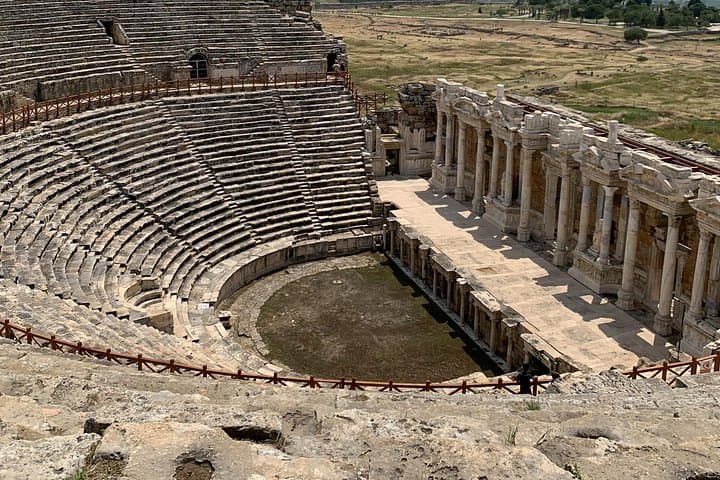
The terraces are travertine, living limestone sculpted over millennia by mineral-rich thermal waters; above them sit the ruins of Hierapolis, a Roman spa city where colonnades, a theater and necropolis record centuries of human pilgrimage to these springs. The thermal pools dare you to step in, and the so-called Cleopatra’s Pool — an archaeological-swimming site — offers a rare chance to swim among submerged columns.
Culturally, the area sits at the edge of Denizli province and has long been both a local bathing ground and a trade crossroads. Geology and history intersect here: calcium carbonate deposits build terraces slowly, while Roman and Byzantine stonework holds stories of health, religion and commerce.
Practical guidance: expect a long day — most private transfers run 10–12 hours from pick-up to return; the drive from Kuşadası is roughly three hours each way. Entrance to the Pamukkale–Hierapolis site is usually ticketed, and some terraces require barefoot walking or staying on boardwalks to protect the deposits. Bring water, sun protection, and shoes that are easy to remove. Lunch stops are typically an hour; plan for moderate walking on uneven stone and packed paths. If you want to swim in the ancient pool, check availability and whether that admission is included in your tour. Timing your visit for early morning or late afternoon reduces glare on the white terraces and avoids midday crowds.
Expect roughly three hours each way by private vehicle, depending on traffic and stops.
Not always; some operators include site admissions or pool access while others list them as extra—confirm when you book.
Swimming in most open travertine terraces is restricted to protect the formations, but the designated ancient pool (Cleopatra’s Pool) may allow swimming for an additional fee and is subject to availability.
Parts of the site have uneven stone and stairs; some areas are stroller accessible but expect to carry young children over steps or on boardwalks.
Gezenthi Travel Agency operates guided outdoor trips and adventures with an emphasis on safety, stewardship, and memorable experiences.


You leave Kusadası before the heat climbs, watching the coastline recede as the minarets give way to plain and scrub. The road to Pamukkale is three hours of changing light and small Anatolian towns until the landscape opens onto bright, white terraces that look almost artificial — until you feel the warm steam and hear the faint trickle of water.
You leave Kusadası before the heat climbs, watching the coastline recede as the minarets give way to plain and scrub. The road to Pamukkale is three hours of changing light and small Anatolian towns until the landscape opens onto bright, white terraces that look almost artificial — until you feel the warm steam and hear the faint trickle of water.
The terraces are travertine, living limestone sculpted over millennia by mineral-rich thermal waters; above them sit the ruins of Hierapolis, a Roman spa city where colonnades, a theater and necropolis record centuries of human pilgrimage to these springs. The thermal pools dare you to step in, and the so-called Cleopatra’s Pool — an archaeological-swimming site — offers a rare chance to swim among submerged columns.
Culturally, the area sits at the edge of Denizli province and has long been both a local bathing ground and a trade crossroads. Geology and history intersect here: calcium carbonate deposits build terraces slowly, while Roman and Byzantine stonework holds stories of health, religion and commerce.
Practical guidance: expect a long day — most private transfers run 10–12 hours from pick-up to return; the drive from Kuşadası is roughly three hours each way. Entrance to the Pamukkale–Hierapolis site is usually ticketed, and some terraces require barefoot walking or staying on boardwalks to protect the deposits. Bring water, sun protection, and shoes that are easy to remove. Lunch stops are typically an hour; plan for moderate walking on uneven stone and packed paths. If you want to swim in the ancient pool, check availability and whether that admission is included in your tour. Timing your visit for early morning or late afternoon reduces glare on the white terraces and avoids midday crowds.