THE ADVENTURE COLLECTIVE® · Independent discovery and booking for outdoor travel

Trace tango from portside alleys to historic cafés on this private, customizable three-hour walking tour of Buenos Aires. Visit Gardel’s house, Café Tortoni and Plaza Dorrego while a local guide brings the music and stories to life.
Trace tango from portside alleys to historic cafés on this private, customizable three-hour walking tour of Buenos Aires. Visit Gardel’s house, Café Tortoni and Plaza Dorrego while a local guide brings the music and stories to life.
You step off a narrow Avenida and the city breathes tango: the muffled clack of heels on cobbles, an old radio trailing a bandoneón line through a café doorway. This private, three-hour walking tour threads San Telmo, Avenida de Mayo and La Boca—neighborhoods where the dance first sharpened its edges—and stops at historic sites like the Casa Museo Carlos Gardel, Café Tortoni and Plaza Dorrego.
Verified experiences and guided adventures in the surrounding area.
Operated by Tours Buenos Aires · Buenos Aires, Ciudad Autónoma de Buenos Aires
You step off a narrow Avenida and the city breathes tango: the muffled clack of heels on cobbles, an old radio trailing a bandoneón line through a café doorway. This private, three-hour walking tour threads San Telmo, Avenida de Mayo and La Boca—neighborhoods where the dance first sharpened its edges—and stops at historic sites like the Casa Museo Carlos Gardel, Café Tortoni and Plaza Dorrego.
Tango began in the late 19th century at the port, born of immigrant rhythms, Afro-Argentine influences and the city’s restless social mix. Buenos Aires’ geology is plain and practical—the broad Río de la Plata and the flat pampas beyond—so the dance and its venues concentrated in streets, salons and cafés rather than hills. Along the route you’ll see architecture from colonial balconies to Belle Époque facades, and hear how lyricists and compadres shaped an Argentine voice.
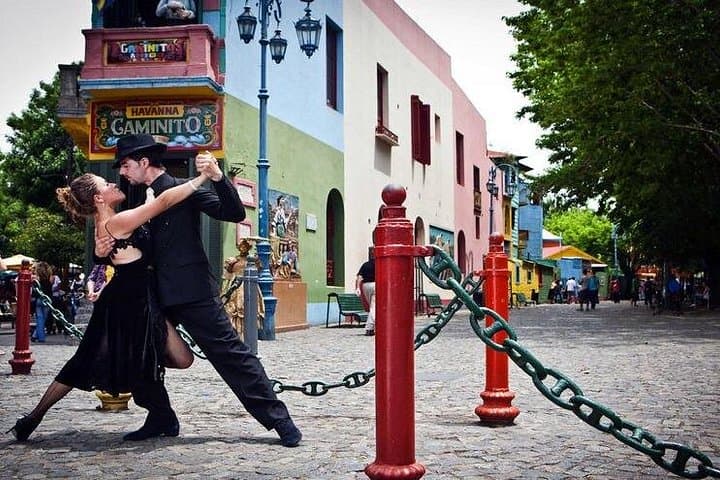
Local color matters: cafés were rehearsal rooms, milongas remain community hubs, and La Boca’s Caminito still stages choreographed daily performances. The guide customizes the order and pace, allowing 10–20 minute stops at signature cafés and museum interiors.
Practical notes: expect mostly flat, cobbled streets and light walking (roughly 2–3 km total). Wear sturdy shoes for uneven pavement, carry small bills for coffee or an impromptu show, and bring a compact camera for low-light interiors. Morning or late-afternoon tours avoid hottest hours and make street photography cleaner. Hotel pickup and private guide are included; cancellation is refundable with 24‑hour notice. This is a tactile, urban cultural walk—best for travelers who want history delivered in person and in step.
Yes—this private tour is classified as physically easy and can be paced for children or older guests; notify the operator about mobility needs.
The tour lists visits such as Casa Carlos Gardel and cafés; confirm whether admission is included when booking since some sites may charge separately.
Yes—this is a customizable private tour; the guide will tailor stops and timing to your interests within the three-hour window.
Private guides often offer Spanish and English; request your preferred language at booking to ensure availability.
Tours Buenos Aires operates guided outdoor trips and adventures with an emphasis on safety, stewardship, and memorable experiences.
You step off a narrow Avenida and the city breathes tango: the muffled clack of heels on cobbles, an old radio trailing a bandoneón line through a café doorway. This private, three-hour walking tour threads San Telmo, Avenida de Mayo and La Boca—neighborhoods where the dance first sharpened its edges—and stops at historic sites like the Casa Museo Carlos Gardel, Café Tortoni and Plaza Dorrego.
You step off a narrow Avenida and the city breathes tango: the muffled clack of heels on cobbles, an old radio trailing a bandoneón line through a café doorway. This private, three-hour walking tour threads San Telmo, Avenida de Mayo and La Boca—neighborhoods where the dance first sharpened its edges—and stops at historic sites like the Casa Museo Carlos Gardel, Café Tortoni and Plaza Dorrego.
Tango began in the late 19th century at the port, born of immigrant rhythms, Afro-Argentine influences and the city’s restless social mix. Buenos Aires’ geology is plain and practical—the broad Río de la Plata and the flat pampas beyond—so the dance and its venues concentrated in streets, salons and cafés rather than hills. Along the route you’ll see architecture from colonial balconies to Belle Époque facades, and hear how lyricists and compadres shaped an Argentine voice.
Local color matters: cafés were rehearsal rooms, milongas remain community hubs, and La Boca’s Caminito still stages choreographed daily performances. The guide customizes the order and pace, allowing 10–20 minute stops at signature cafés and museum interiors.
Practical notes: expect mostly flat, cobbled streets and light walking (roughly 2–3 km total). Wear sturdy shoes for uneven pavement, carry small bills for coffee or an impromptu show, and bring a compact camera for low-light interiors. Morning or late-afternoon tours avoid hottest hours and make street photography cleaner. Hotel pickup and private guide are included; cancellation is refundable with 24‑hour notice. This is a tactile, urban cultural walk—best for travelers who want history delivered in person and in step.