THE ADVENTURE COLLECTIVE® · Independent discovery and booking for outdoor travel

Trace 2,500 years of Mediterranean history in one day: stroll Perge’s Roman colonnades, feel the theater stones of Aspendos, and cool off beneath Kurşunlu Waterfall. This private tour from Antalya pairs archaeology with forested waterfalls and a local lunch.
Trace 2,500 years of Mediterranean history in one day: stroll Perge’s Roman colonnades, feel the theater stones of Aspendos, and cool off beneath Kurşunlu Waterfall. This private tour from Antalya pairs archaeology with forested waterfalls and a local lunch.
The morning light in Antalya hits the coach like a signal: today, the coast gives way to layers of history. You leave the spray of the Mediterranean behind and drive inland, cedars and olive groves flicking past as your private guide outlines a route that has been walked, fought over, and rebuilt for millennia.
Verified experiences and guided adventures in the surrounding area.
Operated by kapadokya seyahat acentası turizm ve otelcilik işlt. ltd.şti. · Antalya, Antalya Province
The morning light in Antalya hits the coach like a signal: today, the coast gives way to layers of history. You leave the spray of the Mediterranean behind and drive inland, cedars and olive groves flicking past as your private guide outlines a route that has been walked, fought over, and rebuilt for millennia.
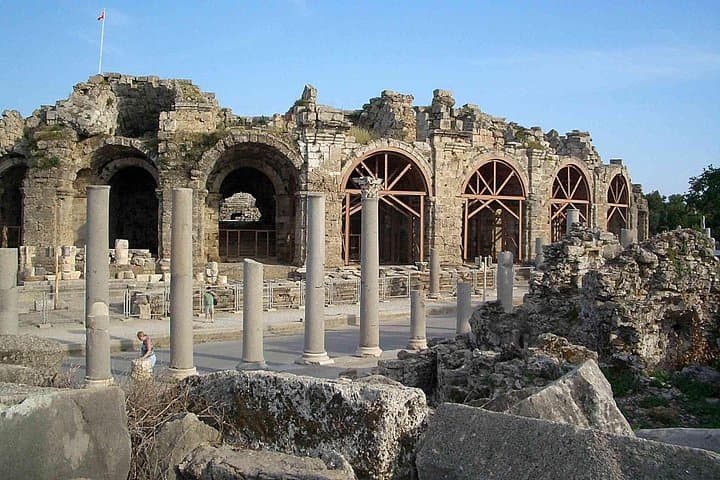
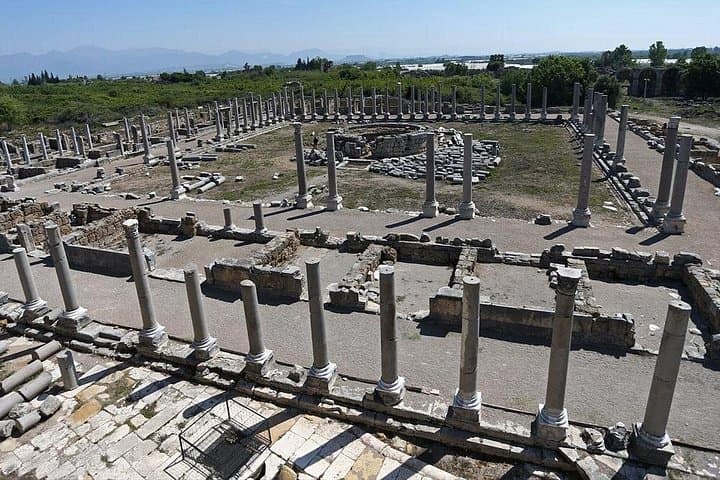
Perge arrives first: a long, low amphitheater of ruined columns, a Roman agora and a paved Cardo Maximus that still hints at its old geometry. Walks here cover roughly 1.5 km across uneven stadium stone and compacted earth, with little elevation gain but plenty of steps. Your guide points out vestiges of Artemis worship and coins stamped with the city’s iconography; these are the signs of a town that traded influence between Persians, Greeks and Romans.
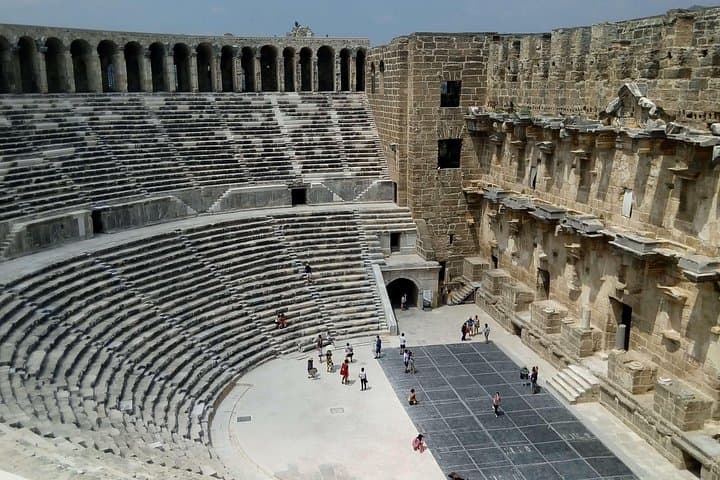
An hour on, and Aspendos asserts itself with one commanding structure — the theater. Built by the Romans and famed for its acoustics, the Aspendos Theater keeps its stone voice. Climbing the theater’s stepped tiers (around 120–150 steps if you loop the outer galleries) gives a sense of scale and of the engineering that put Pamphylia on ancient trade maps. Aspendos once exported salt, oil and wool down the Eurymedon; today the stones still feel like ledger lines of that commerce.
Kurşunlu Waterfall closes the day with a very different rhythm. The river here dares you to slow down; a shaded 600–800 m boardwalk winds through a pine-and-plane forest, dropping about 40–60 m to a pool ringed by ferns. The waterfall’s geology is basalt and travertine in micro‑ledges carved over time — a compact, photogenic contrast to the open ruins of the morning.
Local context matters. These sites sit within Antalya Province, the crossroads of Pamphylia and Lycia; every carved stone and channel has been shaped by centuries of shifting empires and local agricultural life. Expect to eat Turkish-style lunch at a nearby restaurant included in the tour, and to hear local stories over coffee at the waterfall.
Practical guidance: this private tour is 6–8 hours, best started early to avoid midday heat and crowds. Wear supportive walking shoes for uneven ruins, bring sun protection and a refillable water bottle, and carry a light rain layer in spring and fall. The route is low-tech — no climbing gear required — but requires steady footing on steps and narrow paths. Pickup in Antalya city center is standard; check pickup timing and bring a camera, a small backpack, and respect the conservation signs at natural sites to protect fragile mosses and watercourses.
The private tour typically runs 6–8 hours (360–480 minutes) including transport, guided visits, and lunch.
Yes — admission to Perge, Aspendos and Kurşunlu Waterfall is included in the tour price.
Yes — hotel pickup in Antalya city center is available; confirm your exact pickup point when booking.
Yes — the tour is family-friendly, though infants must sit on an adult’s lap and strollers may be used in limited areas.
Expect moderate walking with some stairs and uneven terrain; flat paths at Kurşunlu are short but may be slippery when wet.
Yes — a Turkish-style lunch at a local restaurant is included in the itinerary.
kapadokya seyahat acentası turizm ve otelcilik işlt. ltd.şti. operates guided outdoor trips and adventures with an emphasis on safety, stewardship, and memorable experiences.
The morning light in Antalya hits the coach like a signal: today, the coast gives way to layers of history. You leave the spray of the Mediterranean behind and drive inland, cedars and olive groves flicking past as your private guide outlines a route that has been walked, fought over, and rebuilt for millennia.
The morning light in Antalya hits the coach like a signal: today, the coast gives way to layers of history. You leave the spray of the Mediterranean behind and drive inland, cedars and olive groves flicking past as your private guide outlines a route that has been walked, fought over, and rebuilt for millennia.
Perge arrives first: a long, low amphitheater of ruined columns, a Roman agora and a paved Cardo Maximus that still hints at its old geometry. Walks here cover roughly 1.5 km across uneven stadium stone and compacted earth, with little elevation gain but plenty of steps. Your guide points out vestiges of Artemis worship and coins stamped with the city’s iconography; these are the signs of a town that traded influence between Persians, Greeks and Romans.
An hour on, and Aspendos asserts itself with one commanding structure — the theater. Built by the Romans and famed for its acoustics, the Aspendos Theater keeps its stone voice. Climbing the theater’s stepped tiers (around 120–150 steps if you loop the outer galleries) gives a sense of scale and of the engineering that put Pamphylia on ancient trade maps. Aspendos once exported salt, oil and wool down the Eurymedon; today the stones still feel like ledger lines of that commerce.
Kurşunlu Waterfall closes the day with a very different rhythm. The river here dares you to slow down; a shaded 600–800 m boardwalk winds through a pine-and-plane forest, dropping about 40–60 m to a pool ringed by ferns. The waterfall’s geology is basalt and travertine in micro‑ledges carved over time — a compact, photogenic contrast to the open ruins of the morning.
Local context matters. These sites sit within Antalya Province, the crossroads of Pamphylia and Lycia; every carved stone and channel has been shaped by centuries of shifting empires and local agricultural life. Expect to eat Turkish-style lunch at a nearby restaurant included in the tour, and to hear local stories over coffee at the waterfall.
Practical guidance: this private tour is 6–8 hours, best started early to avoid midday heat and crowds. Wear supportive walking shoes for uneven ruins, bring sun protection and a refillable water bottle, and carry a light rain layer in spring and fall. The route is low-tech — no climbing gear required — but requires steady footing on steps and narrow paths. Pickup in Antalya city center is standard; check pickup timing and bring a camera, a small backpack, and respect the conservation signs at natural sites to protect fragile mosses and watercourses.