THE ADVENTURE COLLECTIVE® · Independent discovery and booking for outdoor travel

A day-long private excursion from Cairo to Wadi Al-Hitan’s fossil fields and the surprising waterfalls of Wadi El Rayan. Expect desert geology, ancient whale remains, and a peaceful oasis contrast in one full-day trip.
A day-long private excursion from Cairo to Wadi Al-Hitan’s fossil fields and the surprising waterfalls of Wadi El Rayan. Expect desert geology, ancient whale remains, and a peaceful oasis contrast in one full-day trip.
You leave Cairo before sunrise and the city’s concrete gives way to broad, quiet desert. By mid-morning you stand on a low limestone ridge at Wadi Al-Hitan (Whales Valley), where fossilized whale skeletons lie half-buried in ochre sand — giants of an ancient sea that the desert now guards.
Verified experiences and guided adventures in the surrounding area.
You leave Cairo before sunrise and the city’s concrete gives way to broad, quiet desert. By mid-morning you stand on a low limestone ridge at Wadi Al-Hitan (Whales Valley), where fossilized whale skeletons lie half-buried in ochre sand — giants of an ancient sea that the desert now guards.
Wadi Al-Hitan is UNESCO-listed for its exceptional paleontological record: Eocene-era archaeocetes that map a coastline that shifted millions of years ago. The geology is simple and honest — sedimentary shelves, gullies carved by flash floods, and exposed strata that read like pages of Earth’s biography. A short drive takes you to Wadi El Rayan, where spring-fed lakes and stepped waterfalls interrupt the desert’s monotony; the upper and lower lakes are man-made features fed by agricultural drainage but have created a striking oasis of migrating birds and ribboned water.
Culturally, Fayoum has long been a farming and pottery region; small villages at the edge of the lakes offer simple cafés and local pottery stalls for quick stops.
Practical guidance: this is a full 10-hour day with long drives on paved and unpaved roads, plus short guided walks on soft sand and rock. Temperatures can spike — start early, carry 3+ liters of water, sun protection, and sturdy walking shoes. Facilities are limited: bring snacks and toilet paper; mobile signal is patchy. Respect marked paths in Wadi Al-Hitan to avoid damaging fossils, and plan photo time at the waterfalls in the late afternoon light for the best contrast against the desert.
The tour is about 10 hours from Cairo with long transfers and short guided walks at each site; expect a relaxed pace with time for photos and breaks.
You can view exposed fossils in Wadi Al-Hitan from marked viewpoints and paths, but touching or removing fossils is prohibited; follow guides and signage.
Older children who tolerate long drives and heat are fine; keep young children shaded and hydrated — facilities are limited.
Facilities are minimal: bring snacks and toilet paper; some small cafés or stalls exist near the lakes but options are limited.
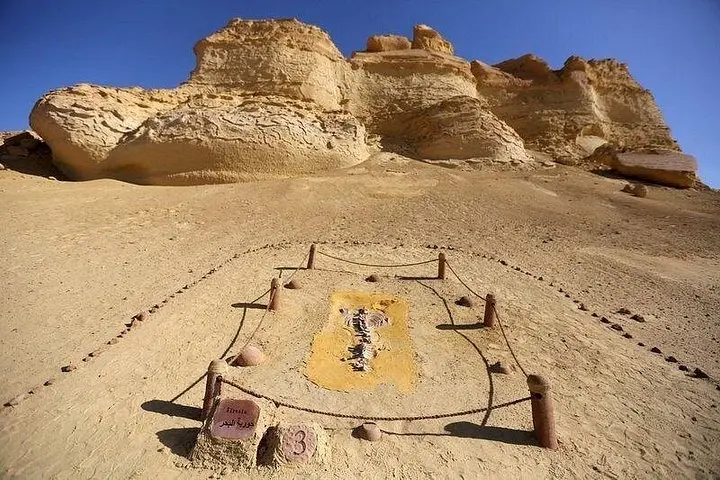
You leave Cairo before sunrise and the city’s concrete gives way to broad, quiet desert. By mid-morning you stand on a low limestone ridge at Wadi Al-Hitan (Whales Valley), where fossilized whale skeletons lie half-buried in ochre sand — giants of an ancient sea that the desert now guards.
You leave Cairo before sunrise and the city’s concrete gives way to broad, quiet desert. By mid-morning you stand on a low limestone ridge at Wadi Al-Hitan (Whales Valley), where fossilized whale skeletons lie half-buried in ochre sand — giants of an ancient sea that the desert now guards.
Wadi Al-Hitan is UNESCO-listed for its exceptional paleontological record: Eocene-era archaeocetes that map a coastline that shifted millions of years ago. The geology is simple and honest — sedimentary shelves, gullies carved by flash floods, and exposed strata that read like pages of Earth’s biography. A short drive takes you to Wadi El Rayan, where spring-fed lakes and stepped waterfalls interrupt the desert’s monotony; the upper and lower lakes are man-made features fed by agricultural drainage but have created a striking oasis of migrating birds and ribboned water.
Culturally, Fayoum has long been a farming and pottery region; small villages at the edge of the lakes offer simple cafés and local pottery stalls for quick stops.
Practical guidance: this is a full 10-hour day with long drives on paved and unpaved roads, plus short guided walks on soft sand and rock. Temperatures can spike — start early, carry 3+ liters of water, sun protection, and sturdy walking shoes. Facilities are limited: bring snacks and toilet paper; mobile signal is patchy. Respect marked paths in Wadi Al-Hitan to avoid damaging fossils, and plan photo time at the waterfalls in the late afternoon light for the best contrast against the desert.