THE ADVENTURE COLLECTIVE® · Independent discovery and booking for outdoor travel

A half-day road out of Baku opens onto an archaeological and geological stage: prehistoric petroglyphs, mud volcanoes that bubble like a lunar plain, and ancient flames that still burn. This full-day loop through Qobustan and Absheron blends hands-on history with raw natural phenomena.
A half-day road out of Baku opens onto an archaeological and geological stage: prehistoric petroglyphs, mud volcanoes that bubble like a lunar plain, and ancient flames that still burn. This full-day loop through Qobustan and Absheron blends hands-on history with raw natural phenomena.
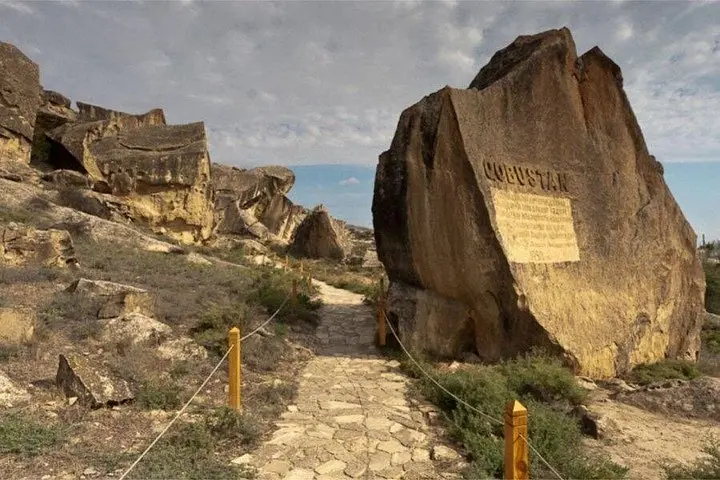
There is a moment on the road out of Baku where the city’s glass towers fall away and the land unspools into a hard, wind-sculpted plain. Your minivan hums along the asphalt and the Caspian waits somewhere off to the right, a pale promise. By midmorning you stand under a low sky at the Gobustan rock art site, where slabs of weathered stone keep a running record of human life on the steppe: hunters with spears, boats with many oars, and abstract spirals carved by hands thousands of years old.
Verified experiences and guided adventures in the surrounding area.
Operated by Royal Travel Baku · Baku, Baku
There is a moment on the road out of Baku where the city’s glass towers fall away and the land unspools into a hard, wind-sculpted plain. Your minivan hums along the asphalt and the Caspian waits somewhere off to the right, a pale promise. By midmorning you stand under a low sky at the Gobustan rock art site, where slabs of weathered stone keep a running record of human life on the steppe: hunters with spears, boats with many oars, and abstract spirals carved by hands thousands of years old.
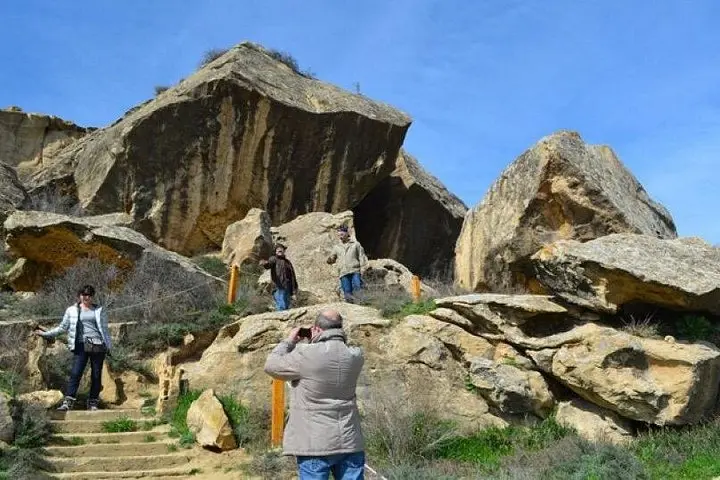
Gobustan’s petroglyphs are the narrative spine of this looped itinerary. The rock art museum provides context—tools, radiocarbon dates and careful interpretation—before you walk the short, uneven trails out to the panels. Geologically, the landscape is a record of sea-level shifts and tectonic squeezes; the same gas-bearing strata that created these dry, cracked plains also feed the nearby mud volcanoes and the ever-burning fires of Absheron.
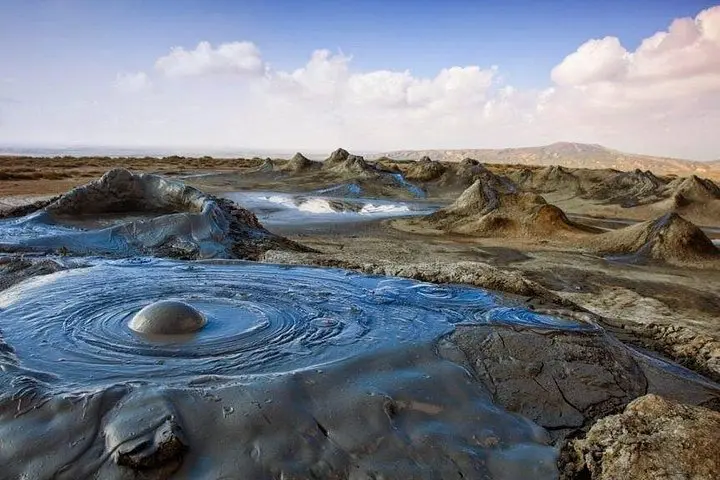
The mud volcanoes look like a planetary surface on pause—bubble pits, conelets of dried grey mud and occasional wet boils that hiss and pop. They are cold, slow eruptions of mud and gas rather than fire, but their alien textures are as convincing as any volcanic field.
Later the tour moves toward Ateshgah and Yanardag—places where gas seeping from the ground meets an old human impulse to interpret flame as sacred. Ateshgah’s stone compound tells a history of pilgrimage, trade and syncretic worship; Yanardag is a living hillside where flame licks from fissures and the night air takes on copper and sulfur.
Practical side: the full program runs about 6.5 hours door-to-door from central Baku, with short walks at each stop (expect 1–3 km of walking, mostly flat with some uneven stone paths and low steps; elevation changes are modest). The pace is easy but requires mobility to climb small slopes and follow trail markers. Bring sunscreen, a sun hat and a sturdy pair of closed-toe shoes—the mud sites can be squelchy; the rock art approaches are loose and rocky.
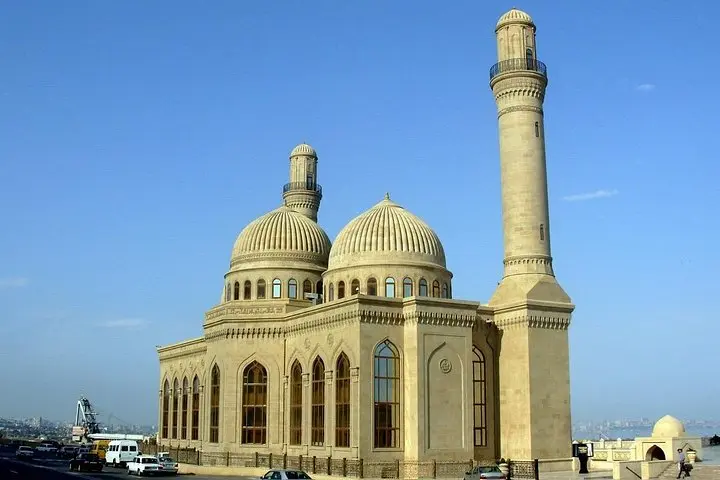
Cultural notes: dress respectfully for mosque and shrine visits; guides usually explain local customs and will point out architecture and historical layers. The tour includes bottled water, an English-speaking guide and air-conditioned transport; if booking for two people you may earn a free Old Town stroll in Baku.
Best time to visit is spring or fall when temperatures are comfortable and dust is lower. Summer brings strong sun and heat; winter can be windy and cool. Preserve the sites: do not touch petroglyphs or climb on fragile features. The landscape here is older than any single story—it will keep its secrets if we keep our distance.
The tour is approximately 6.5 hours and departs from central Baku (the usual meeting point is in front of the Constitutional Court). Pickup options from many hotels and the airport are available.
Admissions to some sites like the mud volcanoes, Yanardag and Ateshgah are included; the museum visit may be included depending on the operator—confirm when booking.
Short walks are required and there are uneven surfaces; it’s family-friendly but not ideal for people with serious mobility limitations—check accessibility details for each stop.
There are restroom facilities at museum and major stops; food is not usually provided beyond water—plan on returning to Baku for a full meal or bring snacks.
Yes—photography is allowed at most sites, though flash and intrusive tripods may be discouraged at sensitive areas and inside religious spaces.
Dress modestly—cover shoulders and knees; women may be asked to cover hair with a scarf when entering mosque compounds.
Royal Travel Baku operates guided outdoor trips and adventures with an emphasis on safety, stewardship, and memorable experiences.
There is a moment on the road out of Baku where the city’s glass towers fall away and the land unspools into a hard, wind-sculpted plain. Your minivan hums along the asphalt and the Caspian waits somewhere off to the right, a pale promise. By midmorning you stand under a low sky at the Gobustan rock art site, where slabs of weathered stone keep a running record of human life on the steppe: hunters with spears, boats with many oars, and abstract spirals carved by hands thousands of years old.
There is a moment on the road out of Baku where the city’s glass towers fall away and the land unspools into a hard, wind-sculpted plain. Your minivan hums along the asphalt and the Caspian waits somewhere off to the right, a pale promise. By midmorning you stand under a low sky at the Gobustan rock art site, where slabs of weathered stone keep a running record of human life on the steppe: hunters with spears, boats with many oars, and abstract spirals carved by hands thousands of years old.
Gobustan’s petroglyphs are the narrative spine of this looped itinerary. The rock art museum provides context—tools, radiocarbon dates and careful interpretation—before you walk the short, uneven trails out to the panels. Geologically, the landscape is a record of sea-level shifts and tectonic squeezes; the same gas-bearing strata that created these dry, cracked plains also feed the nearby mud volcanoes and the ever-burning fires of Absheron.
The mud volcanoes look like a planetary surface on pause—bubble pits, conelets of dried grey mud and occasional wet boils that hiss and pop. They are cold, slow eruptions of mud and gas rather than fire, but their alien textures are as convincing as any volcanic field.
Later the tour moves toward Ateshgah and Yanardag—places where gas seeping from the ground meets an old human impulse to interpret flame as sacred. Ateshgah’s stone compound tells a history of pilgrimage, trade and syncretic worship; Yanardag is a living hillside where flame licks from fissures and the night air takes on copper and sulfur.
Practical side: the full program runs about 6.5 hours door-to-door from central Baku, with short walks at each stop (expect 1–3 km of walking, mostly flat with some uneven stone paths and low steps; elevation changes are modest). The pace is easy but requires mobility to climb small slopes and follow trail markers. Bring sunscreen, a sun hat and a sturdy pair of closed-toe shoes—the mud sites can be squelchy; the rock art approaches are loose and rocky.
Cultural notes: dress respectfully for mosque and shrine visits; guides usually explain local customs and will point out architecture and historical layers. The tour includes bottled water, an English-speaking guide and air-conditioned transport; if booking for two people you may earn a free Old Town stroll in Baku.
Best time to visit is spring or fall when temperatures are comfortable and dust is lower. Summer brings strong sun and heat; winter can be windy and cool. Preserve the sites: do not touch petroglyphs or climb on fragile features. The landscape here is older than any single story—it will keep its secrets if we keep our distance.