THE ADVENTURE COLLECTIVE® · Independent discovery and booking for outdoor travel

Drive a custom street go‑kart through Osaka’s neon lit quarters, guided by professionals who navigate Shinsaibashi, Dotonbori and Namba. This one‑hour urban tour blends pop‑culture costumes with strict ID and safety rules — perfect for city explorers who want speed and local flavor.
Drive a custom street go‑kart through Osaka’s neon lit quarters, guided by professionals who navigate Shinsaibashi, Dotonbori and Namba. This one‑hour urban tour blends pop‑culture costumes with strict ID and safety rules — perfect for city explorers who want speed and local flavor.
The road breathes under a low evening sky as neon signs pulse and the canal nudges the pavement — you slide into a custom street go‑kart and the city immediately rearranges itself around motion. Drivers in playful costumes thread through Shinsaibashi, sweep past Dotonbori’s Glico man and feel the jolt of Osaka’s nightlife push from the sidewalks into the street.
Verified experiences and guided adventures in the surrounding area.
Operated by Street Kart · Osaka, Osaka Prefecture
The road breathes under a low evening sky as neon signs pulse and the canal nudges the pavement — you slide into a custom street go‑kart and the city immediately rearranges itself around motion. Drivers in playful costumes thread through Shinsaibashi, sweep past Dotonbori’s Glico man and feel the jolt of Osaka’s nightlife push from the sidewalks into the street.
Osaka’s center grew as a mercantile hub; its narrow alleys and wide boulevards still reflect layers of Edo‑period trade routes and postwar reconstruction. The geology is plain — flat river plains carved by the Yodo — but the culture is dense: ramen stalls, pachinko light, and a street‑food ethic that rewards slow exploration after the kart returns to the shop.
Expect urban textures: slick asphalt, tight turns, and crowds that thin at off‑peak hours. Guides lead compact groups and enforce local traffic rules and safety; riders must carry an International Driving Permit in the 1949 convention format and their passport. Karts are tuned for city speeds, not racetrack g‑forces; the fun comes from sliding through neighborhoods at a human scale and spotting local details — Hozenji’s moss alleyway or a hidden market stall — that cars skip.
Practical notes: wear closed, flat shoes and minimal loose clothing, arrive early to check IDP documentation, and choose a late‑afternoon slot to avoid rush hour and see neon bloom. Hydrate, secure loose items, and listen to the guide — they manage group spacing and turns so the city stays yours for the hour.
Yes — you must present a physical International Driving Permit issued under the 1949 Geneva Convention (or an accepted translation from JAF for certain countries) plus your passport.
Tours may be canceled or rescheduled for rain or unsafe road conditions; the cancellation policy typically allows a full refund if canceled 24 hours prior.
Yes — costumed rentals are included, but avoid long, loose garments that can catch on the kart; guides will advise on safe costume choices.
Not recommended for travelers with significant mobility or spinal issues; participants should have a moderate level of fitness and be able to enter/exit karts unassisted.
Street Kart operates guided outdoor trips and adventures with an emphasis on safety, stewardship, and memorable experiences.

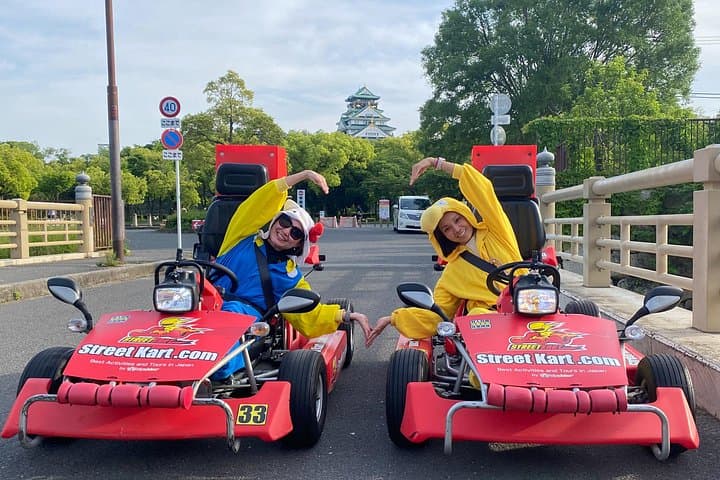


The road breathes under a low evening sky as neon signs pulse and the canal nudges the pavement — you slide into a custom street go‑kart and the city immediately rearranges itself around motion. Drivers in playful costumes thread through Shinsaibashi, sweep past Dotonbori’s Glico man and feel the jolt of Osaka’s nightlife push from the sidewalks into the street.
The road breathes under a low evening sky as neon signs pulse and the canal nudges the pavement — you slide into a custom street go‑kart and the city immediately rearranges itself around motion. Drivers in playful costumes thread through Shinsaibashi, sweep past Dotonbori’s Glico man and feel the jolt of Osaka’s nightlife push from the sidewalks into the street.
Osaka’s center grew as a mercantile hub; its narrow alleys and wide boulevards still reflect layers of Edo‑period trade routes and postwar reconstruction. The geology is plain — flat river plains carved by the Yodo — but the culture is dense: ramen stalls, pachinko light, and a street‑food ethic that rewards slow exploration after the kart returns to the shop.
Expect urban textures: slick asphalt, tight turns, and crowds that thin at off‑peak hours. Guides lead compact groups and enforce local traffic rules and safety; riders must carry an International Driving Permit in the 1949 convention format and their passport. Karts are tuned for city speeds, not racetrack g‑forces; the fun comes from sliding through neighborhoods at a human scale and spotting local details — Hozenji’s moss alleyway or a hidden market stall — that cars skip.
Practical notes: wear closed, flat shoes and minimal loose clothing, arrive early to check IDP documentation, and choose a late‑afternoon slot to avoid rush hour and see neon bloom. Hydrate, secure loose items, and listen to the guide — they manage group spacing and turns so the city stays yours for the hour.