THE ADVENTURE COLLECTIVE® · Independent discovery and booking for outdoor travel

Four hours of whitewater on the Paiva River, framed by Arouca’s folded rock and protected walkways—this family-friendly rafting trip mixes adrenaline with natural history and included safety gear.
Four hours of whitewater on the Paiva River, framed by Arouca’s folded rock and protected walkways—this family-friendly rafting trip mixes adrenaline with natural history and included safety gear.
You feel the river before you see it: a constant, metallic susurration that grows into a confident roar as the canyon narrows. At the Espiunca parking (Km 8), guides tighten helmets and hand out neoprene kits while the Paiva, a ribbon of green cutting through granite and schist, seems to dare the morning light. Within minutes you push off—cold spray on your face, the current picking up like a living engine. Rapids roll under the raft, then ease into glassy pools where kingfishers hunt and the cliffs let loose the scent of fern and wet stone.
Verified experiences and guided adventures in the surrounding area.
Operated by Clube do Paiva - The River Experts · Arouca, Porto
You feel the river before you see it: a constant, metallic susurration that grows into a confident roar as the canyon narrows. At the Espiunca parking (Km 8), guides tighten helmets and hand out neoprene kits while the Paiva, a ribbon of green cutting through granite and schist, seems to dare the morning light. Within minutes you push off—cold spray on your face, the current picking up like a living engine. Rapids roll under the raft, then ease into glassy pools where kingfishers hunt and the cliffs let loose the scent of fern and wet stone.
This short corridor of river sits inside the Arouca Geopark, a region prized for its Precambrian and Palaeozoic geology and dramatic river-carved gorges. The Paiva Walkways, a wooden path built along the riverbank to protect the riparian zone, is visible from several drops; the walkways are recent additions that channel foot traffic away from fragile habitats. Centuries of erosion have exposed folded schist and quartzite here—rock faces that tell a slow story of pressure and time while the river writes the quicker one.
Culturally, Arouca is a territory of small villages, granite farmhouses, and layers of shepherding and textile history. Locals still harvest chestnuts and keep small vineyards; on quieter pools you may see evidence of old stone mills or terraces. Guides often point out protected species, and the operator includes a short photo-report so you leave with more than wet shoes: an illustrated record of the river corridor and the animals that use it.
Practicalities frame the adventure. The full outing runs about four hours, with roughly 1–2 hours on the water depending on conditions. Meeting point is the Paiva Walkways Espiunca side (Km 8); transfers to the launch and complete safety gear are included—neoprene suits and boots, thermal midlayers, windbreaks, helmets, and life jackets. Age limit starts at 5 years, and the route is advertised as suitable for all fitness levels, though it is not recommended for pregnant travelers or those with serious heart or spinal conditions.
Expect changing water and weather. Spring brings higher flows and colder water; summer mean flows drop and air warms; autumn colors deepen the canyon and render the light cinematic; winter outings run on clearer days and are cooler. Bring a swimsuit, quick-dry layers, a towel and a waterproof phone case. Guides lead every run, brief on technique, and moderate the lines through the rapids so families and first-timers can join in the thrills without feeling left behind.
For people who want both adrenaline and a window into a living geological classroom, the Paiva is compact, uncompromising, and accessible—an afternoon where river, stone, and careful stewardship meet on someone else’s timetable, and you get to keep the picture.
The full activity takes about four hours, which includes safety briefing, transfers to the launch, and roughly 1–2 hours of paddling depending on water level.
Children aged 5 and up are accepted and life jackets are provided; basic comfort in the water is recommended but full swimming ability is not required.
Wear a swimsuit and quick-dry layers; bring a towel, change of clothes, and a waterproof case—neoprene suits, boots, helmets, and life jackets are provided.
Meet at the Paiva Walkways parking on the Espiunca side (Km 8); guides will organize transfers and briefing from that point.
Not recommended for pregnant travelers, or those with serious heart or spinal issues; disclose any health concerns when booking.
Full refund if cancelled at least 24 hours before departure; trips may be cancelled for bad weather or unsafe river conditions.
Clube do Paiva - The River Experts operates guided outdoor trips and adventures with an emphasis on safety, stewardship, and memorable experiences.


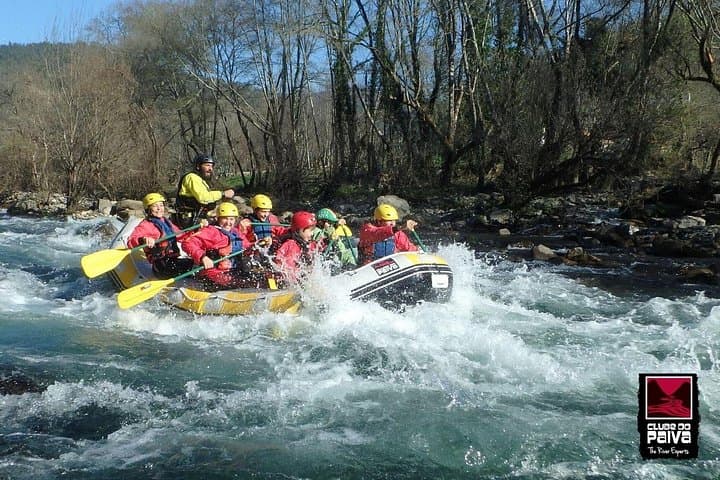

You feel the river before you see it: a constant, metallic susurration that grows into a confident roar as the canyon narrows. At the Espiunca parking (Km 8), guides tighten helmets and hand out neoprene kits while the Paiva, a ribbon of green cutting through granite and schist, seems to dare the morning light. Within minutes you push off—cold spray on your face, the current picking up like a living engine. Rapids roll under the raft, then ease into glassy pools where kingfishers hunt and the cliffs let loose the scent of fern and wet stone.
You feel the river before you see it: a constant, metallic susurration that grows into a confident roar as the canyon narrows. At the Espiunca parking (Km 8), guides tighten helmets and hand out neoprene kits while the Paiva, a ribbon of green cutting through granite and schist, seems to dare the morning light. Within minutes you push off—cold spray on your face, the current picking up like a living engine. Rapids roll under the raft, then ease into glassy pools where kingfishers hunt and the cliffs let loose the scent of fern and wet stone.
This short corridor of river sits inside the Arouca Geopark, a region prized for its Precambrian and Palaeozoic geology and dramatic river-carved gorges. The Paiva Walkways, a wooden path built along the riverbank to protect the riparian zone, is visible from several drops; the walkways are recent additions that channel foot traffic away from fragile habitats. Centuries of erosion have exposed folded schist and quartzite here—rock faces that tell a slow story of pressure and time while the river writes the quicker one.
Culturally, Arouca is a territory of small villages, granite farmhouses, and layers of shepherding and textile history. Locals still harvest chestnuts and keep small vineyards; on quieter pools you may see evidence of old stone mills or terraces. Guides often point out protected species, and the operator includes a short photo-report so you leave with more than wet shoes: an illustrated record of the river corridor and the animals that use it.
Practicalities frame the adventure. The full outing runs about four hours, with roughly 1–2 hours on the water depending on conditions. Meeting point is the Paiva Walkways Espiunca side (Km 8); transfers to the launch and complete safety gear are included—neoprene suits and boots, thermal midlayers, windbreaks, helmets, and life jackets. Age limit starts at 5 years, and the route is advertised as suitable for all fitness levels, though it is not recommended for pregnant travelers or those with serious heart or spinal conditions.
Expect changing water and weather. Spring brings higher flows and colder water; summer mean flows drop and air warms; autumn colors deepen the canyon and render the light cinematic; winter outings run on clearer days and are cooler. Bring a swimsuit, quick-dry layers, a towel and a waterproof phone case. Guides lead every run, brief on technique, and moderate the lines through the rapids so families and first-timers can join in the thrills without feeling left behind.
For people who want both adrenaline and a window into a living geological classroom, the Paiva is compact, uncompromising, and accessible—an afternoon where river, stone, and careful stewardship meet on someone else’s timetable, and you get to keep the picture.