THE ADVENTURE COLLECTIVE® · Independent discovery and booking for outdoor travel

Trace the origins of the Rapanui people on a private, full-day archaeological tour of Easter Island. Visit Vinapu, Te Pito Kura, Puna Pau and swim at Anakena while a local guide explains moai, quarries and restoration efforts.
Trace the origins of the Rapanui people on a private, full-day archaeological tour of Easter Island. Visit Vinapu, Te Pito Kura, Puna Pau and swim at Anakena while a local guide explains moai, quarries and restoration efforts.
You step off the shaded van and the wind on Easter Island already seems to have a voice, nudging you toward stone giants laid out across plains of volcanic tuff. Over the next seven to eight hours this private field trip walks the island’s archaeology in human scale: Vinapu’s megalithic faces, the magnetic oddity of Te Pito Kura, the red scoria of Puna Pau and the white sand bay of Anakena where chiefs once landed.
Verified experiences and guided adventures in the surrounding area.
Operated by Rapanui Pioneers Society (RPS) · Hanga Roa, Valparaíso Region
You step off the shaded van and the wind on Easter Island already seems to have a voice, nudging you toward stone giants laid out across plains of volcanic tuff. Over the next seven to eight hours this private field trip walks the island’s archaeology in human scale: Vinapu’s megalithic faces, the magnetic oddity of Te Pito Kura, the red scoria of Puna Pau and the white sand bay of Anakena where chiefs once landed.
Geology here is blunt and immediate — basalt flows and ash tuff sculpted by a single volcanic chain. The moai are carved from tuff quarried at Rano Raraku and finished with pukao from Puna Pau’s red scoria; at Vinapu you can see stonework that has sparked centuries of debate about techniques and contact.
Culturally, the moai are public memory given mass: ancestor statues set to watch the living. The island’s history includes a vibrant Polynesian society, later disruptions from contact and missionary eras, and modern restoration that blends local knowledge and archaeology under Rapanui National Park’s protection.
Practical guidance: plan for uneven ground and short walks at each site, sun that can be relentless, and limited facilities at remote ahu. A licensed local guide and private vehicle are included; expect multiple short stops, a beach lunch at Anakena, and flexible pacing to spend more time where you want. Bring water, sun protection, sturdy footwear and respect cordoned sites — the island’s archaeology is fragile and controlled by local conservation rules.
The tour runs about 7–8 hours (450 minutes) and includes private transport, an expert local guide, site visits listed in the itinerary and lunch at Anakena as described.
Yes — Anakena has a sheltered white-sand beach and swimming is possible; facilities are basic and there may be a small fee for changing rooms.
Rapanui National Park has entrance fees that support conservation; verify current fees before travel and keep proof of payment if required by your operator.
Children can participate but should be supervised; travelers with limited mobility may find some sites challenging due to uneven ground — consult the operator about pickup and specific site accessibility.
Rapanui Pioneers Society (RPS) operates guided outdoor trips and adventures with an emphasis on safety, stewardship, and memorable experiences.
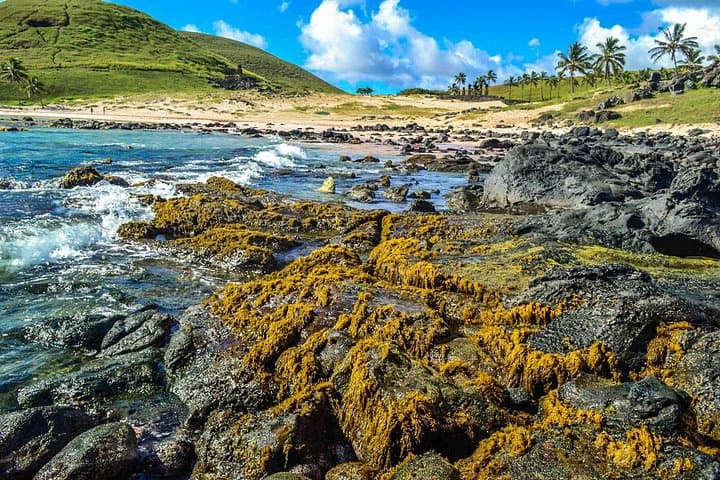


You step off the shaded van and the wind on Easter Island already seems to have a voice, nudging you toward stone giants laid out across plains of volcanic tuff. Over the next seven to eight hours this private field trip walks the island’s archaeology in human scale: Vinapu’s megalithic faces, the magnetic oddity of Te Pito Kura, the red scoria of Puna Pau and the white sand bay of Anakena where chiefs once landed.
You step off the shaded van and the wind on Easter Island already seems to have a voice, nudging you toward stone giants laid out across plains of volcanic tuff. Over the next seven to eight hours this private field trip walks the island’s archaeology in human scale: Vinapu’s megalithic faces, the magnetic oddity of Te Pito Kura, the red scoria of Puna Pau and the white sand bay of Anakena where chiefs once landed.
Geology here is blunt and immediate — basalt flows and ash tuff sculpted by a single volcanic chain. The moai are carved from tuff quarried at Rano Raraku and finished with pukao from Puna Pau’s red scoria; at Vinapu you can see stonework that has sparked centuries of debate about techniques and contact.
Culturally, the moai are public memory given mass: ancestor statues set to watch the living. The island’s history includes a vibrant Polynesian society, later disruptions from contact and missionary eras, and modern restoration that blends local knowledge and archaeology under Rapanui National Park’s protection.
Practical guidance: plan for uneven ground and short walks at each site, sun that can be relentless, and limited facilities at remote ahu. A licensed local guide and private vehicle are included; expect multiple short stops, a beach lunch at Anakena, and flexible pacing to spend more time where you want. Bring water, sun protection, sturdy footwear and respect cordoned sites — the island’s archaeology is fragile and controlled by local conservation rules.