THE ADVENTURE COLLECTIVE® · Independent discovery and booking for outdoor travel

A quieter, northeasterly approach to Kilimanjaro, the Rongai Route offers patient ascents, wide trails, and an acclimatization day beneath Mawenzi. This 7-day itinerary balances summit ambition with smart pacing—ideal for climbers who want solitude and a higher success rate.
A quieter, northeasterly approach to Kilimanjaro, the Rongai Route offers patient ascents, wide trails, and an acclimatization day beneath Mawenzi. This 7-day itinerary balances summit ambition with smart pacing—ideal for climbers who want solitude and a higher success rate.
Pre-dawn on day six, headlamp beams stitch a ribbon of light up a black slope. The air is thin enough that each breath feels deliberate; the world narrows to boot, rope, and the slow, patient rhythm your guide urges. Above you, the jagged silhouette of Mawenzi gives way to Kibo’s white crown—Uhuru Peak—still hours and thousands of breaths away.
Verified experiences and guided adventures in the surrounding area.
Operated by ZARA TOURS · Moshi, Kilimanjaro Region
Pre-dawn on day six, headlamp beams stitch a ribbon of light up a black slope. The air is thin enough that each breath feels deliberate; the world narrows to boot, rope, and the slow, patient rhythm your guide urges. Above you, the jagged silhouette of Mawenzi gives way to Kibo’s white crown—Uhuru Peak—still hours and thousands of breaths away.
The Rongai Route approaches Kilimanjaro from the northeast, a quieter corridor used by pastoralists long before it became a path for climbers. Unlike Marangu or Machame, Rongai conserves a slower tempo: wide trails through farmland, banks of pine, moorland dotted with giant senecios, then the lunar Saddle between Mawenzi and Kibo. Geologically, the mountain is a stratovolcano with the still-intact Kibo crater at its heart; glacial remnants at the summit are shrinking, reminders of a rapidly changing climate.
Culture follows the road into Moshi—coffee farms, Chagga villages with stone terraces and banana groves, and porters whose knowledge of the mountain rivals any map. Guides from Zara Tanzania Adventures layer local stories into briefings: how caravans once moved by moonlight to avoid the afternoon heat, and how community tourism channels funds back into conservation and schools.
The itinerary is deliberately paced: five nights on the mountain with an acclimatization day at Mawenzi Tarn, a summit push that begins around midnight, and a long descent back to Marangu Gate. Expect daily hiking distances from 6–22 km and altitude ranges from about 1,950 m at Rongai Gate to 5,895 m at Uhuru Peak. The hardest day is the final ascent and rapid descent—12–15 hours that require steady energy management and careful pacing.
Practical guidance: hydrate early and often—aim for 3–4 liters a day on ascent. Layering is essential; temperatures swing from humid lowland warmth to sub-zero wind at the rim. Boots should be broken in and have good ankle support; trekking poles are invaluable on scree. Your guide will monitor for AMS symptoms—report headaches, nausea, or dizziness immediately. Allow the extra acclimatization day at Mawenzi Tarn; it’s not luxury, it’s insurance.
Logistics are straightforward: pickup from Moshi or Kilimanjaro Airport, seven days total, meals included on the mountain, and camping or basic hut accommodations depending on nights. Physically, this is an endurance challenge more than a technical climb; no ropes or ice axes are required for the standard route, but respect the altitude. If you want a quieter approach to Africa’s highest peak that trades crowds for landscape and acclimatization time, Rongai delivers a disciplined, elemental ascent with real cultural context and conservation-minded operators.
This typical Rongai itinerary runs seven days, including an acclimatization day at Mawenzi Tarn and a midnight summit push.
No technical mountaineering skills are required for the standard Rongai Route—it's a high-altitude trek rather than a technical climb.
You’ll range from about 1,950 m to 5,895 m; the summit day is the longest and most strenuous—expect 12–15 hours with steep sections near the rim.
Yes—meals (breakfast, lunch, dinner) are included on the mountain, typically prepared by support staff and tailored for high-energy trekking.
Train with long hikes carrying a daypack, build aerobic fitness, and include stair or hill repeats; practice with altitude where possible.
Guides monitor symptoms closely; they may slow pace, administer oxygen, descend if necessary, or evacuate to lower altitude for safety.
ZARA TOURS operates guided outdoor trips and adventures with an emphasis on safety, stewardship, and memorable experiences.
Pre-dawn on day six, headlamp beams stitch a ribbon of light up a black slope. The air is thin enough that each breath feels deliberate; the world narrows to boot, rope, and the slow, patient rhythm your guide urges. Above you, the jagged silhouette of Mawenzi gives way to Kibo’s white crown—Uhuru Peak—still hours and thousands of breaths away.
Pre-dawn on day six, headlamp beams stitch a ribbon of light up a black slope. The air is thin enough that each breath feels deliberate; the world narrows to boot, rope, and the slow, patient rhythm your guide urges. Above you, the jagged silhouette of Mawenzi gives way to Kibo’s white crown—Uhuru Peak—still hours and thousands of breaths away.
The Rongai Route approaches Kilimanjaro from the northeast, a quieter corridor used by pastoralists long before it became a path for climbers. Unlike Marangu or Machame, Rongai conserves a slower tempo: wide trails through farmland, banks of pine, moorland dotted with giant senecios, then the lunar Saddle between Mawenzi and Kibo. Geologically, the mountain is a stratovolcano with the still-intact Kibo crater at its heart; glacial remnants at the summit are shrinking, reminders of a rapidly changing climate.
Culture follows the road into Moshi—coffee farms, Chagga villages with stone terraces and banana groves, and porters whose knowledge of the mountain rivals any map. Guides from Zara Tanzania Adventures layer local stories into briefings: how caravans once moved by moonlight to avoid the afternoon heat, and how community tourism channels funds back into conservation and schools.
The itinerary is deliberately paced: five nights on the mountain with an acclimatization day at Mawenzi Tarn, a summit push that begins around midnight, and a long descent back to Marangu Gate. Expect daily hiking distances from 6–22 km and altitude ranges from about 1,950 m at Rongai Gate to 5,895 m at Uhuru Peak. The hardest day is the final ascent and rapid descent—12–15 hours that require steady energy management and careful pacing.
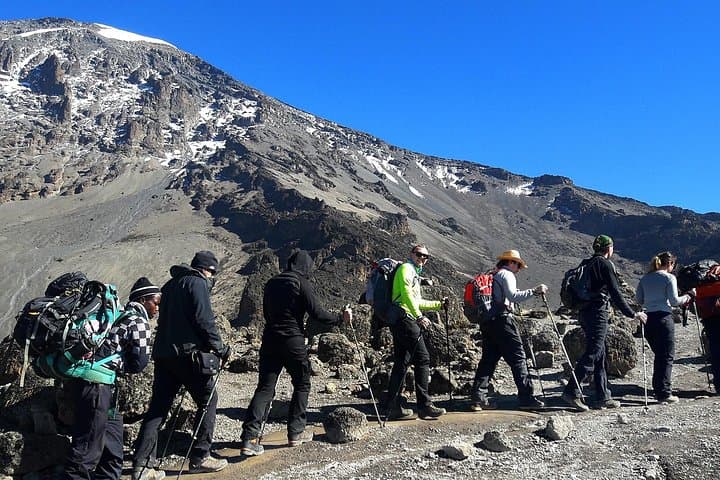
Practical guidance: hydrate early and often—aim for 3–4 liters a day on ascent. Layering is essential; temperatures swing from humid lowland warmth to sub-zero wind at the rim. Boots should be broken in and have good ankle support; trekking poles are invaluable on scree. Your guide will monitor for AMS symptoms—report headaches, nausea, or dizziness immediately. Allow the extra acclimatization day at Mawenzi Tarn; it’s not luxury, it’s insurance.
Logistics are straightforward: pickup from Moshi or Kilimanjaro Airport, seven days total, meals included on the mountain, and camping or basic hut accommodations depending on nights. Physically, this is an endurance challenge more than a technical climb; no ropes or ice axes are required for the standard route, but respect the altitude. If you want a quieter approach to Africa’s highest peak that trades crowds for landscape and acclimatization time, Rongai delivers a disciplined, elemental ascent with real cultural context and conservation-minded operators.