THE ADVENTURE COLLECTIVE® · Independent discovery and booking for outdoor travel

Travel the Transapuseana into the Apuseni to explore one of Europe’s oldest gold mines and complete an 8 km hike across a historic mining landscape. This full-day trip combines archaeology, mountain views and a local conservation story.
Travel the Transapuseana into the Apuseni to explore one of Europe’s oldest gold mines and complete an 8 km hike across a historic mining landscape. This full-day trip combines archaeology, mountain views and a local conservation story.
You leave Cluj on the Transapuseana and the road seems to push the hills aside, offering 360-degree views that sharpen as you descend into the Apuseni. By midmorning you stand at the edge of Roșia Montană’s cobbled lanes and breath that smells faintly of pine and old rock; nearby, a Roman gallery yawns into the mountain like a story waiting to be read.
Verified experiences and guided adventures in the surrounding area.
Operated by Get a Cluj Tour · Roșia Montană, Alba
You leave Cluj on the Transapuseana and the road seems to push the hills aside, offering 360-degree views that sharpen as you descend into the Apuseni. By midmorning you stand at the edge of Roșia Montană’s cobbled lanes and breath that smells faintly of pine and old rock; nearby, a Roman gallery yawns into the mountain like a story waiting to be read.
The site began as Alburnus Maior when Rome arrived more than 2,000 years ago; the tunnels and spoil heaps are geological records of gold-bearing quartz veins and human industry. The village’s layered history—Roman engineering, medieval exploitation, 20th-century politics and a 21st-century civic movement—culminated in its 2021 UNESCO inscription and the halted cyanide project that once threatened the valley.
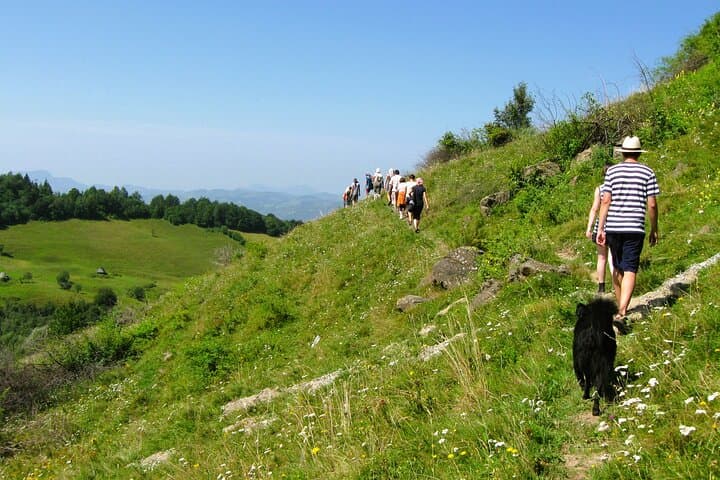
The guided visit includes the Mining Museum and a walk through ancient galleries, followed by an 8 km hike across pastoral slopes and former mining terraces (elevation 847–1,112 m; ~265 m net gain; ~2.5 hours walking). Trails range from packed dirt to rocky switchbacks; forests will often seem to close in and then fling wide on exposed ridgelines where views over the Arieș Valley reward the climb.
Practical guidance: bring sturdy boots, at least 1 L water plus layers for sudden weather shifts, and allow 12–13 hours for transport, interpretation, and the hike. Respect fenced historic entrances and follow your guide—this is a cultural landscape as much as it is a walk in the mountains.
Yes—entrance to the Mining Museum and guided access to historic galleries are included in the tour price.
The guided hike is about 8 km with minimum elevation ~847 m and maximum ~1,112 m, roughly 265 m net change and about 2.5 hours walking time.
Yes—hotel pick up and drop off in Cluj-Napoca are provided for private tours and meeting instructions are given for shared departures.
Service animals are permitted; general pets are not recommended due to museum restrictions, transportation rules and trail conditions.
Get a Cluj Tour operates guided outdoor trips and adventures with an emphasis on safety, stewardship, and memorable experiences.


You leave Cluj on the Transapuseana and the road seems to push the hills aside, offering 360-degree views that sharpen as you descend into the Apuseni. By midmorning you stand at the edge of Roșia Montană’s cobbled lanes and breath that smells faintly of pine and old rock; nearby, a Roman gallery yawns into the mountain like a story waiting to be read.
You leave Cluj on the Transapuseana and the road seems to push the hills aside, offering 360-degree views that sharpen as you descend into the Apuseni. By midmorning you stand at the edge of Roșia Montană’s cobbled lanes and breath that smells faintly of pine and old rock; nearby, a Roman gallery yawns into the mountain like a story waiting to be read.
The site began as Alburnus Maior when Rome arrived more than 2,000 years ago; the tunnels and spoil heaps are geological records of gold-bearing quartz veins and human industry. The village’s layered history—Roman engineering, medieval exploitation, 20th-century politics and a 21st-century civic movement—culminated in its 2021 UNESCO inscription and the halted cyanide project that once threatened the valley.
The guided visit includes the Mining Museum and a walk through ancient galleries, followed by an 8 km hike across pastoral slopes and former mining terraces (elevation 847–1,112 m; ~265 m net gain; ~2.5 hours walking). Trails range from packed dirt to rocky switchbacks; forests will often seem to close in and then fling wide on exposed ridgelines where views over the Arieș Valley reward the climb.
Practical guidance: bring sturdy boots, at least 1 L water plus layers for sudden weather shifts, and allow 12–13 hours for transport, interpretation, and the hike. Respect fenced historic entrances and follow your guide—this is a cultural landscape as much as it is a walk in the mountains.