THE ADVENTURE COLLECTIVE® · Independent discovery and booking for outdoor travel

Sail into Tauranga and spend your day in Rotorua’s living geothermal world, guided by locals who’ve harnessed steam and hot springs for generations. This shore excursion threads together redwood groves, Māori culture, and geysers—timed to get you back to the ship with stories still warm.
Sail into Tauranga and spend your day in Rotorua’s living geothermal world, guided by locals who’ve harnessed steam and hot springs for generations. This shore excursion threads together redwood groves, Māori culture, and geysers—timed to get you back to the ship with stories still warm.
Morning breaks over Mauao as the Pacific slides against Pilot Bay, and a small group steps from the cruise port toward a waiting coach. Within minutes, Tauranga’s salt air gives way to the sweet-green scent of kiwifruit country. The road climbs inland past rows of trellised vines, farmland opening to the volcanic heart of the North Island. Ahead, the land exhales—thin white plumes rise from Rotorua’s basin, the earth quietly breathing before you even arrive.
Verified experiences and guided adventures in the surrounding area.
Operated by Zealandier Tours · Tauranga, Bay of Plenty
Morning breaks over Mauao as the Pacific slides against Pilot Bay, and a small group steps from the cruise port toward a waiting coach. Within minutes, Tauranga’s salt air gives way to the sweet-green scent of kiwifruit country. The road climbs inland past rows of trellised vines, farmland opening to the volcanic heart of the North Island. Ahead, the land exhales—thin white plumes rise from Rotorua’s basin, the earth quietly breathing before you even arrive.
This shore excursion compresses the region’s greatest hits into a well-paced day designed around your ship’s time in port. First look: Whakarewarewa Forest, where Californian redwoods tower 60 meters above soft, pine-scented trails. The trees stand like a patient audience while your guide lays out local honey and tangy kiwifruit—a small, bright flavor of the Bay of Plenty—before the journey continues toward Rotorua proper.
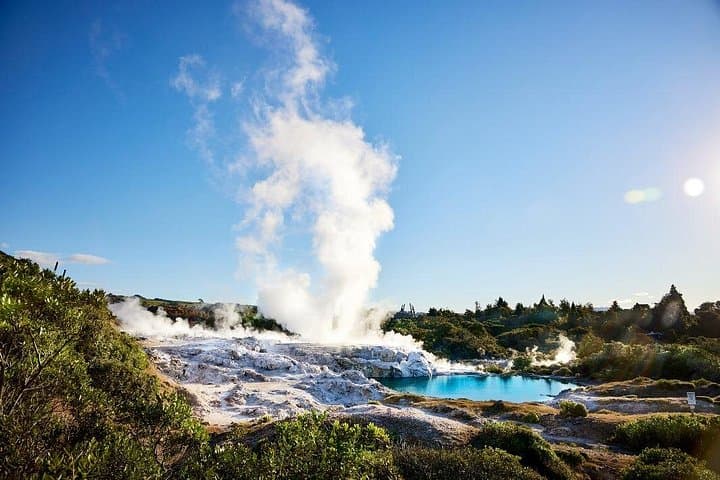
In the Government Gardens, Edwardian facades meet a deep Māori story. The land was gifted by Ngāti Whakaue in the late 19th century “for the people of the world,” and you can still feel that generous idea in the open lawns and the steady bubble of Rachel Spring. But it’s at Whakarewarewa—the Living Māori Village—where the region’s geology and culture fully connect. Here, steam vents thread through backyards. Pools simmer. The ground mutters underfoot. A local guide welcomes you onto their whenua (land) and walks you through daily life lived atop a geothermal field: corn cooked in mineral-rich water, meals slow-steamed in ground vents, bathhouses warmed by the earth. The village speaks, and the geysers answer. When Pohutu erupts—sometimes 20 times a day—it drums skyward, a measure of raw heat pushing its own cadence into the air.
Lunch fits the day’s rhythm, with time to eat near the lakefront or at the village café depending on capacity. On the return, a brief stop at the Kaituna River’s Trout Pool reveals another facet of this landscape: emerald water sliding through native bush, a nervous energy that sends rafters over nearby drops. Even if no boats appear, the river presses on, daring the Bay to keep up.
Expect light walking throughout: short, even paths in the redwoods, boardwalks and packed gravel at the village, a few steps and gentle slopes. Plan for 7 hours round-trip from the port, with flexible departure to match your ship. Bring a layer—the inland plateau runs cooler than the coast—and don’t be surprised by the sulfur scent; like the steam, it’s part of Rotorua’s signature. By the time Mauao returns to view, you’ve traced the island’s spine from sand to steam and back again, a tidy arc across the Bay of Plenty.
Expect 2–3 km total across the day on flat forest paths, geothermal boardwalks, and garden walkways with short stairs.
Lunch is not included. The guide will stop near the lakefront or at the village café for you to purchase food.
Yes. The tour is scheduled around your ship’s arrival and departure and includes a worry-free on-time return policy.
You’ll notice a sulfur scent around geothermal areas, especially on cooler days, but most visitors adapt quickly.
Yes. Facilities are available at major stops including the redwoods, Government Gardens area, and the Living Māori Village.
It’s suitable for most abilities, but some uneven surfaces and steps exist at the village. Mobility aids may have limited access in certain areas.
Zealandier Tours operates guided outdoor trips and adventures with an emphasis on safety, stewardship, and memorable experiences.


Morning breaks over Mauao as the Pacific slides against Pilot Bay, and a small group steps from the cruise port toward a waiting coach. Within minutes, Tauranga’s salt air gives way to the sweet-green scent of kiwifruit country. The road climbs inland past rows of trellised vines, farmland opening to the volcanic heart of the North Island. Ahead, the land exhales—thin white plumes rise from Rotorua’s basin, the earth quietly breathing before you even arrive.
Morning breaks over Mauao as the Pacific slides against Pilot Bay, and a small group steps from the cruise port toward a waiting coach. Within minutes, Tauranga’s salt air gives way to the sweet-green scent of kiwifruit country. The road climbs inland past rows of trellised vines, farmland opening to the volcanic heart of the North Island. Ahead, the land exhales—thin white plumes rise from Rotorua’s basin, the earth quietly breathing before you even arrive.
This shore excursion compresses the region’s greatest hits into a well-paced day designed around your ship’s time in port. First look: Whakarewarewa Forest, where Californian redwoods tower 60 meters above soft, pine-scented trails. The trees stand like a patient audience while your guide lays out local honey and tangy kiwifruit—a small, bright flavor of the Bay of Plenty—before the journey continues toward Rotorua proper.
In the Government Gardens, Edwardian facades meet a deep Māori story. The land was gifted by Ngāti Whakaue in the late 19th century “for the people of the world,” and you can still feel that generous idea in the open lawns and the steady bubble of Rachel Spring. But it’s at Whakarewarewa—the Living Māori Village—where the region’s geology and culture fully connect. Here, steam vents thread through backyards. Pools simmer. The ground mutters underfoot. A local guide welcomes you onto their whenua (land) and walks you through daily life lived atop a geothermal field: corn cooked in mineral-rich water, meals slow-steamed in ground vents, bathhouses warmed by the earth. The village speaks, and the geysers answer. When Pohutu erupts—sometimes 20 times a day—it drums skyward, a measure of raw heat pushing its own cadence into the air.
Lunch fits the day’s rhythm, with time to eat near the lakefront or at the village café depending on capacity. On the return, a brief stop at the Kaituna River’s Trout Pool reveals another facet of this landscape: emerald water sliding through native bush, a nervous energy that sends rafters over nearby drops. Even if no boats appear, the river presses on, daring the Bay to keep up.
Expect light walking throughout: short, even paths in the redwoods, boardwalks and packed gravel at the village, a few steps and gentle slopes. Plan for 7 hours round-trip from the port, with flexible departure to match your ship. Bring a layer—the inland plateau runs cooler than the coast—and don’t be surprised by the sulfur scent; like the steam, it’s part of Rotorua’s signature. By the time Mauao returns to view, you’ve traced the island’s spine from sand to steam and back again, a tidy arc across the Bay of Plenty.