THE ADVENTURE COLLECTIVE® · Independent discovery and booking for outdoor travel

Hit the pavement for a two‑hour running tour that threads Paris’s modern and historic cores — from Hôtel de Ville through Les Halles and up to Sacré‑Cœur. Expect cobbles, Haussmann boulevards, and panoramic city views with practical tips for timing and gear.
Hit the pavement for a two‑hour running tour that threads Paris’s modern and historic cores — from Hôtel de Ville through Les Halles and up to Sacré‑Cœur. Expect cobbles, Haussmann boulevards, and panoramic city views with practical tips for timing and gear.
The run begins where the city opens its arms: beside the Hôtel de Ville, feet on Rue de Rivoli as lamps and shopfronts blur into motion. For two hours you move through changing Paris — glass and metal of the Centre Pompidou, the compact crossroads of Les Halles, the classical hush of the Palais‑Royal, and the jewel-box geometry of Place Vendôme. The route climbs to Montmartre, finishing with the broad sweep of the city laid out beneath the Sacré‑Cœur.
Verified experiences and guided adventures in the surrounding area.
The run begins where the city opens its arms: beside the Hôtel de Ville, feet on Rue de Rivoli as lamps and shopfronts blur into motion. For two hours you move through changing Paris — glass and metal of the Centre Pompidou, the compact crossroads of Les Halles, the classical hush of the Palais‑Royal, and the jewel-box geometry of Place Vendôme. The route climbs to Montmartre, finishing with the broad sweep of the city laid out beneath the Sacré‑Cœur.
Paris is a layered city: Roman roads and medieval alleys under modern boulevards, a riverscape carved by the Seine and shaped by Haussmann’s 19th‑century redesign. Architecture tells the cultural story — baroque opulence at the Opéra Garnier, bold modernism at the Pompidou — while cafés and corner boulangeries mark neighborhood life. Expect cobblestones and broad paved boulevards, riverfront stretches, and a steady ascent up the Butte Montmartre that rewards with panoramic views.
Practical guidance: this is a two‑hour urban run at a conversational pace — roughly 5–8 km depending on stops — so train for easy endurance and run in supportive road shoes with good grip for cobbles. Bring a small hydration bottle or a light pack, carry a card for transit back to your hotel, and choose early evening or morning to avoid peak foot‑traffic. Be prepared for route adjustments during major events (notably the Paris 2024 Games); confirm the meeting point near Hôtel de Ville. Travel light, watch traffic at intersections, and let the city’s architecture set the cadence — the streets push you forward and Paris answers with history at every step.
The tour lasts about two hours and runs at a conversational pace with short photo stops; expect roughly 5–8 km depending on routing and crowds.
Between 18 July and 8 September 2024 the meeting point is next to the Hôtel de Ville metro station on rue de Rivoli, in front of the Hôtel de Ville.
No — parts of the route include cobblestones, narrow sidewalks and a steep climb to Montmartre that are not suitable for wheelchair access.
Small, secure packs are fine but avoid large rucksacks; carry essentials in a zipped pocket and consider leaving valuables at your accommodation.
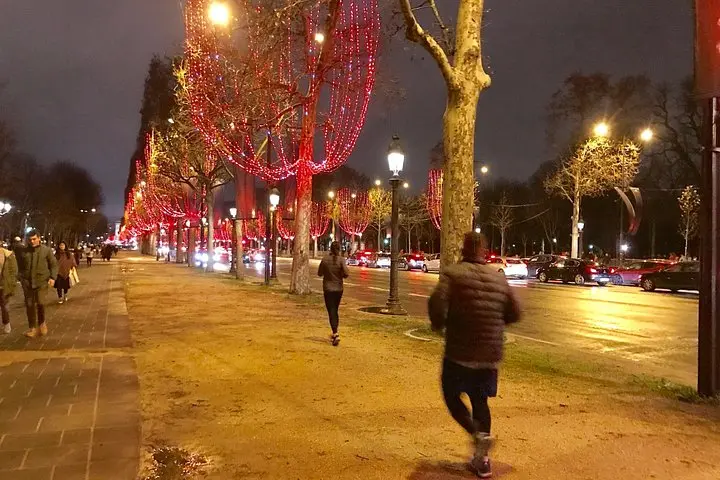
The run begins where the city opens its arms: beside the Hôtel de Ville, feet on Rue de Rivoli as lamps and shopfronts blur into motion. For two hours you move through changing Paris — glass and metal of the Centre Pompidou, the compact crossroads of Les Halles, the classical hush of the Palais‑Royal, and the jewel-box geometry of Place Vendôme. The route climbs to Montmartre, finishing with the broad sweep of the city laid out beneath the Sacré‑Cœur.
The run begins where the city opens its arms: beside the Hôtel de Ville, feet on Rue de Rivoli as lamps and shopfronts blur into motion. For two hours you move through changing Paris — glass and metal of the Centre Pompidou, the compact crossroads of Les Halles, the classical hush of the Palais‑Royal, and the jewel-box geometry of Place Vendôme. The route climbs to Montmartre, finishing with the broad sweep of the city laid out beneath the Sacré‑Cœur.
Paris is a layered city: Roman roads and medieval alleys under modern boulevards, a riverscape carved by the Seine and shaped by Haussmann’s 19th‑century redesign. Architecture tells the cultural story — baroque opulence at the Opéra Garnier, bold modernism at the Pompidou — while cafés and corner boulangeries mark neighborhood life. Expect cobblestones and broad paved boulevards, riverfront stretches, and a steady ascent up the Butte Montmartre that rewards with panoramic views.
Practical guidance: this is a two‑hour urban run at a conversational pace — roughly 5–8 km depending on stops — so train for easy endurance and run in supportive road shoes with good grip for cobbles. Bring a small hydration bottle or a light pack, carry a card for transit back to your hotel, and choose early evening or morning to avoid peak foot‑traffic. Be prepared for route adjustments during major events (notably the Paris 2024 Games); confirm the meeting point near Hôtel de Ville. Travel light, watch traffic at intersections, and let the city’s architecture set the cadence — the streets push you forward and Paris answers with history at every step.