THE ADVENTURE COLLECTIVE® · Independent discovery and booking for outdoor travel

Walk the Thames Path where the Magna Carta was sealed and discover riverside memorials that invite conversation with history. This self-guided audio tour pairs clear directions with reflective stops — ideal for a 60–90 minute cultural walk near Egham.
Walk the Thames Path where the Magna Carta was sealed and discover riverside memorials that invite conversation with history. This self-guided audio tour pairs clear directions with reflective stops — ideal for a 60–90 minute cultural walk near Egham.
The walk begins beside the bronze Queen Elizabeth II statue, where the Thames eases past meadow and cause the reeds to lean like listeners. A gravel strip of the Thames Path unfurls downstream: boats drift, cattle graze on wet grass, and the river’s current seems to insist you slow your pace and look. The route traces the place where, in 1215, barons and a reluctant king shaped limits on power — a compact, grassy stage of English constitutional history.
Verified experiences and guided adventures in the surrounding area.
Operated by VoiceMap Audio Tours · Egham, Surrey
The walk begins beside the bronze Queen Elizabeth II statue, where the Thames eases past meadow and cause the reeds to lean like listeners. A gravel strip of the Thames Path unfurls downstream: boats drift, cattle graze on wet grass, and the river’s current seems to insist you slow your pace and look. The route traces the place where, in 1215, barons and a reluctant king shaped limits on power — a compact, grassy stage of English constitutional history.
Runnymede’s riverside is low-lying gravel terrace carved by the Thames over millennia; you’ll pass historic markers such as the Magna Carta Memorial, the John F. Kennedy Memorial, and modern installations like Writ in Water and The Jurors. Nearby Ankerwycke hides an ancient yew and traces of Bronze Age activity, while Tudor associations — Henry VIII’s reputed haunts — give the landscape an intimate, human scale. Local culture leans toward reflective remembrance: memorials are designed to be sat with, read, and discussed.
Practically, expect 1–1.5 hours of easy walking on compacted paths with occasional muddy stretches after rain. The trail is largely flat but exposed to wind and sun; bring a waterproof layer and sensible footwear. Use the downloadable GPS tour for narration and offline maps, and plan a stop at the Magna Carta Tea Room if you want refreshments. Respect pasture fencing and livestock, keep dogs under control, and allow time to sit at The Jurors — the installation rewards slow contemplation. Early morning or late afternoon light sharpens the river views and gives quieter access to the memorials.
Start at the Queen Elizabeth II statue on the Thames Path at Runnymede and finish at The Jurors sculpture a short riverside walk downstream; the app provides precise directions.
Much of the Thames Path here is firm and level, making it accessible in dry conditions, but some grassy approaches and gates can be narrow—check local access notes in the app.
Yes; dogs are welcome but should be kept on a lead near livestock and memorial areas out of respect for grazing animals and other visitors.
The Magna Carta Tea Room is close by for refreshments and there are limited public facilities in peak areas—plan accordingly before you start.
VoiceMap Audio Tours operates guided outdoor trips and adventures with an emphasis on safety, stewardship, and memorable experiences.
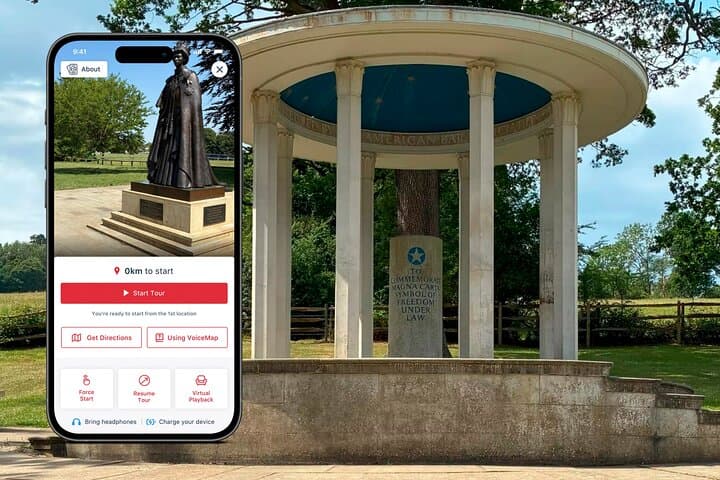


The walk begins beside the bronze Queen Elizabeth II statue, where the Thames eases past meadow and cause the reeds to lean like listeners. A gravel strip of the Thames Path unfurls downstream: boats drift, cattle graze on wet grass, and the river’s current seems to insist you slow your pace and look. The route traces the place where, in 1215, barons and a reluctant king shaped limits on power — a compact, grassy stage of English constitutional history.
The walk begins beside the bronze Queen Elizabeth II statue, where the Thames eases past meadow and cause the reeds to lean like listeners. A gravel strip of the Thames Path unfurls downstream: boats drift, cattle graze on wet grass, and the river’s current seems to insist you slow your pace and look. The route traces the place where, in 1215, barons and a reluctant king shaped limits on power — a compact, grassy stage of English constitutional history.
Runnymede’s riverside is low-lying gravel terrace carved by the Thames over millennia; you’ll pass historic markers such as the Magna Carta Memorial, the John F. Kennedy Memorial, and modern installations like Writ in Water and The Jurors. Nearby Ankerwycke hides an ancient yew and traces of Bronze Age activity, while Tudor associations — Henry VIII’s reputed haunts — give the landscape an intimate, human scale. Local culture leans toward reflective remembrance: memorials are designed to be sat with, read, and discussed.
Practically, expect 1–1.5 hours of easy walking on compacted paths with occasional muddy stretches after rain. The trail is largely flat but exposed to wind and sun; bring a waterproof layer and sensible footwear. Use the downloadable GPS tour for narration and offline maps, and plan a stop at the Magna Carta Tea Room if you want refreshments. Respect pasture fencing and livestock, keep dogs under control, and allow time to sit at The Jurors — the installation rewards slow contemplation. Early morning or late afternoon light sharpens the river views and gives quieter access to the memorials.