THE ADVENTURE COLLECTIVE® · Independent discovery and booking for outdoor travel

A demanding 7–8 day trek through Uganda’s Rwenzori range to Margherita Peak, traversing rainforest, alpine moorland and glacial ridges. This guided climb requires strong fitness, acclimatization time, and comfort on wet, technical terrain.
A demanding 7–8 day trek through Uganda’s Rwenzori range to Margherita Peak, traversing rainforest, alpine moorland and glacial ridges. This guided climb requires strong fitness, acclimatization time, and comfort on wet, technical terrain.
You shoulder a damp pack at Nyakalengija as mist lifts off the Mubuku River and the mountains loom—sheer trunks of bamboo and giant lobelia give way to alpine meadows littered with glacial stones. The trail climbs steadily; the air thins, and the Rwenzori’s glaciers come into view like pale knives above the cloud line.
Verified experiences and guided adventures in the surrounding area.
Operated by Trek Rwenzori Tours · Kasese, Western Region
You shoulder a damp pack at Nyakalengija as mist lifts off the Mubuku River and the mountains loom—sheer trunks of bamboo and giant lobelia give way to alpine meadows littered with glacial stones. The trail climbs steadily; the air thins, and the Rwenzori’s glaciers come into view like pale knives above the cloud line.
The Rwenzori Mountains were uplifted by tectonic forces and carved by ice; Margherita Peak (5,109 m) stands on Mount Stanley and was first scaled by Prince Luigi Amedeo in 1906, who named the summit for Italy’s Queen Margherita. Local Bakonzo communities have lived along the lower slopes for generations, and their knowledge of paths and porters remains essential to any summit attempt.
Over 7–8 days you move through distinct vegetation zones: tropical rainforest, montane forest, heather and giant groundsels, then alpine moorland and glacial moraine. Expect streams, waterfalls, boggy boardwalks and steep, rock-strewn switchbacks. Wildlife includes blue monkeys, black-and-white colobus and the Great Blue Turaco; three-horned chameleons hide in mossy branches.
Practical guide: the itinerary climbs from Nyakalengija (1,615 m) to Margherita (5,109 m) — roughly 3,500 m total elevation gain across huts (Nyabitaba, John Matte, Bujuku, Elena, Kitandara, Guy Yeoman). Acclimatize, hydrate, and accept porter support for overnight gear; guides and park rangers are required and park fees are normally included. Footwear should handle wet, muddy trails and exposed scree; summit day includes steep, icy sections where crampons and careful pacing matter. Aim for the drier months to reduce rain and bog hazards, and be prepared for sudden weather changes at altitude.
For most parties, the route is non-technical but physically demanding; basic alpine skills and comfort on steep, icy sections are recommended, and guides manage technical parts.
Typical trek packages include National Park entrance fees, guides and some hut fees—confirm these details with the operator before booking.
Summit day is long and steep with thin air; expect a pre-dawn start, slow pacing, and cold, windy conditions near the summit.
June–August and December–February are the most reliable for drier weather and clearer summit opportunities.
Trek Rwenzori Tours operates guided outdoor trips and adventures with an emphasis on safety, stewardship, and memorable experiences.
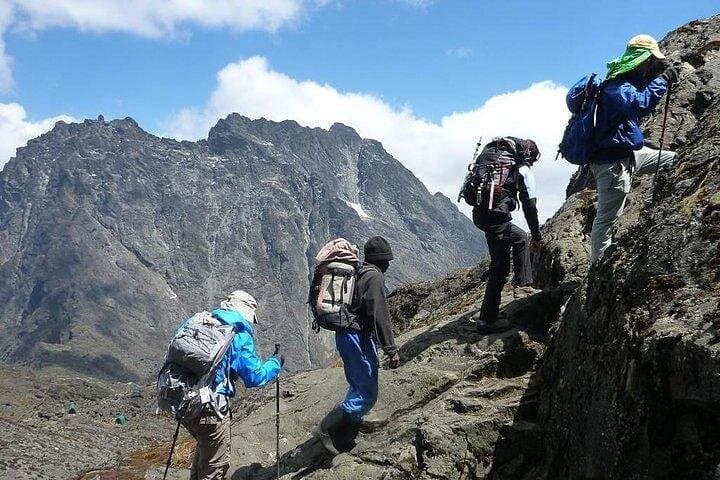


You shoulder a damp pack at Nyakalengija as mist lifts off the Mubuku River and the mountains loom—sheer trunks of bamboo and giant lobelia give way to alpine meadows littered with glacial stones. The trail climbs steadily; the air thins, and the Rwenzori’s glaciers come into view like pale knives above the cloud line.
You shoulder a damp pack at Nyakalengija as mist lifts off the Mubuku River and the mountains loom—sheer trunks of bamboo and giant lobelia give way to alpine meadows littered with glacial stones. The trail climbs steadily; the air thins, and the Rwenzori’s glaciers come into view like pale knives above the cloud line.
The Rwenzori Mountains were uplifted by tectonic forces and carved by ice; Margherita Peak (5,109 m) stands on Mount Stanley and was first scaled by Prince Luigi Amedeo in 1906, who named the summit for Italy’s Queen Margherita. Local Bakonzo communities have lived along the lower slopes for generations, and their knowledge of paths and porters remains essential to any summit attempt.
Over 7–8 days you move through distinct vegetation zones: tropical rainforest, montane forest, heather and giant groundsels, then alpine moorland and glacial moraine. Expect streams, waterfalls, boggy boardwalks and steep, rock-strewn switchbacks. Wildlife includes blue monkeys, black-and-white colobus and the Great Blue Turaco; three-horned chameleons hide in mossy branches.
Practical guide: the itinerary climbs from Nyakalengija (1,615 m) to Margherita (5,109 m) — roughly 3,500 m total elevation gain across huts (Nyabitaba, John Matte, Bujuku, Elena, Kitandara, Guy Yeoman). Acclimatize, hydrate, and accept porter support for overnight gear; guides and park rangers are required and park fees are normally included. Footwear should handle wet, muddy trails and exposed scree; summit day includes steep, icy sections where crampons and careful pacing matter. Aim for the drier months to reduce rain and bog hazards, and be prepared for sudden weather changes at altitude.