THE ADVENTURE COLLECTIVE® · Independent discovery and booking for outdoor travel

Cross the high Andes from Soraypampa to Machu Picchu in four days — a dramatic mix of alpine passes, glacier views and a tropical descent into cloud forest. Learn what to expect, how to prepare, and practical on-trail tips.
Cross the high Andes from Soraypampa to Machu Picchu in four days — a dramatic mix of alpine passes, glacier views and a tropical descent into cloud forest. Learn what to expect, how to prepare, and practical on-trail tips.
You wake before sunrise in a thin, bright air and step out into a world where the mountain keeps its own hours: Salkantay’s glacier faces glare with morning light while the valley below still holds mist like a secret. The first day’s climb through hard-packed puna gives way to the blue-green of Soraypampa and, if you choose, a sidestep to the Humantay lagoon. By day two the trail grinds up to the Salkantay Pass (~4,600 m) — a wind-checked ridge with jagged rock and distant condors circling — then suddenly the world softens as you descend into cloud forest and the smells of coffee and passion fruit.
Verified experiences and guided adventures in the surrounding area.
Operated by Willka Travel · Cusco, Cusco Region
You wake before sunrise in a thin, bright air and step out into a world where the mountain keeps its own hours: Salkantay’s glacier faces glare with morning light while the valley below still holds mist like a secret. The first day’s climb through hard-packed puna gives way to the blue-green of Soraypampa and, if you choose, a sidestep to the Humantay lagoon. By day two the trail grinds up to the Salkantay Pass (~4,600 m) — a wind-checked ridge with jagged rock and distant condors circling — then suddenly the world softens as you descend into cloud forest and the smells of coffee and passion fruit.
Geologically, the Salkantay route follows sharp Andean uplift and glacial scarring before slipping into the sub-tropical drainage of the Urubamba. Culturally it threads past small Quechua communities and ancient Inca causeways; remnants of broad, paved paths appear where imperial engineers once moved people and goods toward the Sacred Valley. The journey ends in Aguas Calientes and a guided visit to Machu Picchu, where stonework and terraces reveal careful engineering and spiritual significance.
Practical guidance: this is a challenging, high-altitude trek — acclimatize in Cusco and train with long hikes at elevation. Pack for temperature swings: layers, reliable boots, rain shell, and a good sleeping bag; the operator provides tents, meals, porters for 7 kg, and a guide. Expect 6–8 hours hiking on long days, rocky and muddy sections in the wet season, and a need to book permits and train seats well in advance. Hydrate, pace your ascent, and respect campsite rules to minimize impact.
Yes: Machu Picchu entry is included in this tour; Huayna Picchu requires a separate, limited permit—reserve well in advance.
The highest point is about 4,600 m; many trekkers feel shortness of breath and mild headache — proper acclimatization and slow pacing help manage symptoms.
Tents, dining tent with tables and chairs, meals (3 breakfasts, 3 lunches, 3 dinners), first-aid kit with emergency oxygen, porters for 7 kg, and an English-speaking guide are provided.
Yes — there is an optional train (approximately US$26) or a 2–3 hour walk along the tracks; choose based on time, cost, and energy levels.
Willka Travel operates guided outdoor trips and adventures with an emphasis on safety, stewardship, and memorable experiences.


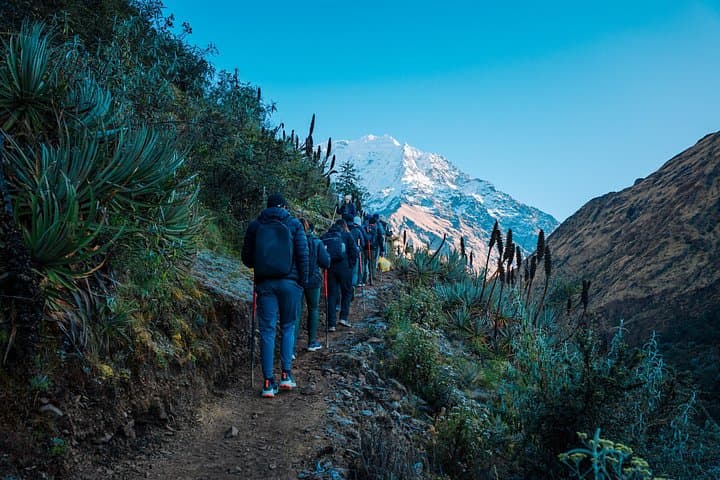
You wake before sunrise in a thin, bright air and step out into a world where the mountain keeps its own hours: Salkantay’s glacier faces glare with morning light while the valley below still holds mist like a secret. The first day’s climb through hard-packed puna gives way to the blue-green of Soraypampa and, if you choose, a sidestep to the Humantay lagoon. By day two the trail grinds up to the Salkantay Pass (~4,600 m) — a wind-checked ridge with jagged rock and distant condors circling — then suddenly the world softens as you descend into cloud forest and the smells of coffee and passion fruit.
You wake before sunrise in a thin, bright air and step out into a world where the mountain keeps its own hours: Salkantay’s glacier faces glare with morning light while the valley below still holds mist like a secret. The first day’s climb through hard-packed puna gives way to the blue-green of Soraypampa and, if you choose, a sidestep to the Humantay lagoon. By day two the trail grinds up to the Salkantay Pass (~4,600 m) — a wind-checked ridge with jagged rock and distant condors circling — then suddenly the world softens as you descend into cloud forest and the smells of coffee and passion fruit.
Geologically, the Salkantay route follows sharp Andean uplift and glacial scarring before slipping into the sub-tropical drainage of the Urubamba. Culturally it threads past small Quechua communities and ancient Inca causeways; remnants of broad, paved paths appear where imperial engineers once moved people and goods toward the Sacred Valley. The journey ends in Aguas Calientes and a guided visit to Machu Picchu, where stonework and terraces reveal careful engineering and spiritual significance.
Practical guidance: this is a challenging, high-altitude trek — acclimatize in Cusco and train with long hikes at elevation. Pack for temperature swings: layers, reliable boots, rain shell, and a good sleeping bag; the operator provides tents, meals, porters for 7 kg, and a guide. Expect 6–8 hours hiking on long days, rocky and muddy sections in the wet season, and a need to book permits and train seats well in advance. Hydrate, pace your ascent, and respect campsite rules to minimize impact.