THE ADVENTURE COLLECTIVE® · Independent discovery and booking for outdoor travel

A demanding 5-day trek from Cusco over the Salkantay Pass that trades the crowds of the Inca Trail for glaciated peaks, cloud forest descents and a coffee‑plantation approach to Machu Picchu. Expect big altitude gains, mixed terrain, and remote campsite nights.
A demanding 5-day trek from Cusco over the Salkantay Pass that trades the crowds of the Inca Trail for glaciated peaks, cloud forest descents and a coffee‑plantation approach to Machu Picchu. Expect big altitude gains, mixed terrain, and remote campsite nights.
The trail opens before dawn: a convoy of minibuses threading out of Cusco, cold air cutting through wool hats as Andean peaks grow taller and closer. You set foot at Challacancha and the landscape immediately changes—scree and puna grass give way to a narrow path that climbs toward Salkantay’s glaciated flanks, while cloud forest waits below like a green tide.
Verified experiences and guided adventures in the surrounding area.
Operated by Vicuna Expeditions · Cusco, Cusco Region
The trail opens before dawn: a convoy of minibuses threading out of Cusco, cold air cutting through wool hats as Andean peaks grow taller and closer. You set foot at Challacancha and the landscape immediately changes—scree and puna grass give way to a narrow path that climbs toward Salkantay’s glaciated flanks, while cloud forest waits below like a green tide.
This route follows a rugged trans-Andean corridor used for centuries by local communities and later mapped by explorers. Geologically the Salkantay massif is a granite-and-sediment composite carved by glaciers; the high pass around 4,600–4,650 m offers stark, wind-sculpted panoramas, then drops into humid montane forest where biodiversity explodes. Culturally the trail threads Quechua villages and small coffee fincas—Lucmabamba’s plantations are living reminders of centuries of cultivation and recent community tourism initiatives.
Expect mixed terrain: rocky ascents, narrow ridgelines, steep descents and jungle tracks. The itinerary covers roughly 60–70 km over five days with daily efforts of 4–8 hours and a highest gain near 1,000–1,200 m on the pass day. Acclimatization in Cusco (48–72 hours) is strongly recommended to reduce altitude risk.
Practical notes: carry layered clothing for sub-zero nights and humid daytime heat, use trekking poles to protect knees on long descents, and pack a water-treatment method—the route crosses streams but potable sources are not guaranteed. If you’re fit, prepared for altitude, and ready to swap comfort for wilderness campsites, the Salkantay route delivers a direct, landscape-first approach to Machu Picchu.
Salkantay itself doesn't require the limited permits of the classic Inca Trail, but you do need Machu Picchu entry tickets and train/bus logistics booked for the final day.
The pass reaches roughly 4,600–4,650 meters above sea level—this is the route’s highest and most exposed section.
The standard Salkantay route is largely campsite-based; alternatives exist that use lodges but they change the itinerary and logistics significantly.
Physically fit beginners can attempt it with proper acclimatization and guidance, but the high altitude and long daily mileage make it challenging for true novices.
Vicuna Expeditions operates guided outdoor trips and adventures with an emphasis on safety, stewardship, and memorable experiences.
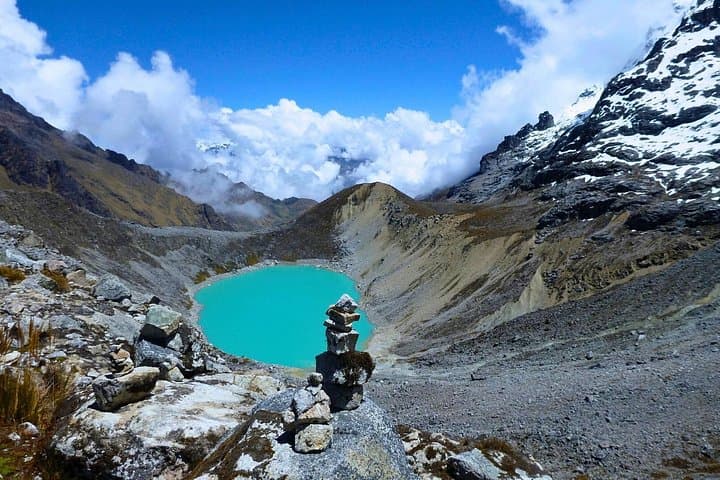


The trail opens before dawn: a convoy of minibuses threading out of Cusco, cold air cutting through wool hats as Andean peaks grow taller and closer. You set foot at Challacancha and the landscape immediately changes—scree and puna grass give way to a narrow path that climbs toward Salkantay’s glaciated flanks, while cloud forest waits below like a green tide.
The trail opens before dawn: a convoy of minibuses threading out of Cusco, cold air cutting through wool hats as Andean peaks grow taller and closer. You set foot at Challacancha and the landscape immediately changes—scree and puna grass give way to a narrow path that climbs toward Salkantay’s glaciated flanks, while cloud forest waits below like a green tide.
This route follows a rugged trans-Andean corridor used for centuries by local communities and later mapped by explorers. Geologically the Salkantay massif is a granite-and-sediment composite carved by glaciers; the high pass around 4,600–4,650 m offers stark, wind-sculpted panoramas, then drops into humid montane forest where biodiversity explodes. Culturally the trail threads Quechua villages and small coffee fincas—Lucmabamba’s plantations are living reminders of centuries of cultivation and recent community tourism initiatives.
Expect mixed terrain: rocky ascents, narrow ridgelines, steep descents and jungle tracks. The itinerary covers roughly 60–70 km over five days with daily efforts of 4–8 hours and a highest gain near 1,000–1,200 m on the pass day. Acclimatization in Cusco (48–72 hours) is strongly recommended to reduce altitude risk.
Practical notes: carry layered clothing for sub-zero nights and humid daytime heat, use trekking poles to protect knees on long descents, and pack a water-treatment method—the route crosses streams but potable sources are not guaranteed. If you’re fit, prepared for altitude, and ready to swap comfort for wilderness campsites, the Salkantay route delivers a direct, landscape-first approach to Machu Picchu.