THE ADVENTURE COLLECTIVE® · Independent discovery and booking for outdoor travel

Leave Mission Bay and cross the jetties into open Pacific water on a 2–3 hour guided cruise that searches for whales and dolphins. Expect naturalist commentary, on-board amenities, and fast-moving pods of dolphins leaving the harbor in their wake.
Leave Mission Bay and cross the jetties into open Pacific water on a 2–3 hour guided cruise that searches for whales and dolphins. Expect naturalist commentary, on-board amenities, and fast-moving pods of dolphins leaving the harbor in their wake.
The boat eases away from the grey shed with the blue awning and, in less than ten minutes, Mission Bay’s calm harbor gives way to the Pacific’s open forehead. The jetties drop off to either side—Ocean Beach Pier and Dog Beach recede like film—while the captain turns the bow toward the deeper water where the ocean moves with the patience of giants.
Verified experiences and guided adventures in the surrounding area.
Operated by San Diego Whale Watching LLC · San Diego, California
The boat eases away from the grey shed with the blue awning and, in less than ten minutes, Mission Bay’s calm harbor gives way to the Pacific’s open forehead. The jetties drop off to either side—Ocean Beach Pier and Dog Beach recede like film—while the captain turns the bow toward the deeper water where the ocean moves with the patience of giants.
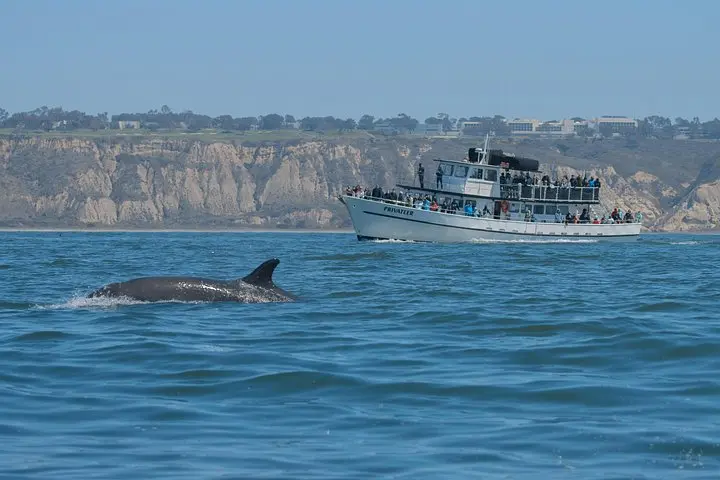
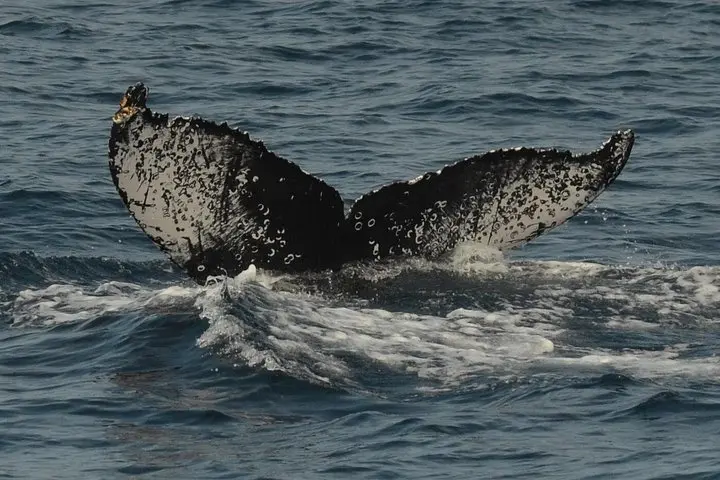
On board, a naturalist scans the horizon and speaks into the mic: a spout, a tail, the quick silver scatter of dolphins. The sea takes on a rhythm; pods race the wake, whales exhale in slow, visible punctuation, and the coastline slides past with cliffs and volleyball courts, the amusement coaster at Belmont Park a distant motion.
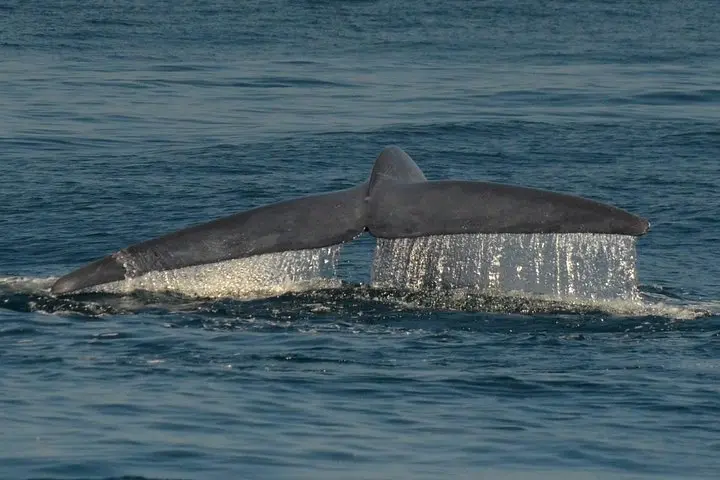
The San Diego coastline is more than a pretty approach. It sits at the meeting line of the Southern California Bight and the California Current, where nutrient-rich waters draw migratory giants—gray whales in winter-spring, blue and humpback whales in summer-fall—along predictable corridors. The Kumeyaay people have read these movements for millennia; today scientists, guides, and whale-watch operators track patterns to balance encounters with protection.
This trip is straightforward: 2–3 hours, roughly 10 minutes to clear the jetties, then a search pattern across the continental shelf. Expect pass-by views of Sunset Cliffs’ sandstone faces and a sweep past Ocean Beach’s pier before the crew slows when animals are found. The boat is set up for comfort—restrooms and a small galley—and the guide narration gives context: species ID, behavior, and local ecology.
Practicalities matter. Check-in opens 45 minutes before departure; priority boarding begins about 20–30 minutes prior. Free parking on Quivira Road is available but fills fast during summer and holidays. Wear layers—the Pacific can be bright and wind-scoured—bring sunscreen and a windproof shell, and consider motion-sickness medication if you’re prone; the first ten minutes of open ocean are the steepest change.
Respectful viewing is part of the experience. Operators in San Diego follow federal and state guidelines: maintain distance when animals are feeding or tending calves, and let the guides position the boat. If you want the best photos, head to the upper observation deck, keep telephoto lenses ready for breaches, and watch for dolphins bow-riding near the stern.
For a post-cruise fix, walk the Ocean Beach pier, sample fish tacos at nearby stands, or drive a short way to Cabrillo National Monument for tidepooling. On good days, the ocean will offer up a small, unforgettable curriculum: speed, scale, and the slow migrations that tie this shore to the wider Pacific.
The trip runs approximately 2–3 hours; time varies depending on sighting locations and sea conditions.
Common sightings include dolphins year-round and migrating whales—gray whales in winter-spring, blue and humpback whales more likely in summer-fall—though sightings can't be guaranteed.
Yes; the tour is rated easy and accessible to most ages, though guests with serious cardiovascular issues are advised not to participate.
Yes, the vessel is equipped with onboard restrooms and a small galley with food and drink for purchase.
Check in at the ticket booth (grey shed with a blue awning) in Mission Bay; arrive at least 45 minutes before departure to allow time for parking and waiver completion.
For a full refund cancel at least 24 hours before departure; trips may be canceled for bad weather or insufficient travelers.
San Diego Whale Watching LLC operates guided outdoor trips and adventures with an emphasis on safety, stewardship, and memorable experiences.
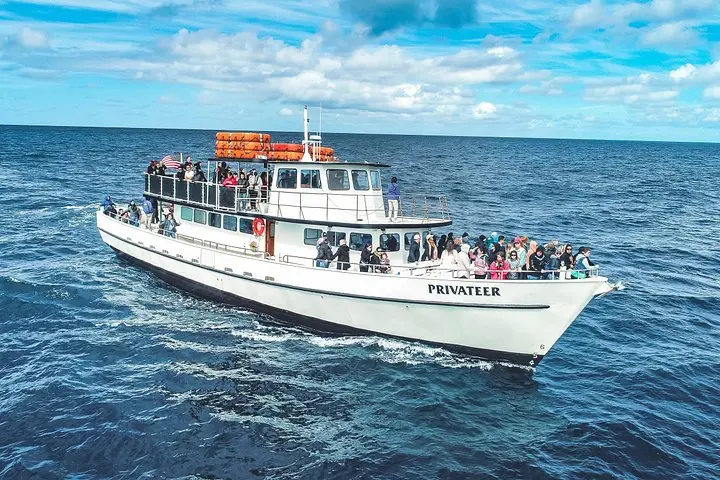
The boat eases away from the grey shed with the blue awning and, in less than ten minutes, Mission Bay’s calm harbor gives way to the Pacific’s open forehead. The jetties drop off to either side—Ocean Beach Pier and Dog Beach recede like film—while the captain turns the bow toward the deeper water where the ocean moves with the patience of giants.
The boat eases away from the grey shed with the blue awning and, in less than ten minutes, Mission Bay’s calm harbor gives way to the Pacific’s open forehead. The jetties drop off to either side—Ocean Beach Pier and Dog Beach recede like film—while the captain turns the bow toward the deeper water where the ocean moves with the patience of giants.
On board, a naturalist scans the horizon and speaks into the mic: a spout, a tail, the quick silver scatter of dolphins. The sea takes on a rhythm; pods race the wake, whales exhale in slow, visible punctuation, and the coastline slides past with cliffs and volleyball courts, the amusement coaster at Belmont Park a distant motion.
The San Diego coastline is more than a pretty approach. It sits at the meeting line of the Southern California Bight and the California Current, where nutrient-rich waters draw migratory giants—gray whales in winter-spring, blue and humpback whales in summer-fall—along predictable corridors. The Kumeyaay people have read these movements for millennia; today scientists, guides, and whale-watch operators track patterns to balance encounters with protection.
This trip is straightforward: 2–3 hours, roughly 10 minutes to clear the jetties, then a search pattern across the continental shelf. Expect pass-by views of Sunset Cliffs’ sandstone faces and a sweep past Ocean Beach’s pier before the crew slows when animals are found. The boat is set up for comfort—restrooms and a small galley—and the guide narration gives context: species ID, behavior, and local ecology.
Practicalities matter. Check-in opens 45 minutes before departure; priority boarding begins about 20–30 minutes prior. Free parking on Quivira Road is available but fills fast during summer and holidays. Wear layers—the Pacific can be bright and wind-scoured—bring sunscreen and a windproof shell, and consider motion-sickness medication if you’re prone; the first ten minutes of open ocean are the steepest change.
Respectful viewing is part of the experience. Operators in San Diego follow federal and state guidelines: maintain distance when animals are feeding or tending calves, and let the guides position the boat. If you want the best photos, head to the upper observation deck, keep telephoto lenses ready for breaches, and watch for dolphins bow-riding near the stern.
For a post-cruise fix, walk the Ocean Beach pier, sample fish tacos at nearby stands, or drive a short way to Cabrillo National Monument for tidepooling. On good days, the ocean will offer up a small, unforgettable curriculum: speed, scale, and the slow migrations that tie this shore to the wider Pacific.